Japan returned to its regular weekdays today after the holiday period. The weather was sunny, and it felt a little warm. However, even though the temperature rose, the intense summer heat has already passed. In the shade, I could feel the fresh autumn air. It will probably feel more like autumn with each passing day. The Square puzzle boxes and 5-sun puzzle boxes that I continued making through last week are now close to completion. For the remaining days of this month, I plan to focus mainly on making the 4-sun 14-step puzzle boxes.
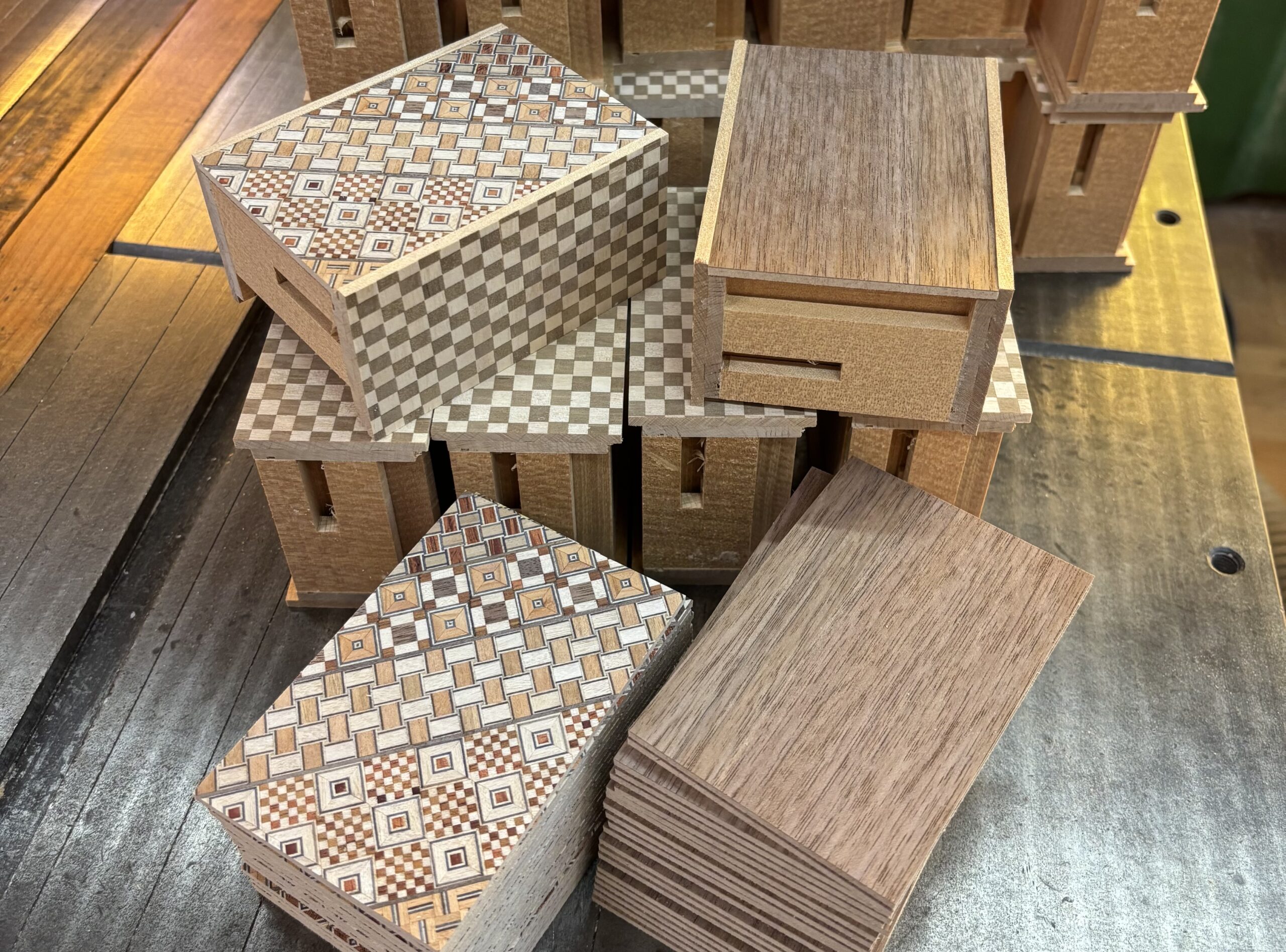
I began making this 4-sun 14-step puzzle box last year. It is popular because its design allows you to enjoy both traditional Yosegi and natural Walnut wood. In the photo, I am about to fit the top and bottom panels into the box. Rather than saying that I attach them, it may be more accurate to say that I fit them into place. I make the small adjustments for this fitting very carefully because they affect how tight the top panel feels when it slides. Of course, the panels must fit perfectly. If they are too loose, a gap will appear between the top panel and the body of the box. For this reason, I fit them slightly tightly. However, on a model like this, where only the top panel moves, I adjust the top and bottom panels a little differently. The bottom panel does not move, so I make its fit slightly looser, allowing it to go into place smoothly. If the bottom panel is fitted too tightly, it may warp. This is because of the box’s structure. On a box like this 14-step model, which has no support in the center, fitting the panel too tightly can cause the middle to sink slightly. For this reason, I make the fit of the top panel a little tighter than that of the bottom panel.
Because I am making only a small number this time, I have not included any special limited-edition designs. However, as you can see in the photo, there are two types: the usual four-color Ichimatsu Yosegi side panels and two-color Ichimatsu Yosegi side panels. As I wrote yesterday, I used the two-color type simply because I did not have enough of the four-color Yosegi sheet. However, I also like the look of this design, so I am thinking about adding it to my regular lineup in the future. One thing I like about this design is that the traditional Yosegi pattern runs diagonally, while the Ichimatsu Yosegi pattern runs vertically. Am I the only one who feels a sense of order in this box?..haha. As I have written before, this two-color Ichimatsu Yosegi has several difficulties during production. On one of the Square puzzle boxes in this batch, part of the sheet was not attached firmly enough, and a small part of the pattern came off, so I had to repair it. This kind of problem rarely happens with the four-color Ichimatsu Yosegi arranged diagonally. I also feel this when making my random wood grain designs. Designs that attract more attention often involve more risks during production. At the same time, perhaps that sense of risk is part of what gives them their special appeal.