The sky turned cloudy again today, reminding me that autumn weather can change quickly. Today in Japan is the day of the Mid-Autumn Moon, when the moon is said to look especially beautiful. It is also called “Jugoya,” or the fifteenth night. It is customary to enjoy the moon while offering round tsukimi dango and Japanese pampas grass, which represents ears of rice. Unfortunately, the sky is a little cloudy today. However, the actual full moon will be around tomorrow, so we may still be able to see a beautiful moon. The date of the Mid-Autumn Moon is based on the traditional lunar calendar, so it often does not fall on the same day as the actual full moon. This time of year also gives us the feeling that the mornings and evenings have become much cooler. Recently, even when the temperature rises during the day, the evenings are often pleasantly cool.
Thanks to yesterday’s sunny weather, the humidity was fairly low today, so I attached the sliding key panels to the 4-sun puzzle boxes. The weather may get worse again tomorrow, so today I worked on the sides with the smaller gluing areas. Since I am making only a small number of boxes this time, I finished this work fairly quickly. After that, I prepared materials for my next production. Recently, apart from the 5-sun 36-step puzzle box, I feel that I have been making many 14-step puzzle boxes. This is because I am working on them alongside boxes that have already been ordered. Before the end of this year, I hope to make some puzzle boxes with more than 20 steps again. The 4-sun 27-step puzzle box, for example, has been out of stock for quite a long time now! 😅
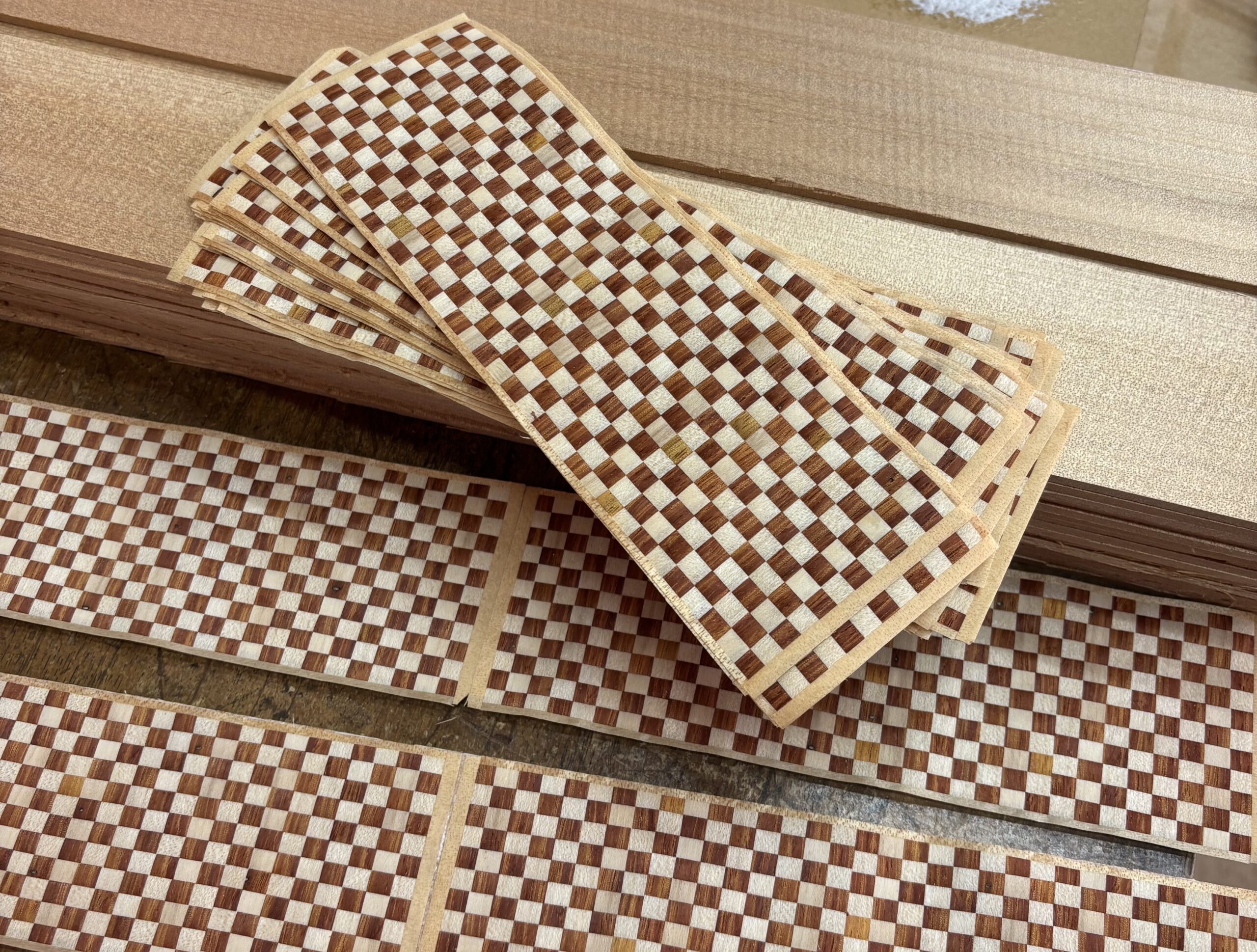
The photo shows the checkered Yosegi that I will use for the puzzle boxes I am making next for Hakone. As usual, it will be used for the side panels. As you can see in the photo, this time I combined Mizuki wood (white) and Rengas wood (red). In Japan, a red-and-white combination is called “Kohaku” and is considered lucky. However, that was not the reason I made this design! 😂 I would like to use more of this red Rengas wood in the future, so I decided to try it in this design. Rengas is a very hard wood. It is not as hard as Purpleheart, but it is still quite difficult to work with. As I mentioned recently, Rengas often has small insect holes. These holes are not large. They are less than 1 mm wide and remain on the surface as small dark spots. This makes the wood difficult to use as solid wood because the holes need to be filled. However, when the wood is sliced thinly like this, I think they can be left as part of the wood’s natural pattern and character. You may not be able to see them clearly in the photo, but there are several small holes in this sheet too. The color also varies depending on the part of the wood. Some areas are dark red, while others have a yellowish or orange color. Some orange-colored areas can also be seen in this sheet. With many red woods, the red color can spread into the white wood beside it and stain it. Rengas does this less than some other red woods, but it can still happen if I am not careful. When I sand the surface, fine red wood dust appears, so I need to remove it carefully with strong compressed air. It is especially important to do this thoroughly before applying the finish coating.
Have a good weekend!