The rain that started last night continued this morning, and it was a very cool morning. This is the final week of September, and I hear that autumn festivals are being held in many areas. Autumn is the harvest season in Japan, so many festivals are connected with the harvest. Unfortunately, it is raining in many places, but this may still be better than holding a festival under the hot midsummer sun.
Rice harvesting began today in the fields around my workshop. It will probably be finished by the beginning of October. Last year, mistakes in government policy caused a rice shortage, which led to higher prices and became a major problem. This year, however, there seems to be too much rice, and that has become another problem. Perhaps there was not actually a shortage, but the distribution of rice did not go smoothly. The government then released its stored rice, and this may have caused further problems with the normal flow of rice into the market. In recent years, I feel that many problems with the way the country is managed have come to the surface.
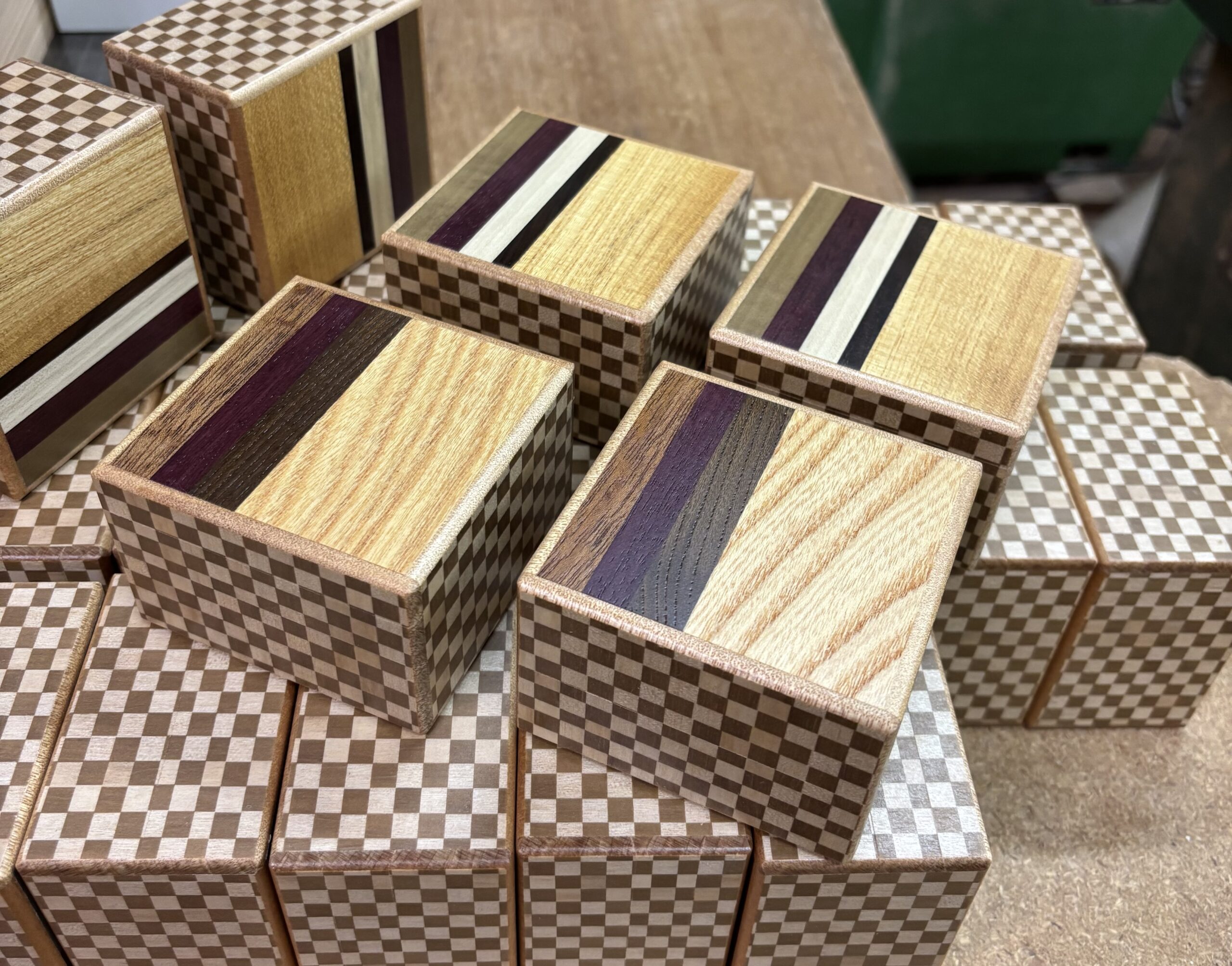
In the end, this batch of Square puzzle boxes includes two types with natural wood designs. I was able to make only two of one type and three of the other. This is because I used natural wood top and bottom panels left over from the 4-sun puzzle boxes I made before. One of these designs, with only two boxes available, uses Jindai Keyaki wood, which is quite unusual for my work. Jindai wood comes from fallen trees or other wood that became buried underground for a very long time. As the wood slowly changed in the ground, its color gradually became darker. Jindai wood is also used in Hakone Yosegi. Most of the black parts in traditional Yosegi patterns are made from this wood. Most Jindai wood used in Yosegi comes from Katsura wood, but the type I used this time is Keyaki. Keyaki is harder than Katsura. I do not know if this is the reason, but this wood did not become completely black. Instead, it has a deep green color. This may also be related to the original color of the wood. Keyaki often has yellow or orange tones, so perhaps it does not always become completely black. In any case, it has produced a very beautiful color in these boxes.
Next to the Jindai Keyaki is the widest section of the panel, made from a yellow wood that I call Keyaki. However, it may actually be a different type of wood. I bought it from a man who used to supply wood for me. He told me, “This wood looks like Keyaki, but it may be something different. It might be called Inomi.” The texture does seem a little rougher than Keyaki, and the color is also more yellow. However, it looks very similar, so I have been using it as Keyaki. Each type of wood also has its own smell, and the smell of this wood is slightly different from Keyaki. Smell can be very helpful when identifying wood. I bought this wood about 20 years ago, and now I have only a small amount left. The man ran his wood shop by himself, but he became ill and closed the business several years ago. Since I can no longer buy this wood, I am thinking carefully about how to make good use of what remains. I have sliced it before, so I may also use it for sliced Yosegi patterns.