Today’s weather was very humid because of the rain we had last night. The humidity was high, so I was glad that I had already finished attaching the sliding key panels. Instead, I decided to spend the day preparing for upcoming work. I was out for a while during the day, so I did not get as much done as usual, but I prepared the side panels for the next batch of Square puzzle boxes and also attached Yosegi sheets for the Mame puzzle boxes that I will be making after that.
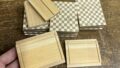
As usual, I prepare the side panels for the Square puzzle boxes by gluing the inner structural board to the outer board. This time, most of the outer boards have the checkered pattern (ichimatsu) that I mentioned in yesterday’s post. After gluing them together, I clamp the panels firmly in a vise and leave them there for a while. The panels are especially likely to warp just after they are glued, so they need time to settle and become stable.
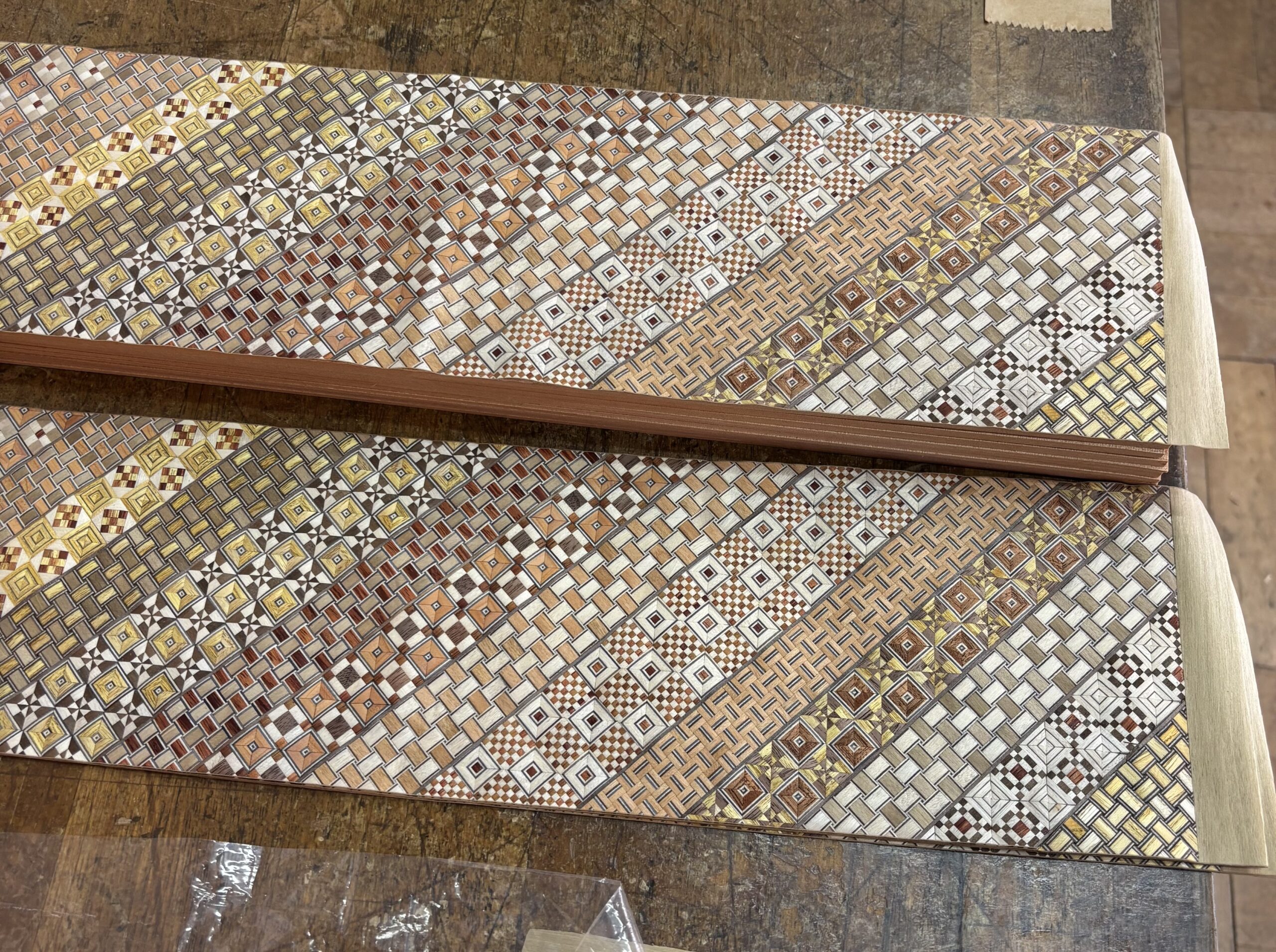
After that, I attached traditional Yosegi sheets for the next batch of Mame puzzle boxes. At the moment, I plan to make them as 18-step puzzle boxes. The 18-step model was the last mechanism that I added to my Mame puzzle box series. Before that, I made 22-step boxes after the 14-step version, but the 22-step design is so delicate that it is not well suited for larger production. I wanted to add another variation that could be made more consistently. The 18-step Mame puzzle box was also made by one of the master craftsmen. Like the 14-step model I wrote about recently, I also have one of his 18-step boxes in my collection. However, I did not copy its dimensions. Instead, I designed the mechanism from scratch using my own 14-step model as the starting point. In the end, though, it turned out to be almost the same size as the master’s box. When you try to fit an 18-step mechanism into a box without changing the overall dimensions very much, the proportions naturally become quite similar. I also make a 2.5-sun puzzle box designed to hold a Mame puzzle box inside it, and its internal dimensions were designed so that it can hold both the 18-step or the 22-step Mame puzzle boxes.
There is no specific Yosegi sheet reserved for my Mame puzzle boxes. I make them using the largest Yosegi sheets that I order from my Yosegi craftsman. In the end, the sheets are cut into very small panels (3 ~ 4 cm), so almost any Yosegi sheet can be used. However, working with larger sheets makes the process much easier.