The rain we had last night made this morning hot and humid once again. As the day went on, the temperature climbed quickly, and by the afternoon it had become extremely hot. Even so, I spent the day in the workshop making good progress on a variety of tasks.
First, I finished the Walnut version of the 4-sun 14-step puzzle boxes, which had already been assembled. Unlike my standard puzzle boxes, this design always requires extra care. In the past, I experienced many failures when attaching the side panels. However, by refining my methods over time, I have been able to make them much more consistently. This batch has gone smoothly so far, and I successfully completed the final finishing work and the undercoat today. However, even though the humidity is fairly high at this time of year, the daytime temperature is simply too high for me to feel comfortable applying the undercoat. Instead, I waited until the evening to do that work. Until then, I kept the boxes safely stored in their case. The thing I worry about most is the side panels warping, but compared with around May, the higher humidity at this time of year actually makes the conditions a little more forgiving. As long as I pay close attention to the temperature, this is not the most difficult season for making these boxes.
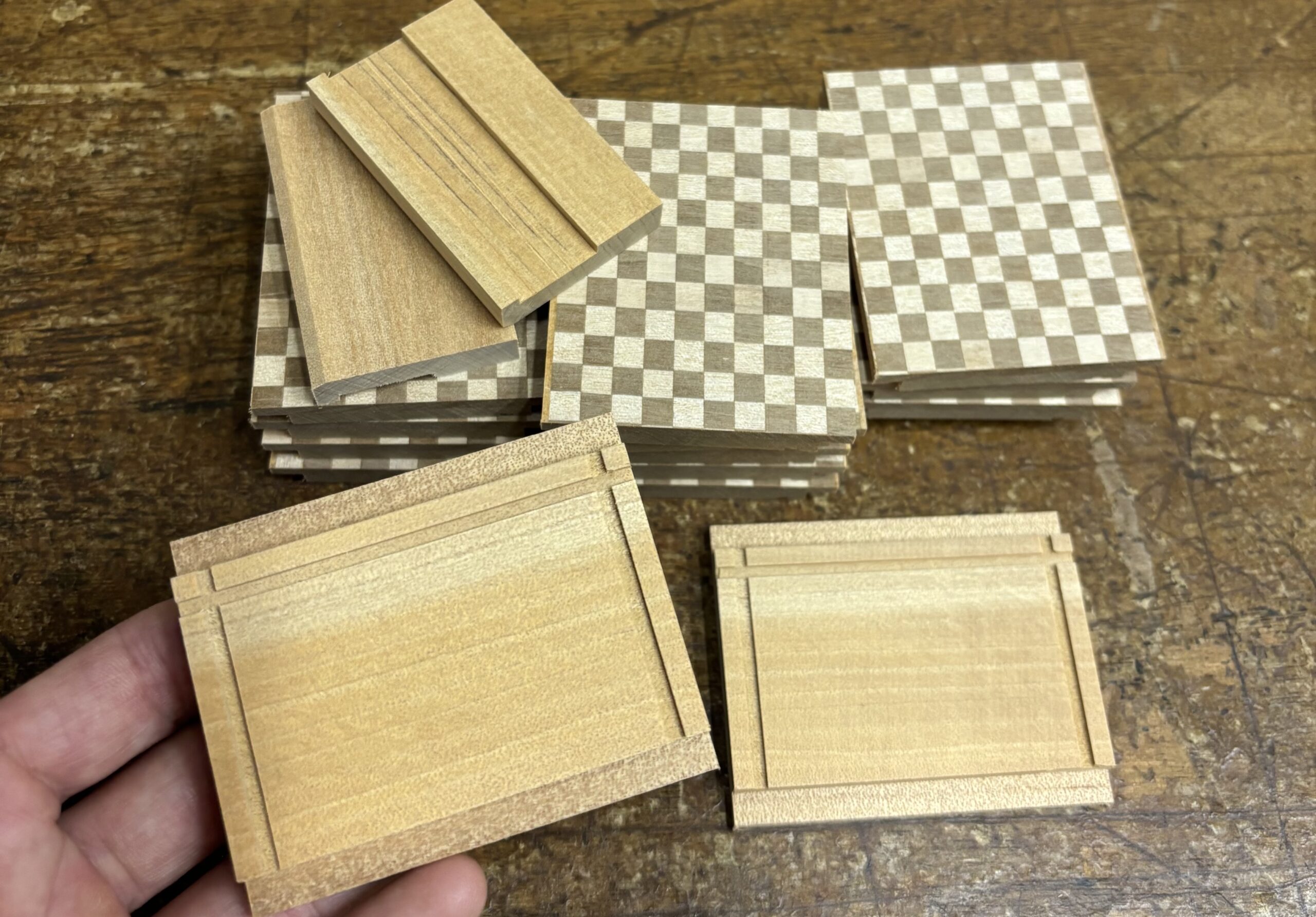
After that, I worked on the side panels for the Square puzzle boxes. The boards that had been clamped in a vise were cut to their final dimensions, and I machined the grooves for the Aruki panels (photo). The height is the same as my 4-sun puzzle boxes, but the length is shorter and is made equal to the width. As a result, the finished box is square when viewed from above. This design was originally developed from my 4-sun puzzle box. I wanted to create a box that could be made using the same materials as the 4-sun model. Looking only at the side panels, it appears to be quite a small box, but its width is exactly the same as that of the 4-sun puzzle box.
Although I plan to continue making only versions other than the traditional Yosegi model, this Square puzzle box is an unusual shape in the history of Japanese puzzle boxes. Traditionally, rectangular boxes have been the most common because they are considered the most stable shape for a Japanese puzzle box. One reason may be that square and cube-shaped boxes are not seen as particularly traditional Japanese forms. In fact, if you look at other traditional Japanese craft boxes, square and cube-shaped designs are relatively uncommon. Those shapes could even be described as having a more Western feel. Even so, I find this shape very appealing because it allows me to create designs that feel a little more playful than traditionally Japanese, such as the Square puzzle box I made before with four different solid woods arranged in a square pattern on the top and bottom panels. I would like to continue creating new designs that make the most of this square shape.
After that, even though the afternoon heat was quite intense, I worked on the frames for the 18-step Mame puzzle boxes. It was a little challenging because of the heat…haha🤣, but I managed to finish the work. This time, I am making about 70 boxes.
Have a great weekend!