Today is the Autumnal Equinox Day, a national holiday in Japan. It is also the final day of the Silver Week holiday that began last Saturday. I stopped by my workshop for a short time today, and there was heavy traffic on the highway as many people were returning home. The Autumnal Equinox Day is said to be the time when day and night are about the same length. From now on, the nights will gradually become longer. In Japan, we often use the phrase “long autumn nights.” The intense summer heat has eased, and this is a pleasant season when we can enjoy the quiet, long evenings.
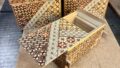
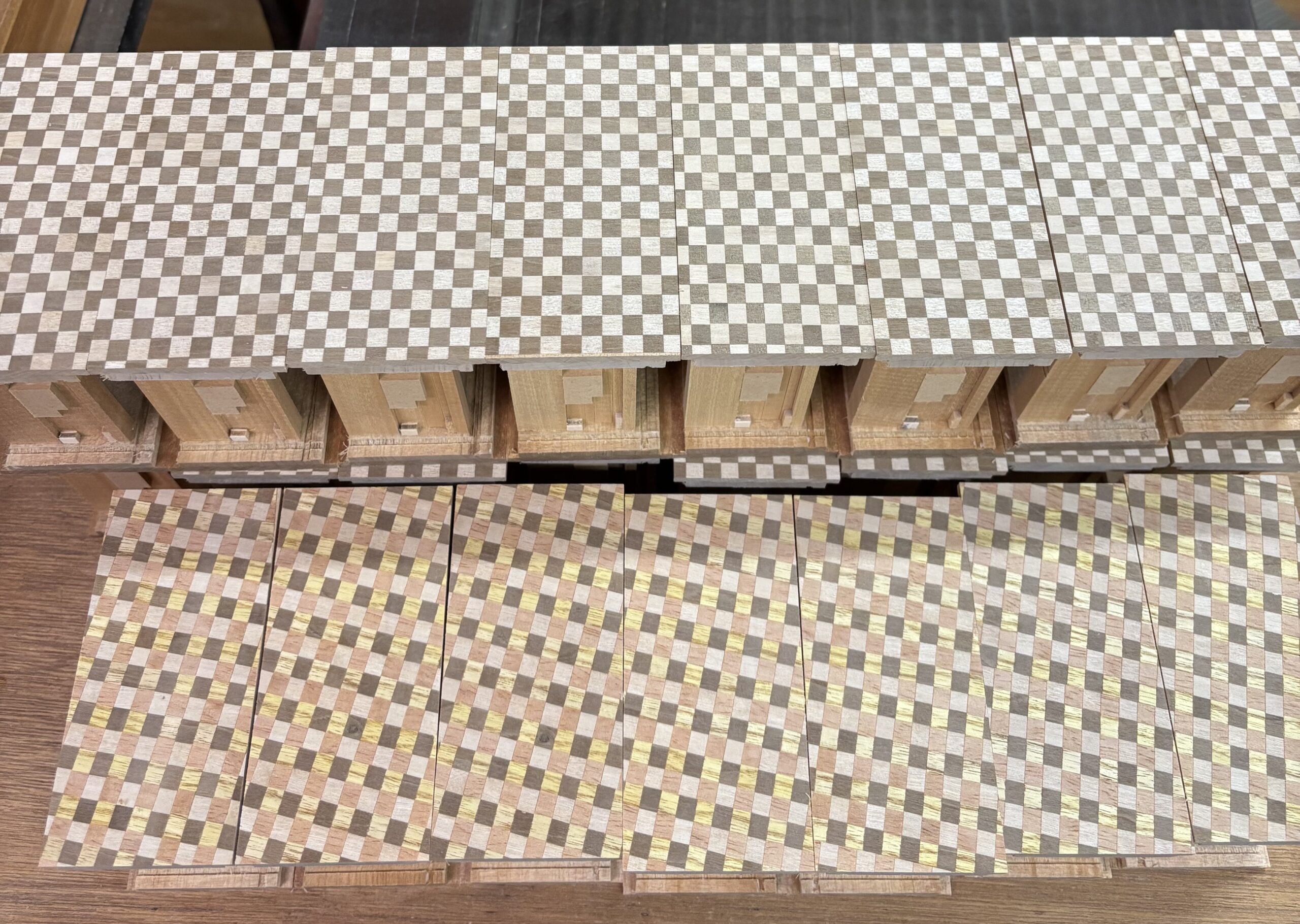
The box I am mainly making now is the 4-sun 14-step puzzle box. I added it to this month’s schedule at short notice and am making only a small number. This model has traditional Yosegi on the top panel. It is also popular because of its reasonable price. Traditional Yosegi is usually made as a large sheet and then cut into smaller pieces. Because of this, the pattern is slightly different on every 14-step puzzle box. When cutting the sheet, I take care to include as much of the pattern as possible on each panel. The side panels have my usual Ichimatsu Yosegi pattern.
As I mentioned before, I am thinking about changing some of the wood colors used in the four-color Ichimatsu Yosegi for my 4-sun puzzle boxes. Until now, I have used Nyatoh as one of the four woods, but I plan to replace it with another wood. I have also used Urushi wood for the yellow color, but I may try a different yellow wood. These four woods were originally chosen because they are easy to slice. They are all fairly soft and have a fine, even grain.
The main reason for changing the woods is my material stock. I have not bought much Nyatoh recently, and its color can vary greatly from piece to piece. Instead, I would like to use a dark red wood called Rengas. I have often used Rengas for solid wood puzzle boxes, but I now have many pieces that are more suitable for slicing, so I would like to use them. Rengas is very hard, and thin sheets can easily tear or develop holes during slicing. However, I recently made a two-color Ichimatsu pattern using Rengas and white Mizuki wood, and it sliced quite well. This made me want to continue using it. I have also used it before in a three-color Ichimatsu pattern, although it is still quite difficult to slice successfully. The dark red parts of Rengas often have many insect holes, which can be a problem when using it as solid wood. The holes remain visible and take a lot of work to fill. However, when the wood is sliced into thin sheets, these holes are not a problem and do not need to be filled.
For these reasons, the current lot of 4-sun puzzle boxes includes both the last of this four-color Ichimatsu pattern and a two-color Ichimatsu pattern. There was not enough of the four-color sheet for the whole lot, so I also used the two-color type. When I compare them, the two-color pattern may look more Japanese!..haha. The four-color pattern may be a little too bright, although this is probably a matter of personal taste. Adding red may make it look even brighter. I will probably attach the red-and-white two-color Ichimatsu sheet that I made recently sometime next week. After seeing how it looks on the boxes, I would like to think about the colors again and share the result here.