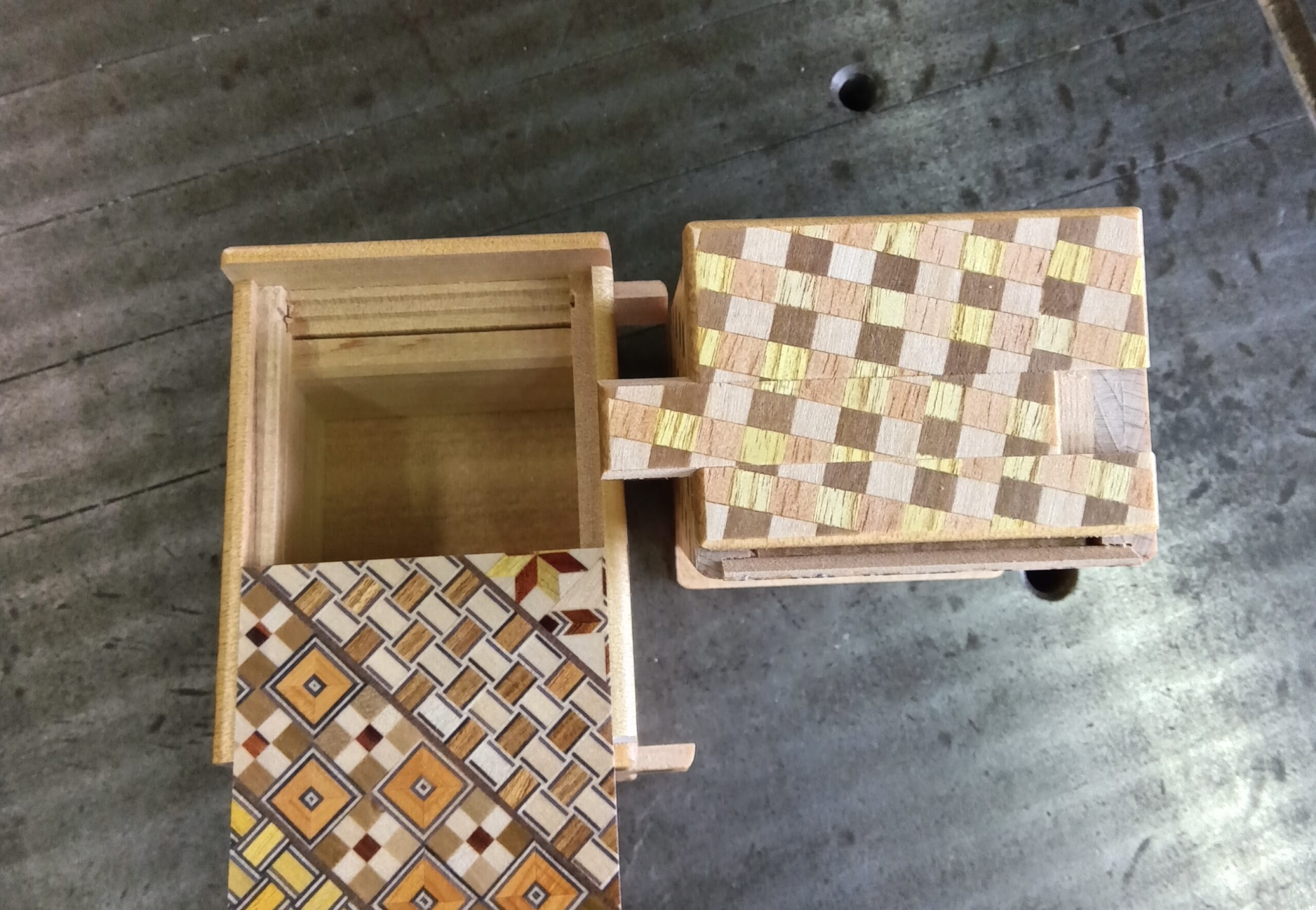
The rain from yesterday stopped by the morning, and today is cloudy. On days like this after rain, the humidity is often higher than the day before, so I need to be careful with my work. The humidity was quite high in the morning, but since I had to go out in the afternoon, I worked on preparing the 4-sun boxes for attaching the sliding key panels during the morning. I had already made the sliding key panels yesterday, so today I worked on attaching the small internal wooden parts and shaping the box itself. Then, in the evening after I came back from going out, I attached the panel to one side of the box. Since this is a double box, both sides have the same structure, so it doesn’t matter which side I attach first. Both sides use slightly smaller Aruki panels, so extra care is needed to prevent warping.
Now, the coating of the 3-sun 18-steps puzzle boxes is finished, and the production process is complete. After this, I will separate the parts that have stuck together during the coating and adjust the movement. As I’ve mentioned before, this 3-sun 18-steps box used to have some structural weakness. To improve it, I slightly increased the thickness of the axis panel over the past few years. While working on this batch, I felt again that it might be better to make it even a little thicker—about 0.5 mm more. Since the 18-step design has Aruki sliding panels on both sides with a thickness of 6.5 mm, making the axis thicker will reduce the internal space in a 3-sun size box. However, I still sometimes feel a bit of fragility. So for the next production, I made a note to use a 7 mm thick axis panel.
Also this time, there were a few boxes where the sliding keys had a bit of interference. By “interference,” I mean that when the sliding key moves, it doesn’t move smoothly—it slightly catches on the fixed parts above and below the panel, making the movement feel stiff. In my experience, this tends to happen more often in 14-step and 18-step boxes, and less in 21-step or 27-step ones. The reason is that in the 14-step and 18-step designs, the sliding key moves a longer distance in a single step. This kind of interference is not caused only by the sliding key itself, but also by the relationship between the small wooden parts attached to the key inside and the movement of the Aruki panels. It’s not easy to adjust and make the movement smooth again, but there are ways to do it. Today, I had to adjust several boxes, but I was able to bring them back to a smooth movement safely.
Have a nice weekend! 😊