The day began with cloudy skies, and it was much cooler and more comfortable than yesterday. We also had heavy rain yesterday evening, which helped lower the temperature. At around 2:00 a.m. last night, however, we were surprised by a strong earthquake in our area. My phone suddenly sounded the emergency earthquake alert, which was quite alarming. These alerts usually arrive just before the shaking begins, or at almost the same time. The epicenter was in the prefecture two prefectures away from us, but our area still experienced the second-highest level of shaking. Fortunately, there was no tsunami and the damage was limited. Even so, an earthquake in the middle of the night can be especially dangerous because many people are asleep and may not be able to evacuate quickly. I have heard that some people in Japan keep emergency supplies, such as food, water, and other essentials, beside their bed while they sleep. After last night, I was reminded once again how important it is to be prepared.
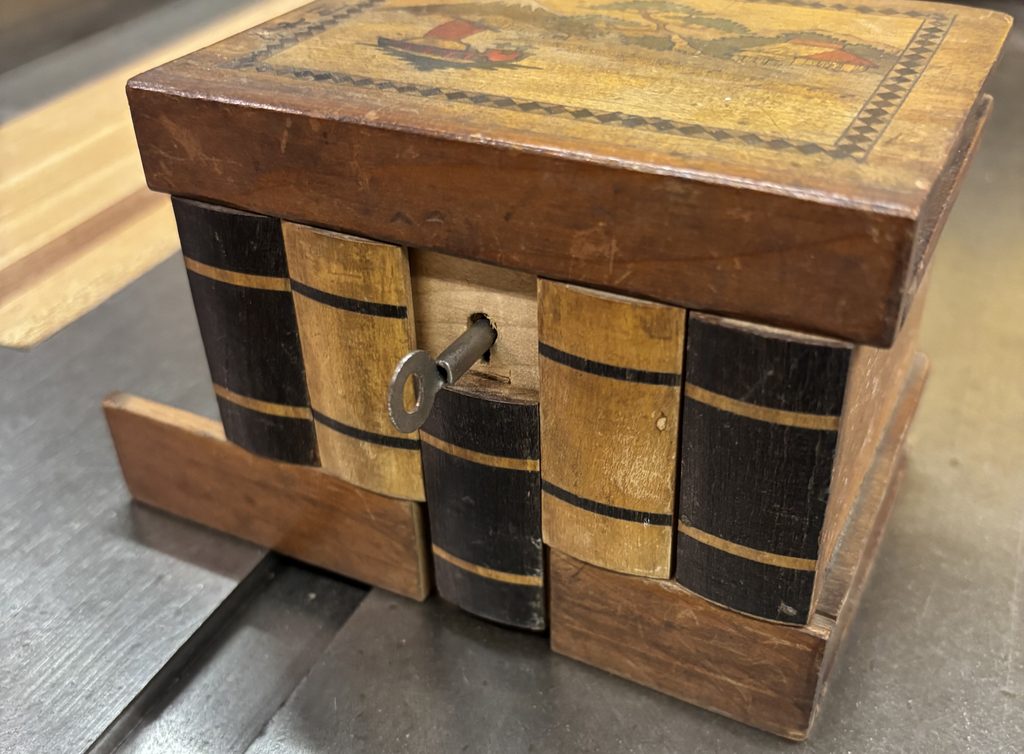
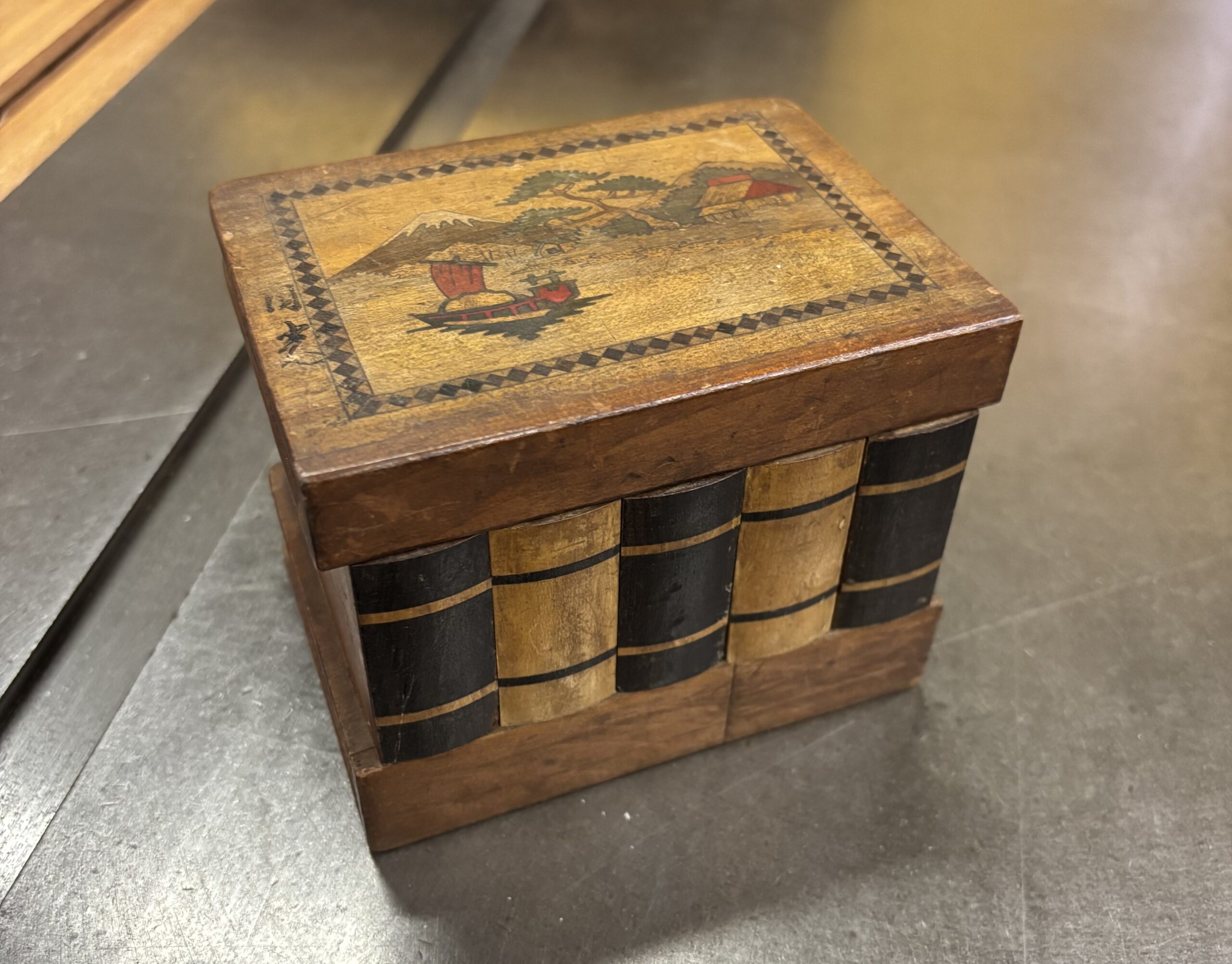
Today I would like to introduce an interesting trick box. It is a book-shaped trick box, known in Japan as a book-shaped trick box, or sometimes Ruiji. The word Ruiji means “similar” or “resembling” in Japanese. It may have been given this name because the box resembles a book or a row of books on a shelf, although the exact origin of the name is unknown. Incidentally, many people know Luigi from Nintendo’s Mario series. It is said that his name comes from the Japanese word ruiji, because Luigi is Mario’s younger twin brother and looks very similar to him.
It is believed that this type of trick box first appeared in the late 1800s or the early 1900s, This type of trick box was especially popular from the 1950s to the 1960s. During that period, Japan was recovering from World War II and experiencing rapid economic growth. As people’s lives became more comfortable, travel also became much more common. Hakone was one of the popular destinations, and trick boxes like this became a classic souvenir that sold very well. At the same time, exports also increased, and many of these boxes were shipped overseas. You could even say that this was the first export boom for Japanese trick (puzzle) boxes. The present day might be considered the second.
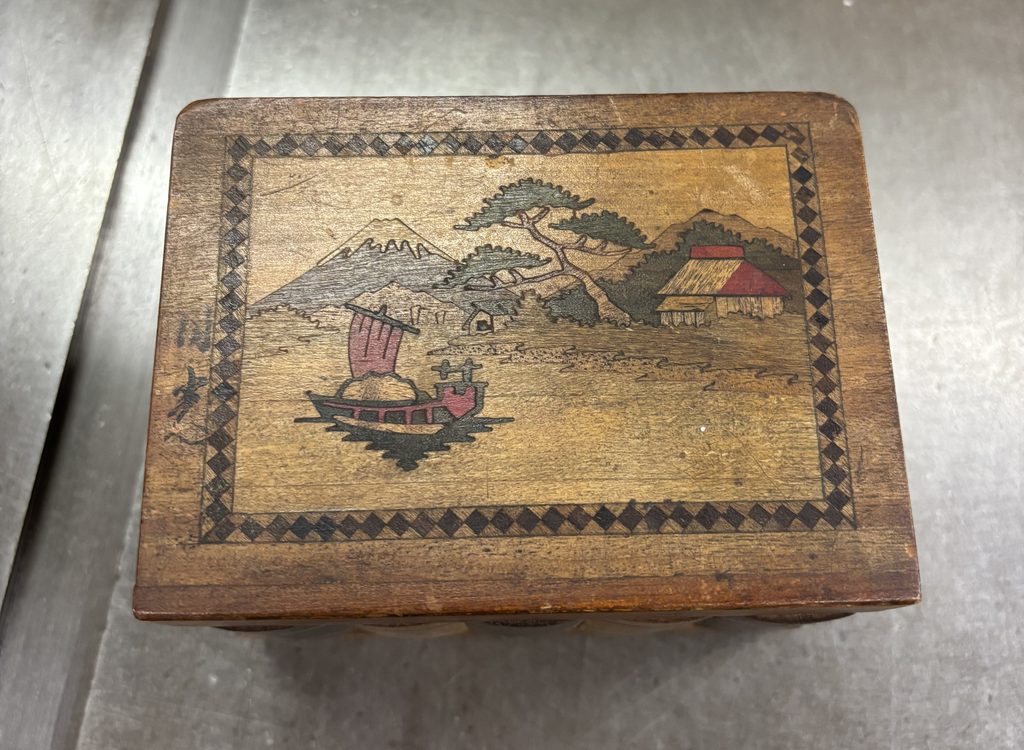
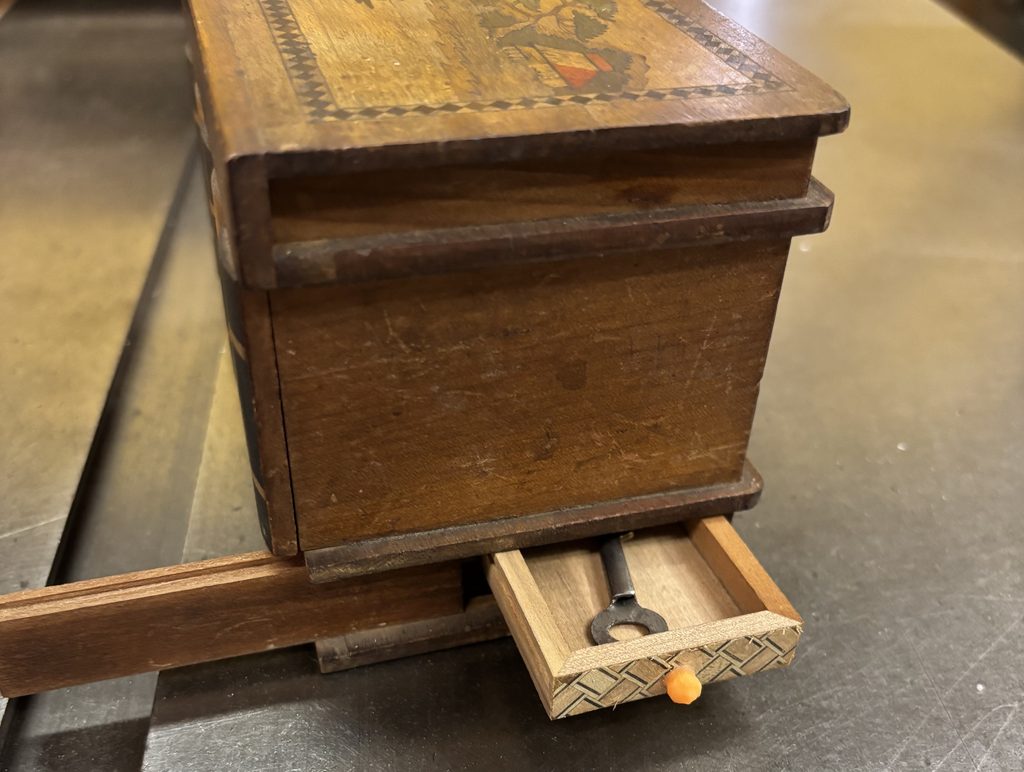
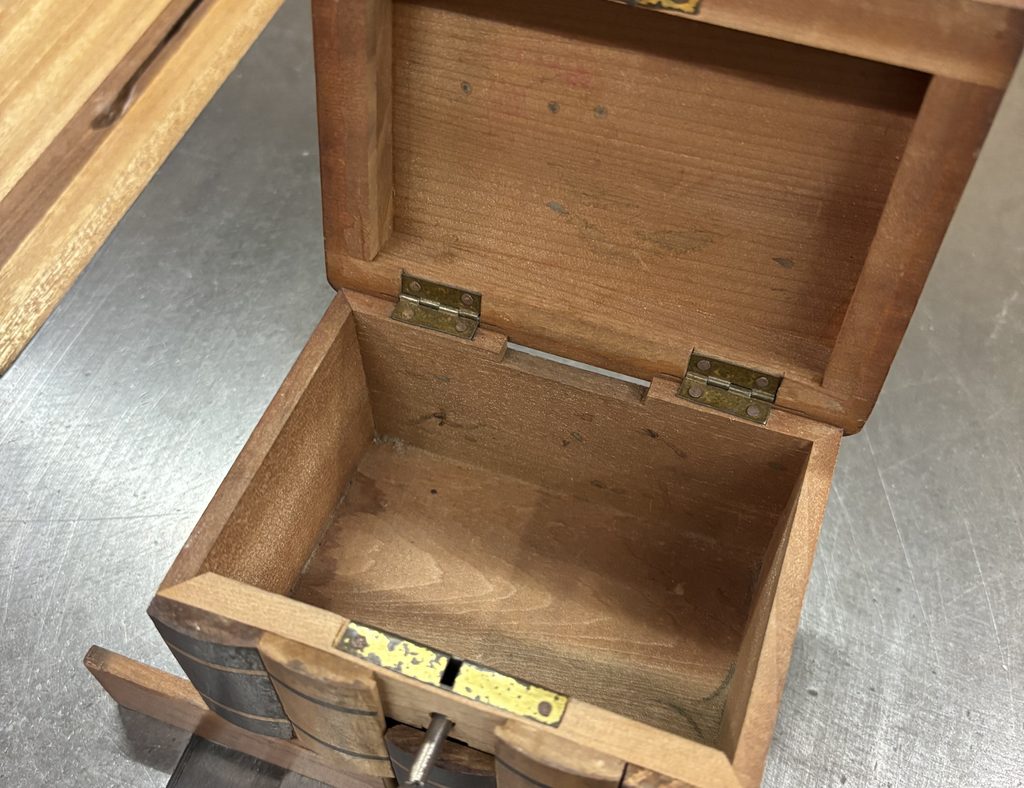
The mechanism is remarkably elaborate, especially by today’s standards. (Laughs.) It includes sliding panels, a hinged top lid, and even a hidden drawer. The decoration is just as impressive. In addition to the wood inlay (sansui) on the top panel, the front of the drawer is decorated with traditional Yosegi as well.
This kind of elaborate construction can also be seen in other trick boxes from the same period. Some were richly decorated with both wood marquetry and traditional Yosegi, and many even used Yosegi sheets made specifically for each individual box. They were truly made with extraordinary care. The opening sequence is as follows:
- Slide the large front bottom panel to the left.
- Slide the small front bottom panel to the left.
- Pull the right side sliding panel toward you.
- Pull out the drawer.
- Take the key from inside the drawer.
- Return the right side sliding panel to its original position.
- Return the small front bottom panel to its original position.
- Slide the center book-shaped panel downward.
- Insert the key into the keyhole that appears and turn it.
- Lift the top lid to open the box.
Using a key makes the whole mechanism feel even more mysterious, which I really like. This type of mechanism was not limited to the book-shaped version. It was also used in other trick boxes, such as house-shaped designs. There were also several versions of this design, including longer bookcase-shaped ones with more books.
Incidentally, this box has the word “Nikko” printed on the top, so it appears to have been sold in Nikko, Tochigi Prefecture, rather than in the Hakone area. Like Japanese puzzle boxes, these trick boxes were often printed with the name of a tourist destination, making them popular souvenirs in many different parts of Japan. Finally, here are the outside dimensions and weight of this box.
Dimensions: 12 × 8.5 × 9.3 cm (4.7 × 3.3 × 3.7 inches)
Weight: 180 g (6.3 oz)