Today marks the end of the Obon holiday for many people. Fortunately, the weather during the holiday was relatively cool, which probably made it more comfortable to spend time outdoors. Today was especially cool, with cloudy skies and a high of only about 28°C. On the other hand, I have heard that places like swimming pools were not as busy as usual because of the cooler weather. For them, it may not have been the best Obon holiday.
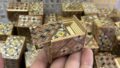
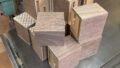
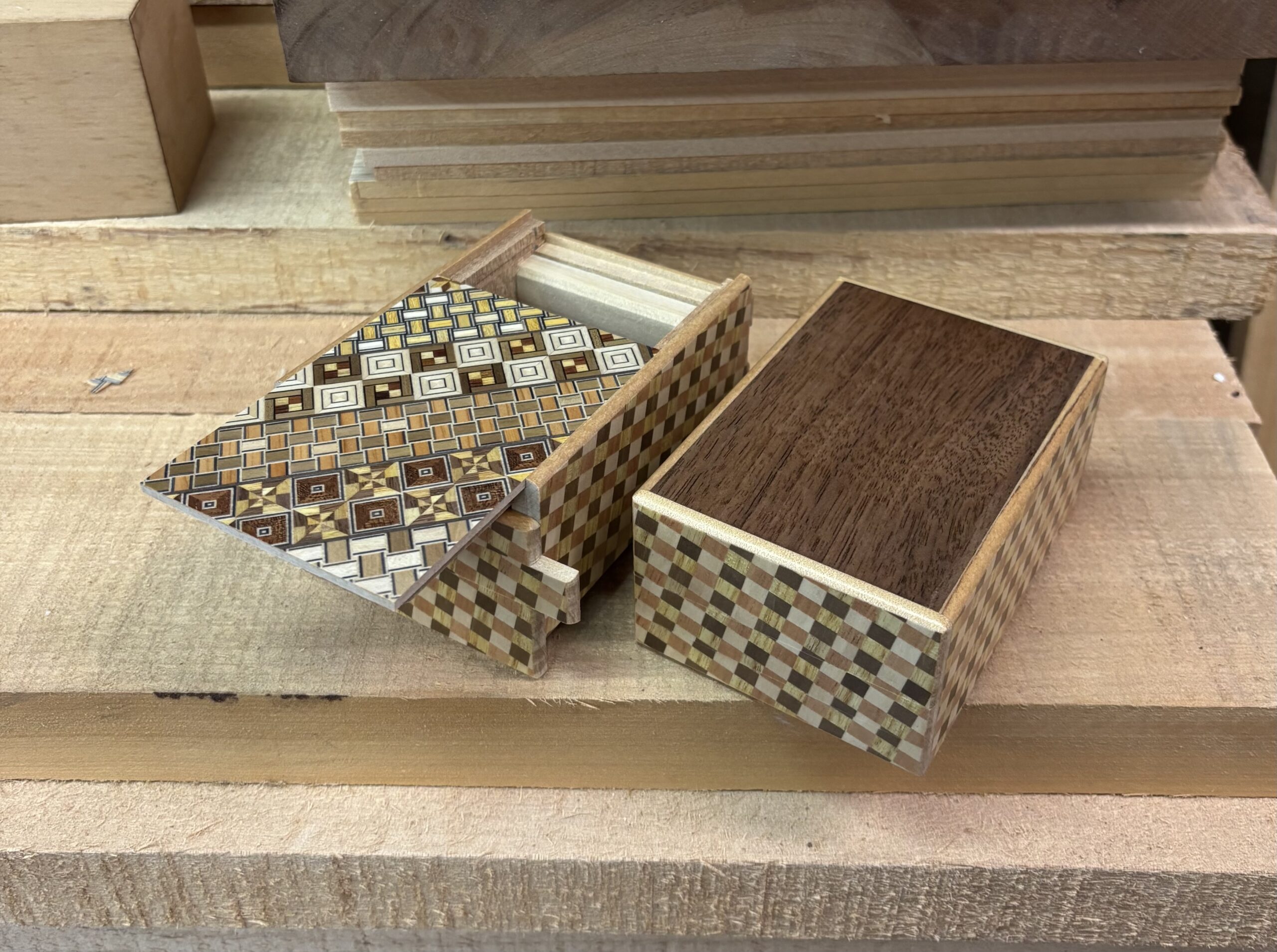
Later this month, I plan to make one more batch of 4-sun puzzle boxes. The reason is simple—I still have enough material left for one batch of the side Aruki panels. I could save it for the next production run, but I do not want it to get mixed in with other materials and accidentally forget about it…haha😅. This batch will also be the 14-step version. It will have checkered Yosegi side panels, a traditional Yosegi top panel, and a Walnut bottom panel. Because only the top panel uses traditional Yosegi, this model costs a little less to make. That may be one of the reasons why it has become so popular. It is a good way to enjoy a traditional Yosegi puzzle box at a more affordable price.
Until about ten years ago, the price of a Japanese puzzle box was made up mostly of the labor required to make it rather than the cost of the materials. Because puzzle boxes are built from wooden panels, they do not actually use a great deal of wood for their size. In my region, there is another traditional craft in which round objects such as trays and bowls are made on a wood lathe. Those items start as solid blocks of wood, and much of the material is carved away and discarded. Compared with that, making puzzle boxes is perhaps a little more efficient with the use of wood. On the other hand, puzzle boxes require a great deal of handwork. The panels must be cut to size, glued together to form the box, and fitted with the Aruki panels. Compared with many other traditional crafts, they involve much more manual work. In other words, they are very labor-intensive. For that reason, most of the selling price came from the time and skill needed to make the box.
In recent years, especially since the pandemic, the cost of materials has risen sharply and now makes up a much larger part of the overall cost. This year, the prices of adhesives and finishes have also increased significantly. Among all the materials, the largest price increase has been for Yosegi sheets. They now cost about two to three times more than they did before. That is one reason I make models like the one mentioned above, with traditional Yosegi used only on the top panel. This helps keep the selling price, especially the wholesale price, a little lower. On the other hand, rather than thinking of it simply as a lower-cost version, some people may enjoy the combination of traditional Yosegi on the top and natural wood on the bottom, allowing them to appreciate two different finishes in a single puzzle box. In fact, natural wood veneer is not inexpensive either. The biggest difference is that traditional Yosegi sheets are available only in limited quantities and cannot be obtained whenever they are needed. Traditional Yosegi remains very popular, so I hope to continue finding new ways to use it in future designs.