It rained again last night, and the humid weather continues. Fortunately, our area has not experienced any heavy rain. However, some other parts of Japan have suffered serious flooding, and many people are concerned. Over the past few years, this kind of flooding has become more common. While it is impossible to prepare for every sudden downpour, I think it is important to learn how to respond when they happen. This weekend also marks the end of the Obon holiday, and many expressways across Japan are crowded with people returning home from visiting their hometowns. My area is one of the places where this traffic is especially heavy, so today I planned my travel to avoid the busiest times.
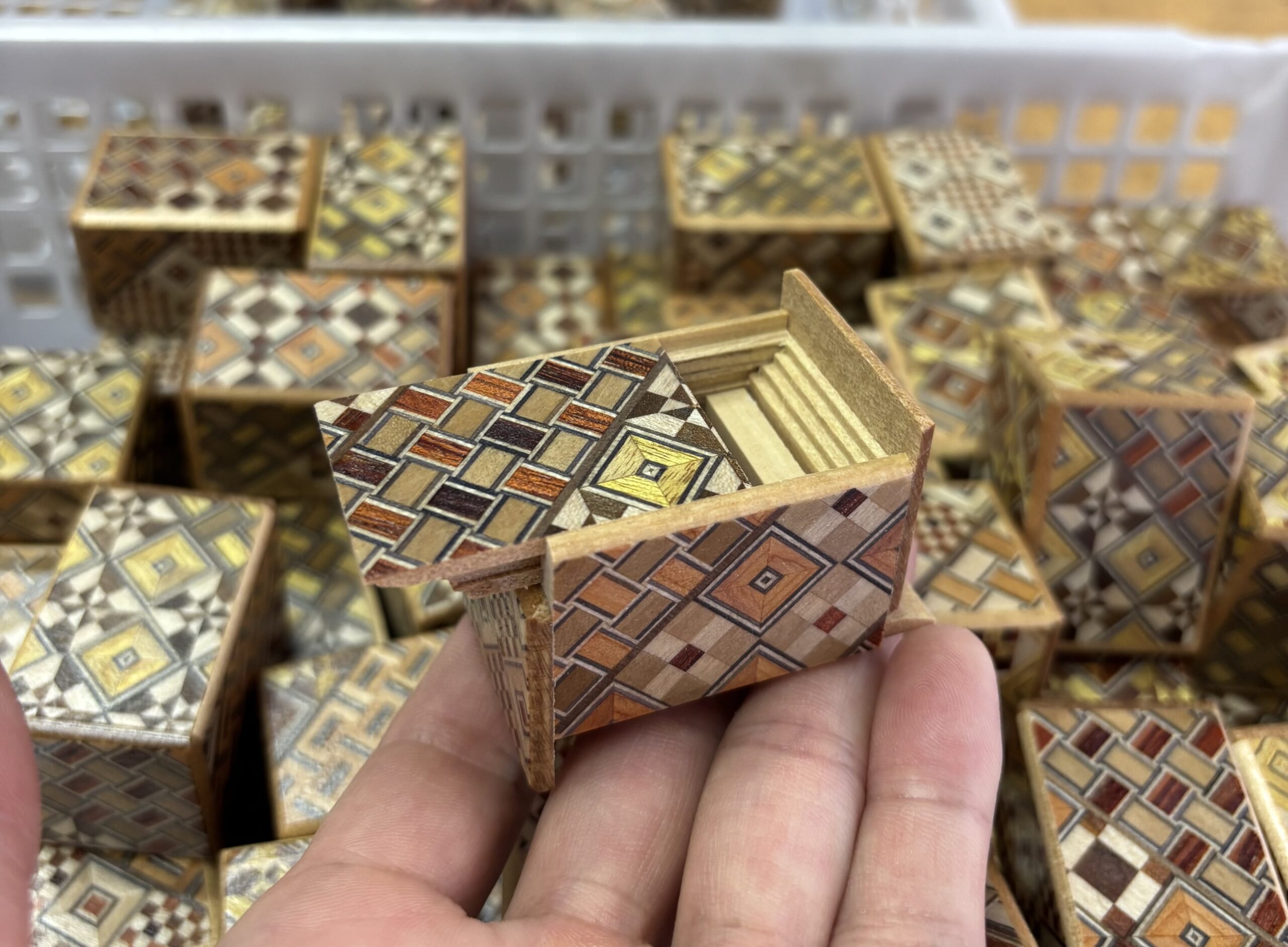
The 18-step Mame puzzle boxes are almost finished. This time, I made them for my own stock. It has been quite a while since I last made Mame puzzle boxes just to keep in stock. Usually, I make them to fill orders from the shops I supply, and then produce a few extra at the same time. The idea for this batch came from the Mame puzzle boxes I made last month. Since I had already been making them, I thought it would be a good time to make some for myself while my hands were still used to the work. You might think that after making them for so many years, I would never lose the feel for it. Of course, my hands still remember much of the process, but if I do not make them for several months, some of that feeling becomes a little dull. Many experienced craftsmen believe that they can produce their best work because they keep making the same thing. That is not true for every type of work, but Japanese puzzle boxes (himitsubako) require many adjustments that rely on experience and feel, so regular practice makes a real difference. The 4-sun and 5-sun puzzle boxes share many similarities, so the skills carry over from one to the other. The Mame puzzle box, however, has its own unique construction, and making it feels quite different from making the larger boxes.
Writing about Mr. Okiyama’s Mame puzzle boxes the other day also influenced me a little while I was making this batch…haha 😅 Even so, I still cannot recreate the same light, smooth feeling of his mechanisms. Perhaps it would be possible if I could spend a great deal of time on each box, but I do not think it is that simple. This time I made about 80 Mame puzzle boxes. For this size of puzzle box, I need to make at least this many to supply wholesale customers, and it also has to make sense from a cost standpoint. Time is another important factor. Finding the right balance between making boxes in larger quantities and making them as individual works is always difficult. I try to keep both at a good standard. You could say that this is a compromise, but for making Japanese puzzle boxes today, I think it is the most practical approach. Many craftsmen today focus mainly on larger-scale production and wholesale, and I think that is also a valid approach. It may even be related to what I mentioned earlier—that you only continue to improve by making the same thing over and over again. As for me, I continue to spend at least some of my time making more individual pieces. I think I will keep searching for the right balance between those two approaches.