Last night, the typhoon finally moved away from our area, but it caused some damage in various places, including collapsed roads and landslides. The weather has improved in many areas, but since we are still in the rainy season, our area is still rainy. Today, I came to the workshop in the afternoon again and did some cleaning and other work. The humidity is still very high, so today I continued with preparation work, such as preparing materials and parts.
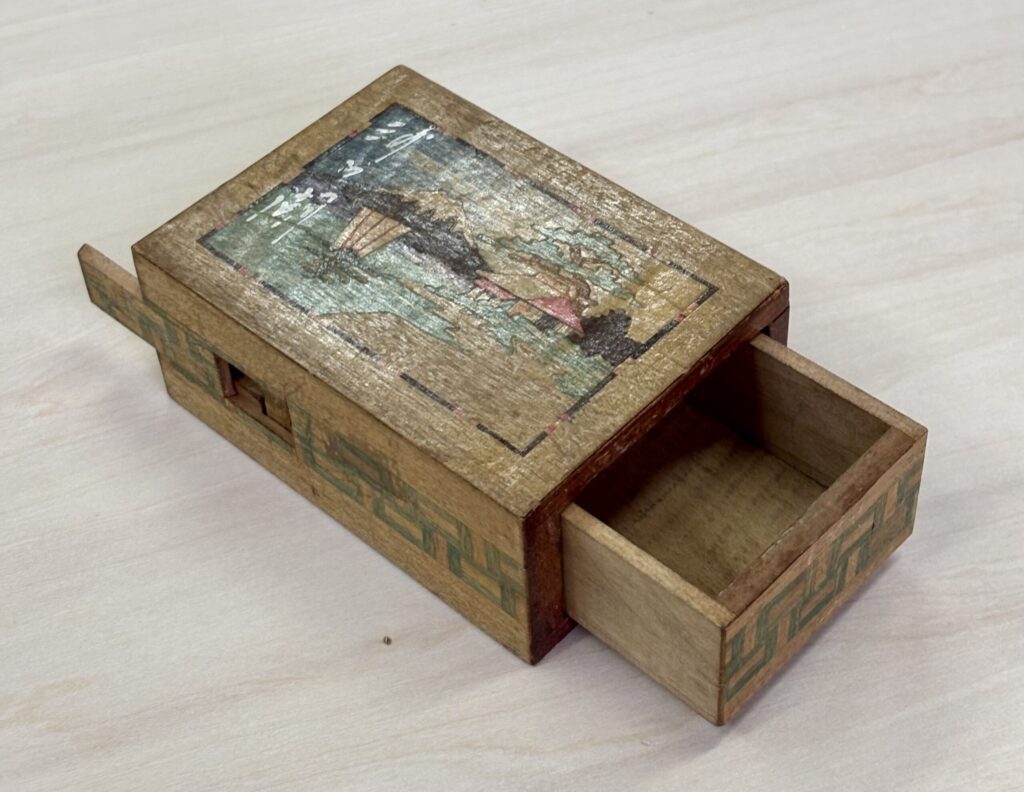
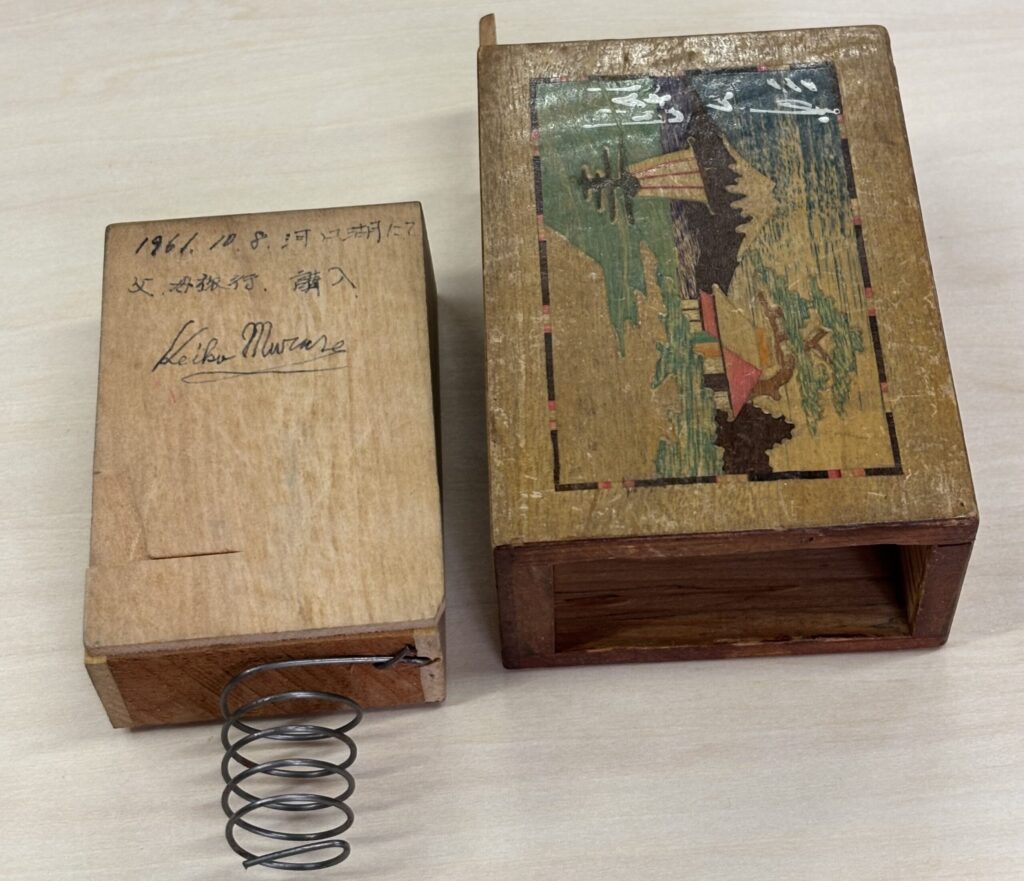
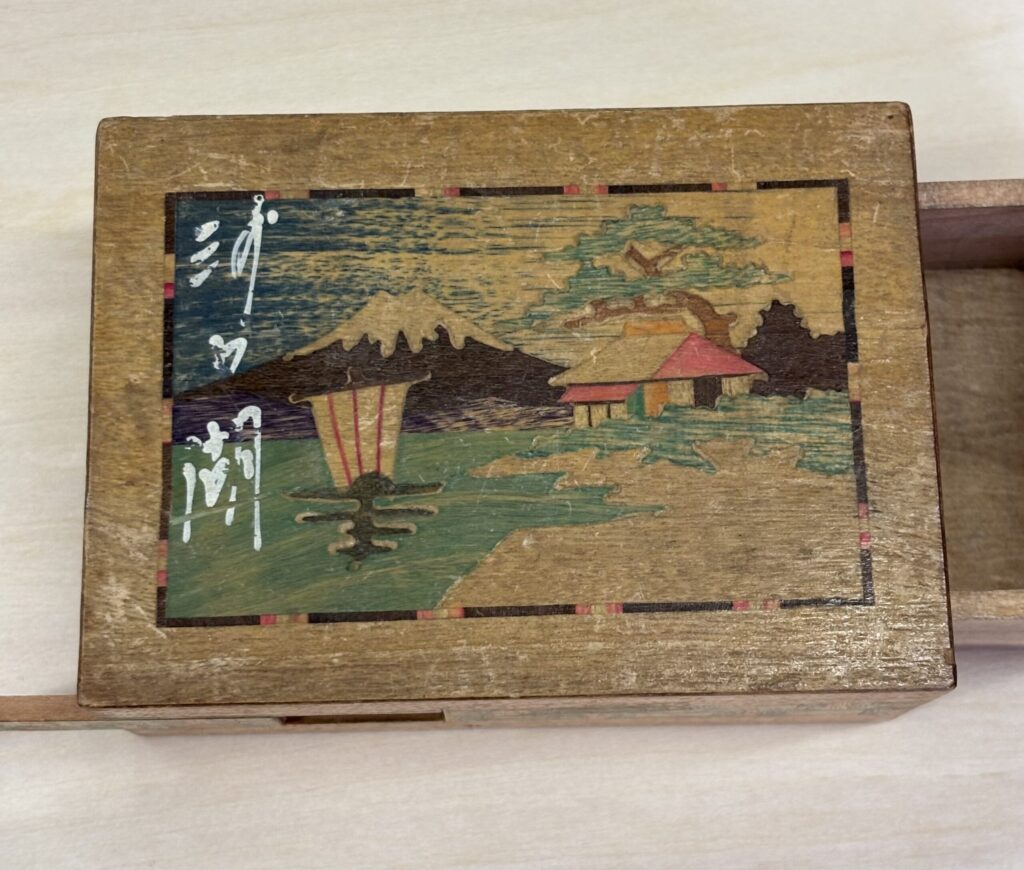
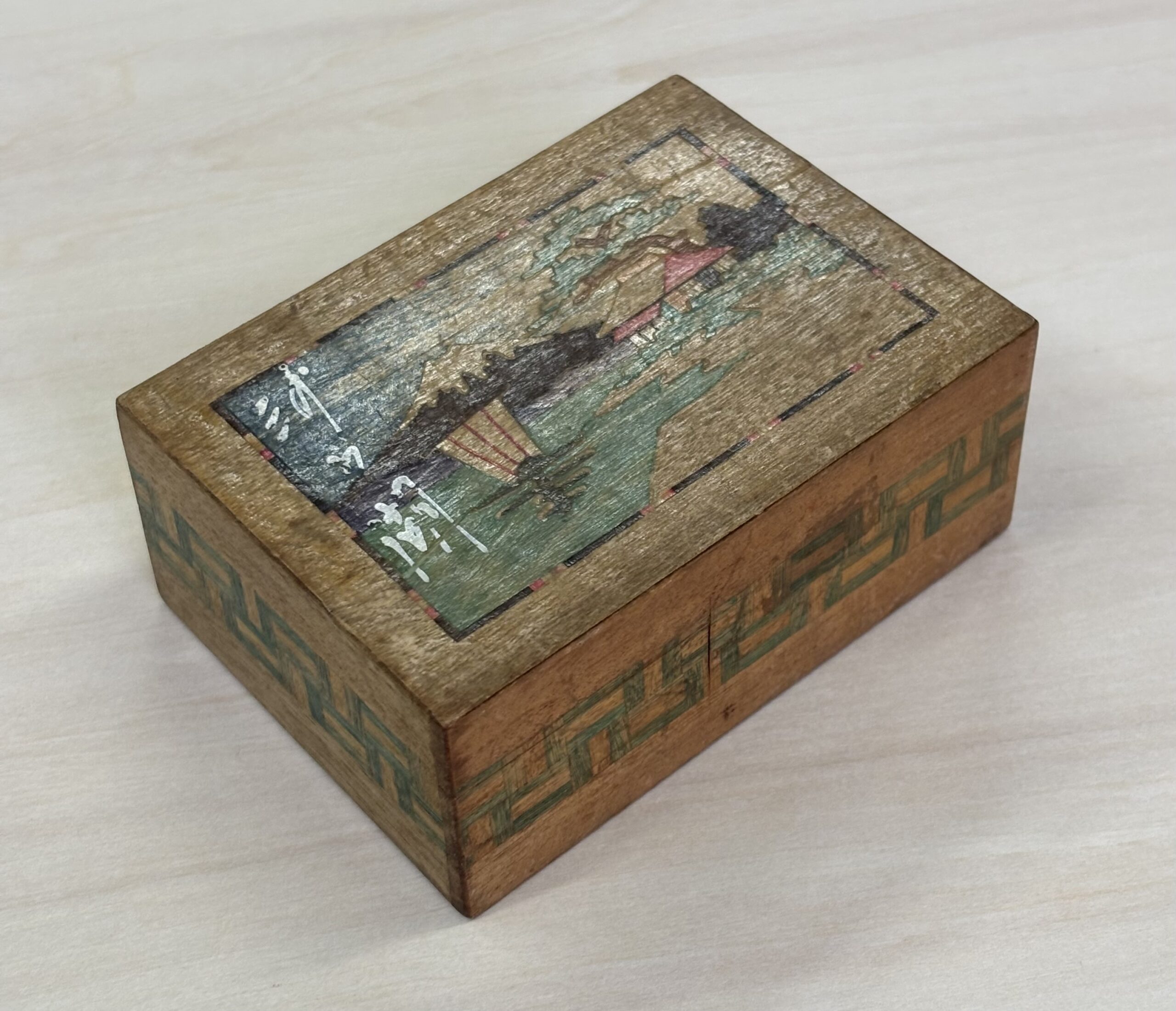
Today, I would like to introduce another interesting box. This is an old box, so it is not in very clean condition, but it is the same type as the “Tobidashi (a spring-loaded drawer)” box I introduced the other day, with a different design. On the bottom of the drawer, there is a handwritten note, probably written by the person (or family) who bought this box. It says, “Purchased at Lake Kawaguchi in 1961.10.8 (October 8th) during my father and mother’s trip.” Below that, there is also something written in English that looks like a name. Since the note says “father and mother,” the person who wrote it seems to have been someone else, possibly the child of the couple. The name appears to be “Keiko Murase,” so perhaps she was their daughter. Since it was 1961, this was 65 years ago. The box is quite worn, but surprisingly, the mechanism still works normally. On the surface of the box, “Lake Kawaguchi” is written. Lake Kawaguchi is a large lake near Mt. Fuji and is also a famous tourist destination. There are five large lakes near Mt. Fuji, and together they are called the Fuji Five Lakes. It seems that this writing was added by hand after the box was completed. At that time, it seems to have been common to add the name of a tourist destination like this later. The box itself was made in Hakone, but depending on where it was sold, the name of that place was added and the box was sold as a souvenir from that location.
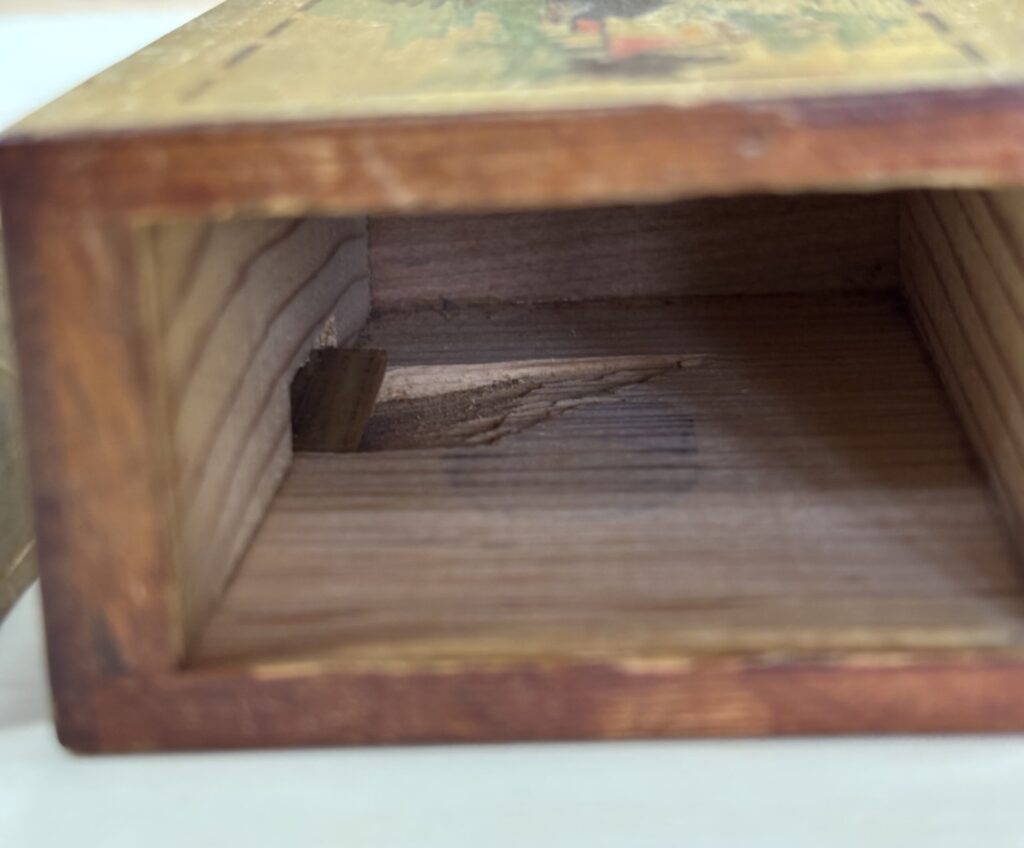
The first thing you notice when looking at this box is its size. It feels different from the Tobidashi boxes that are commonly seen. Compared with the usual type, it is a little shorter in length and taller in height. It seems that the standard sizes differed depending on the craftsman. Usually, the drawer has a stopper attached to the inside top surface of the main body, so it cannot be pulled out completely. However, the stopper on this box has come off and is now missing. Even so, the stopper was probably just a small piece of wood attached to the top surface, so it may have come off after the drawer hit it many times over the years. Thanks to that 🤭, though, the internal structure can now be seen very clearly. To be honest, this was my first time seeing the inside structure of this type of box, and I was surprised by how precisely it was made. Perhaps “ingenuity” is a better word than “precision.”
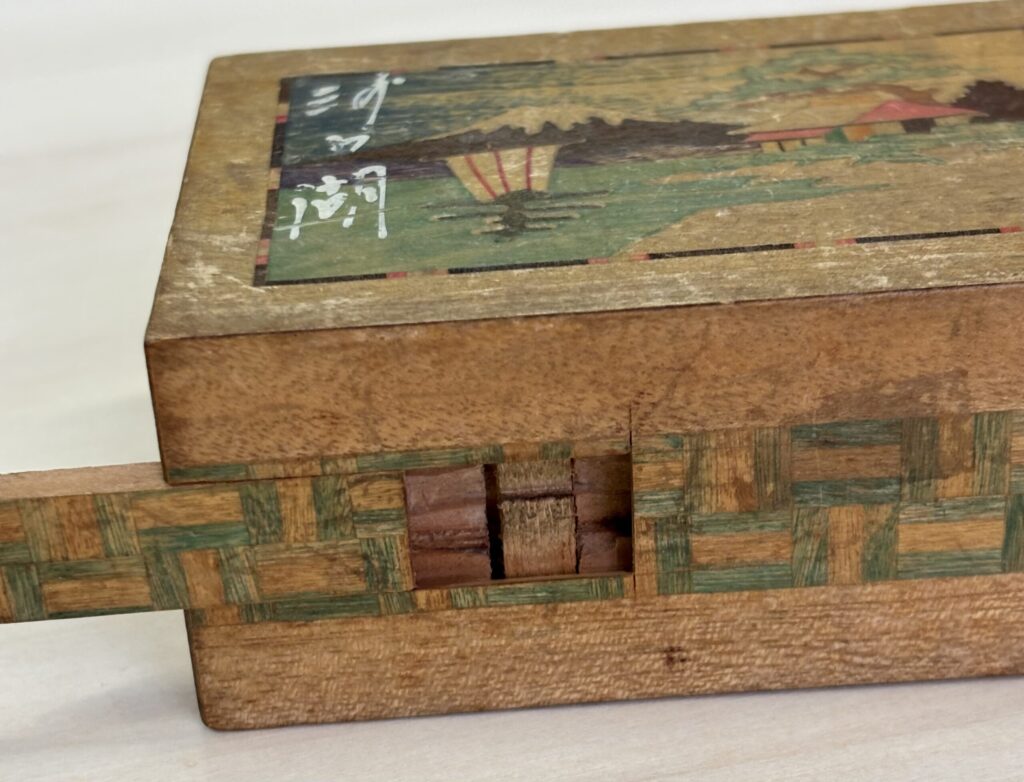
At that time, I do not think small parts and components were as widely available as they are today, but this box was very skillfully made using what was available. The large spring attached to the drawer is made of iron, but for the trigger switch, the maker cleverly used the flexibility of bamboo to make it work. This bamboo switch catches on a cut-out protrusion on the drawer and holds it in place. The carefully calculated structure is simple, but it also shows a kind of cleverness. And it feels nostalgic as well…
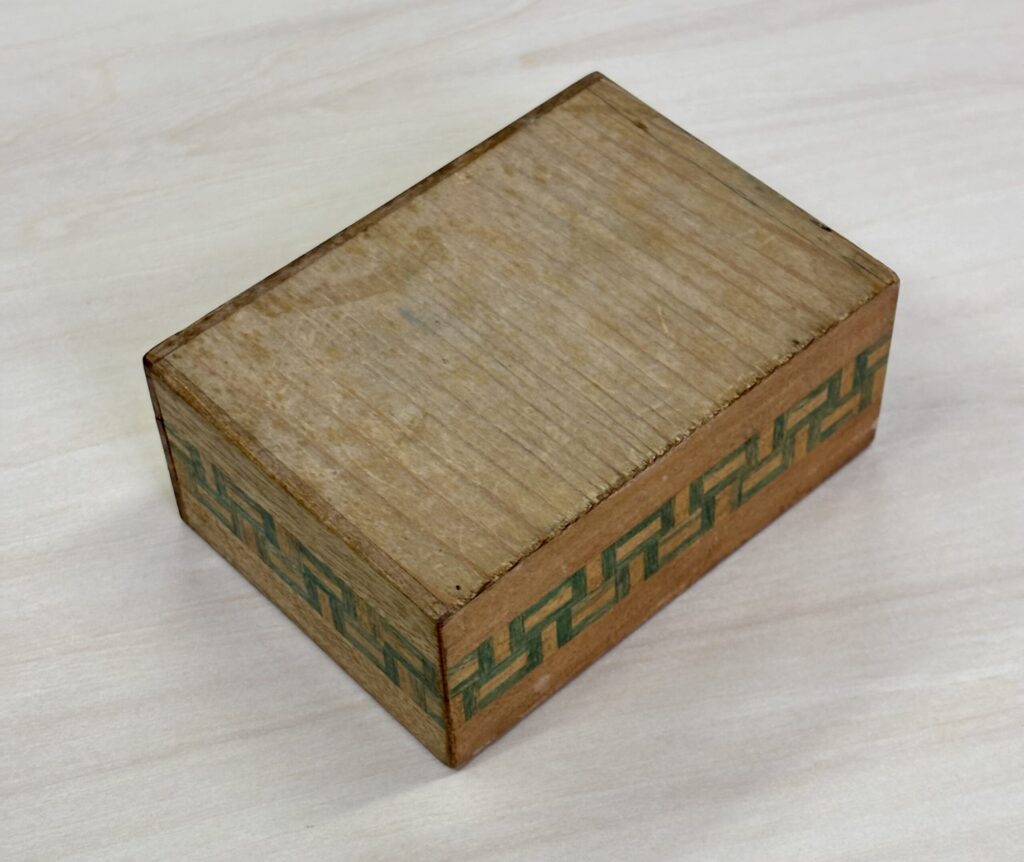
The design of the box has the classic “Sansui” pattern on the top surface, and it seems to have been made to fit the size of this box. However, I also wonder if perhaps this size of Sansui marquetry already existed, and the box was made to match it. In recent years, this kind of thing often happens in my workshop as well, so that thought came to mind. The Sansui design originally seems to be based on Lake Ashi in Hakone, but a design with Mt. Fuji and a lake could certainly also be sold as a Fuji Five Lakes souvenir. The side surfaces of the box have Yosegi with a blue pattern that could almost be described as a “manji” pattern. Because the blue color is clearly dyed, at first glance it almost looks as if the pattern was painted on later, but it is proper Yosegi. This pattern is made by combining blue-dyed wood with brown wood. The movement of the sliding section, where the switch is hidden, is made to match the lines of this pattern. This sliding section is made in the same way as the sliding key (kannuki) of a Japanese puzzle box (himitsubako). It is cut diagonally so that it does not fall out through the surface. This is true of all Tobidashi boxes, but because of this mechanism, one side panel is set inside the body, while the mechanism side is attached later from the outside surface. Because of this, if you look closely, the construction is asymmetrical from left to right.
Finally, I will write down the dimensions and materials of this box.
Outer dimensions: 9.5 × 6.8 × 3.9 cm
Inside dimensions of the drawer: 6.9 × 4.5 × 2.4 cm
Weight: 70 g
Materials: Main body – probably a softwood / Drawer – Katsura wood