The weather has been rather gloomy lately, with cloudy skies continuing day after day. The rainy season has already begun in the southern parts of Japan, and our area will likely enter the rainy season around next week, as it usually does each year. This is probably one of the reasons for the recent weather. In Japan, this time of year is sometimes called “Hashiri tsuyu (Hashiri=early arrival, tsuyu=rainy season)” which refers to the period just before the rainy season officially begins. It is a sign that the rainy season is approaching, and it often brings several days of cloudy or rainy weather.
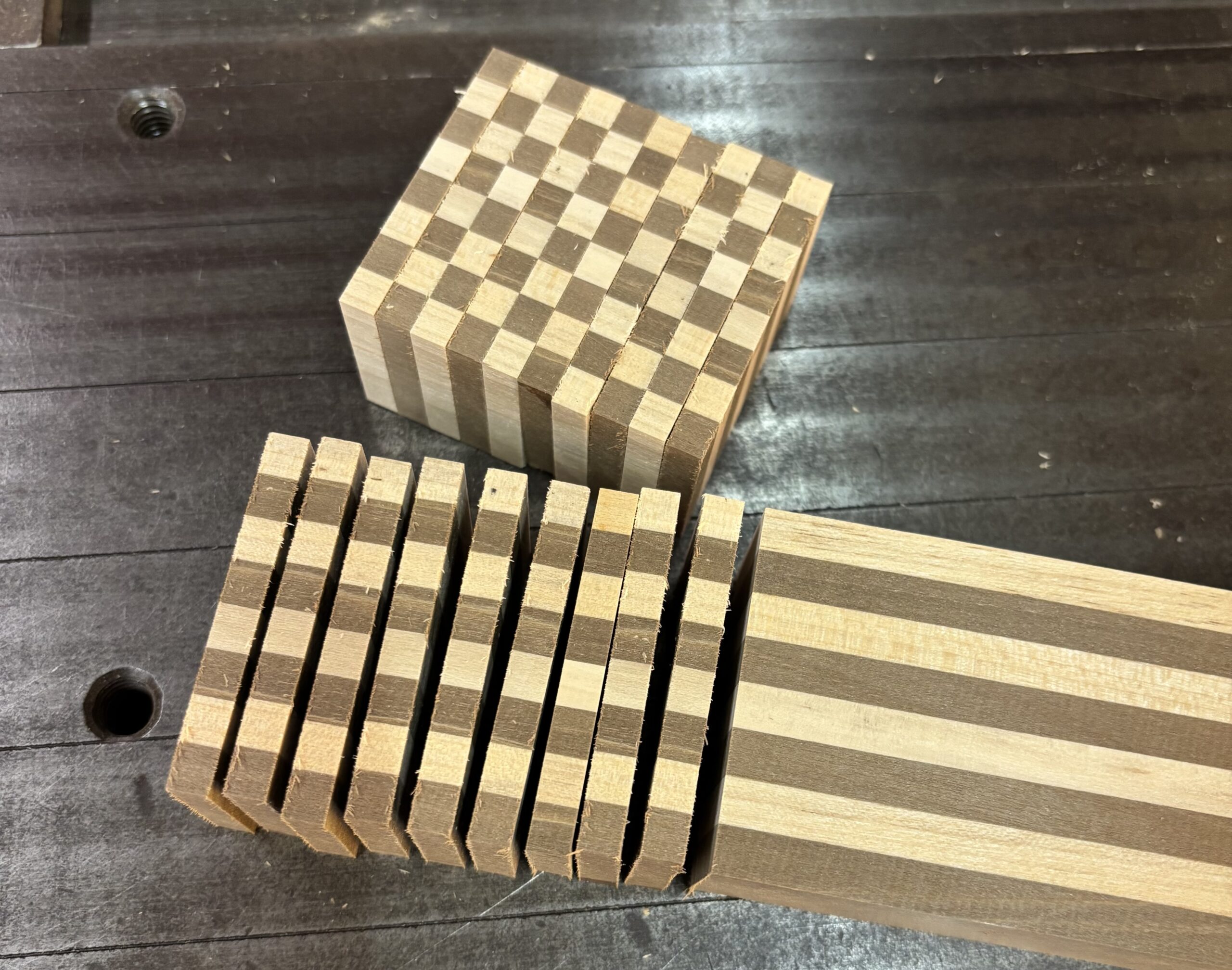
I came to the workshop again this afternoon and spent some time cleaning up and doing a little work. Today, I took the yosegi sheet material that I glued into a striped pattern yesterday and cut it into narrow pieces about 5 mm wide. I then glued 14 pieces together, alternating the pattern, and clamped them tightly in a vise. This process will produce four blocks. In the next step, these blocks will be joined side by side to create pieces about 20 cm long. If I wanted to make these pieces longer, I could simply make another striped block like the one I made yesterday. In theory, that would double the number of parts and increase the length from 20 cm to about 40 cm. In practice, however, wood naturally expands and contracts. Even if a block measures 20 cm at this stage, it will usually shrink a little when it is sliced into veneer sheets. The amount depends on the thickness of the slices, but it is not unusual to lose around 1 cm or so. After that, when the veneer is glued onto a backing board, it absorbs some moisture from the glue and expands slightly again. Even so, it rarely returns exactly to its original 20 cm length. This movement is simply one of the characteristics of working with wood.
For this reason, it is important to be careful when making yosegi for a specific puzzle box. If the material is made to the exact required dimensions, it will often end up being too small after the various stages of processing. Because of this, most yosegi sheets are made slightly larger than necessary. This is true not only for my simple checkered patterns, but also for the traditional patterns made by professional yosegi craftsmen. Traditional yosegi sheets, which combine many different patterns and types of wood, are especially difficult to size accurately. Since the material can expand and contract during the manufacturing process, it is hard to predict the final dimensions precisely. As a result, they are usually made with plenty of extra size to ensure there is enough material for the finished work.
When making puzzle boxes, it is common for some of the extra yosegi sheet material to be trimmed away and discarded. It may seem wasteful, but the size of the box cannot be changed every time, so the boxes are made to consistent dimensions. Of course, it would be possible to adjust the size of the box to match each finished yosegi sheet. However, when a new sheet is made in the future, it might end up slightly smaller than the previous one. It would still meet the requested size, but if the box had been designed around an unusually large sheet, there might not be enough material, and the box itself would have to be made smaller. For this reason, box makers usually make the boxes slightly smaller than the target sheet size, while the yosegi craftsmen make the sheets slightly larger than the specified dimensions. This provides a margin of safety for both sides. Naturally, the extra material is included in the cost of the sheet, and the customer understands this. Having a sheet that is a little larger than needed is much better than finding that it is too small. I think this is simply one of the realities of handmade work. When everything is made by hand and natural materials are involved, precise cost calculations and exact dimensions do not always work as neatly as they do in mass production. Some workshops and stores that sell yosegi products give these leftover pieces of yosegi sheet (The offcuts are the extra sections that remain after the required size has been cut from the sheet) to customers free of charge.