It was another hot day today, but this morning was our neighborhood cleanup day. While it was still relatively cool, I went to help cut the grass at our local Shinto shrine. Each month, one of the small neighborhood groups, made up of about ten households, takes turns cleaning the shrine and cutting the grass. The shrine is a symbolic place in our community and is used for local events, especially the annual festival held every April. It is located in the middle of a forest at the top of a long stone staircase. Climbing those steps is quite a workout! 🤣 Because it is surrounded by trees, the grass and plants grow very quickly, so this work needs to be done every month. Even though we started early in the morning, it was already hot enough to make us sweat. Besides the shrine, our community also has a meeting hall and an open square. This month’s Bon dance festival (summer festival) will be held there 🎐
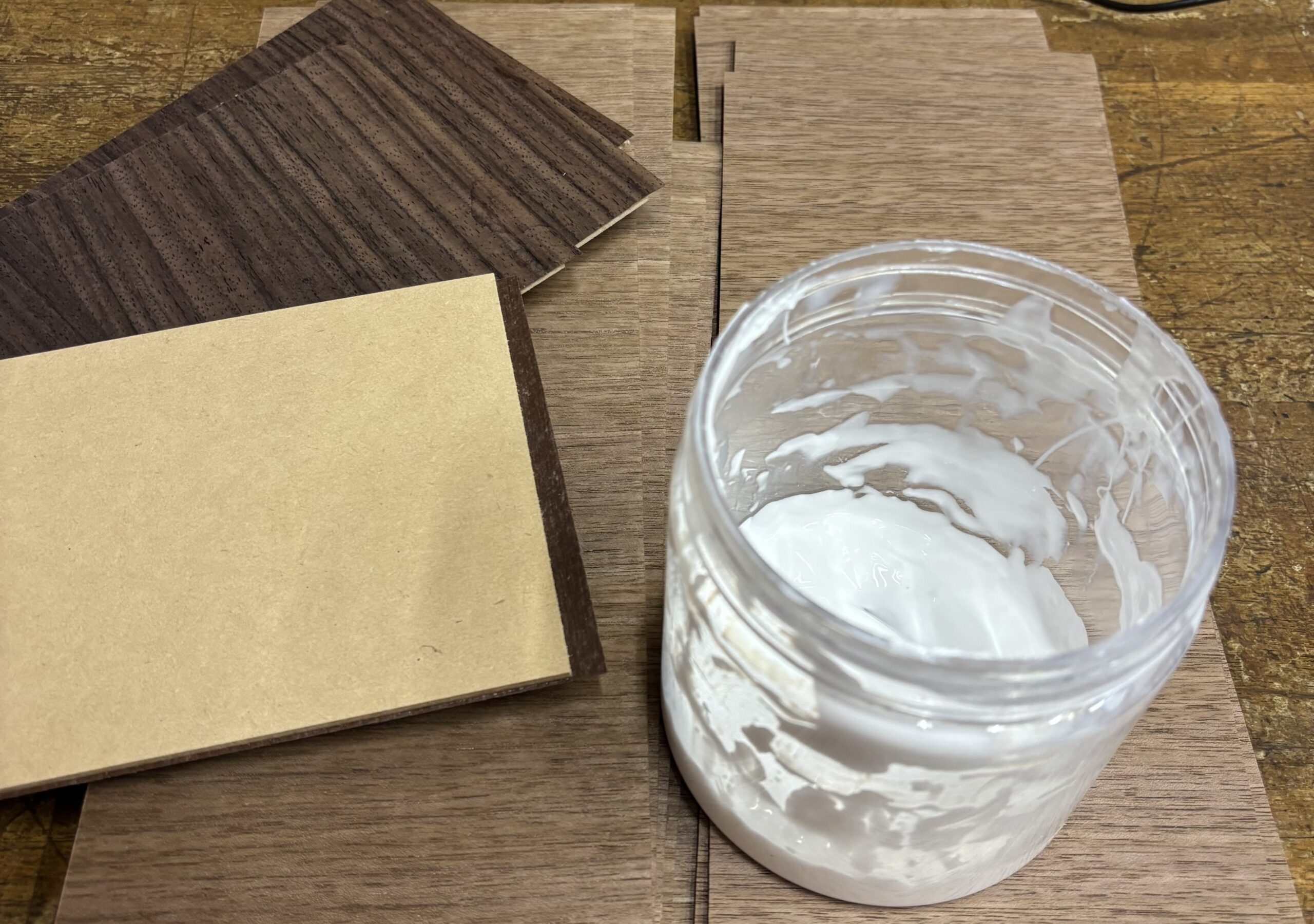
The photo shows the Walnut and Rosewood veneer sheets that I am using for the 4-sun 14-step puzzle boxes I am currently making. Although they look like thin sheets, they are made from real wood. The veneer is sliced from natural wood to a thickness of about 0.3 mm and is attached to an MDF backing. However, when natural wood is sliced this thin, it tends to split along the grain. To prevent this, a thin layer of paper is attached to one side of the veneer. This paper creates a small challenge during production. The paper itself is not really the problem. The real issue is the adhesive used to attach the paper to the veneer. It soaks through the paper and hardens on the paper side, although it does not come through to the wood side. Once it hardens, it becomes almost like plastic, making it difficult to achieve a strong bond with the MDF board. Normally, I could use my usual adhesive to bond a wood veneer to MDF, but in this case I need to use a different type of glue. You can see it in the photo. It looks almost the same as the glue I normally use, but its composition is slightly different. I tested several kinds of glue before finding this one, as many of the others eventually allowed the veneer to peel away.
This glue can bond ordinary wood even when used in the usual way, but applying heat gives it much stronger holding power. That extra strength is necessary when using a slightly stiff sheet like this one, which is also difficult for glue to stick to. Hard woods such as Walnut, Rosewood, and Zebrawood remain very stiff even when made into thin sheets. They also have a strong tendency to curl, so unless they are firmly attached, they may begin to lift away from the MDF board. Softer woods are easier to bond and do not require as much pressure. The character of the sheet varies depending on the type of wood. However, these veneer sheets do not need to be dried for very long and can soon be used as panels for Japanese puzzle boxes, which makes that part of the work easier. By the way, the craftsman’s workshop where I buy these veneer sheets offers more than 60 different kinds of wood. All of them are available as wood veneer sheets.