The typhoon has passed, and today has been a quiet day. However, the weather has not fully improved, and the sky remained cloudy throughout the day. Even so, the humidity dropped, which made it a better day for working.
Today, I worked on shaping and attaching the side panels (sliding key panels) for a 2.5-sun puzzle box. This box uses a sliding key on only one side, and since the box itself is not very large, I was able to attach both side panels at the same time. The other side uses a single-piece Aruki sliding panel.
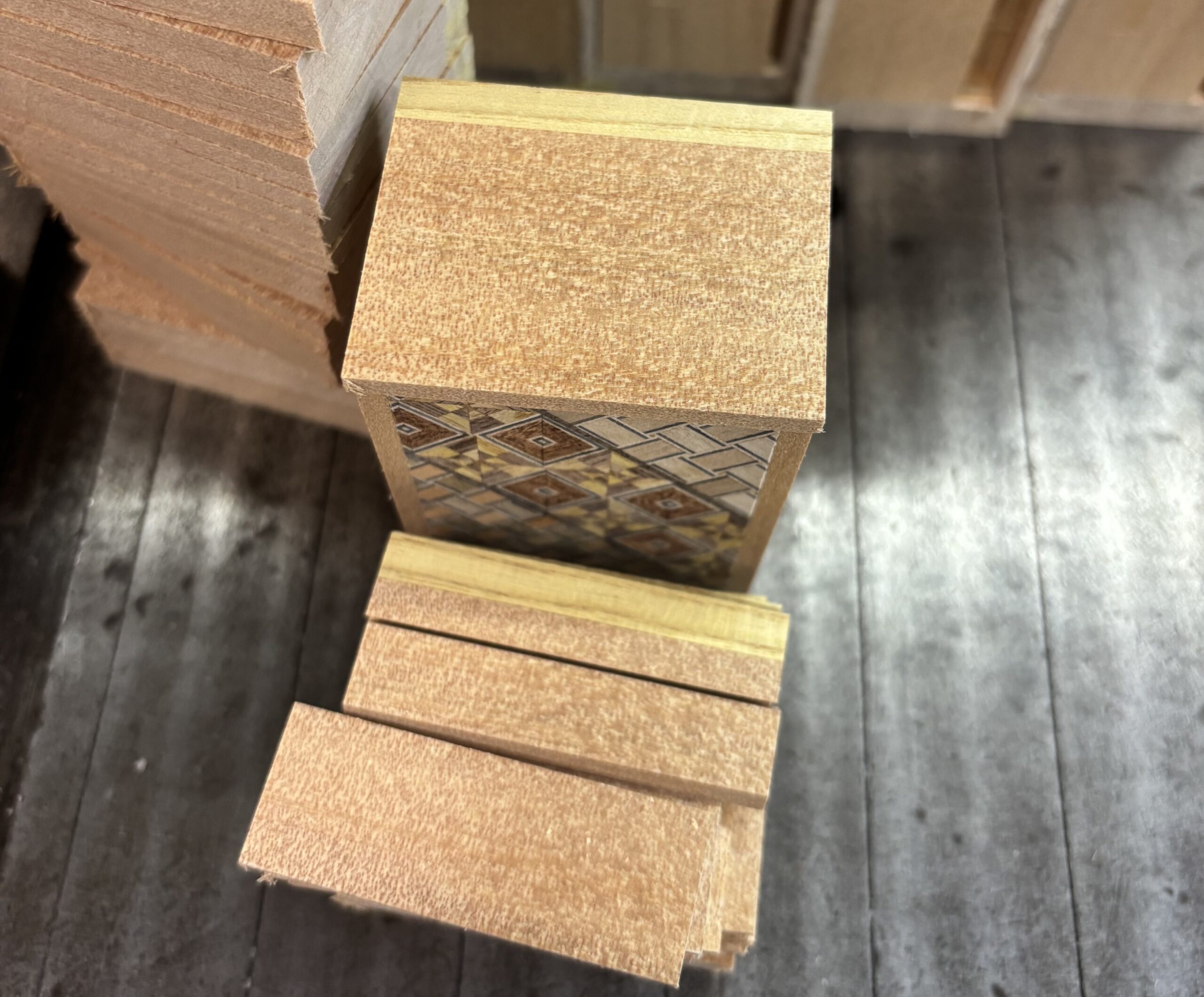
The photo shows the panel attachment process. This time, the panel is made from natural wood, with a strip of Urushi wood (the yellow line at the top) and Agathis wood. Agathis is the same material used for the main body of traditional Japanese puzzle boxes. The slide key panel before attachment can be seen at the bottom of the photo, while the panel has already been attached to the box in the foreground. As shown in the photo, this slide key panel is actually made up of three separate parts. Only the center part moves sideways, and this moving section is called the sliding key (Kannuki in Japanese). With natural wood panels like these, the sliding key does not stand out after attachment. As you can see on the finished box, the grain flows naturally across the panel, making the moving section blend in very well.
With puzzle boxes covered in yosegi panels, the slide key panel must be made from a single sheet of yosegi. Because of this, it is difficult to match the pattern perfectly across all three parts, and the position of the sliding key can often be guessed. This is one of the major advantages of natural wood slide key panels. The grain pattern blends more naturally, making the position of the sliding key much harder to detect. Darker woods are especially effective for this. For example, walnut is an excellent choice because it helps hide the sliding key even more.Natural wood panels also come with challenges, such as a greater tendency to warp and increased difficulty during processing. However, from a puzzle-making perspective, the advantage of making the sliding key less visible is a very significant one.
Besides this work, I also spent some time today planning the structure and selecting materials for the boxes I intend to make this month. According to my current plan, I will be making a 4-sun 4-compartment box this month. For the side panels, I am considering using a different color scheme instead of the usual four-color checkerboard yosegi pattern. I am still exploring the options, but I think it may give the box a fresh and distinctive appearance.