Today is Sunday, and like yesterday, it has been sunny since the morning—a lovely autumn day for an outing. November starts today, so there are only two months left in the year. As the end of the year approaches, I may get busy with personal commitments as well as work, but I hope to keep making boxes at my usual pace. As today is the first of the month, I sent out my monthly newsletter to subscribers. It covers last month’s production and my plans for November. You can sign up through my main website, japanesepuzzlebox.jp. Stock is a little low at the moment, but I plan to make and add several products to the shop during November.
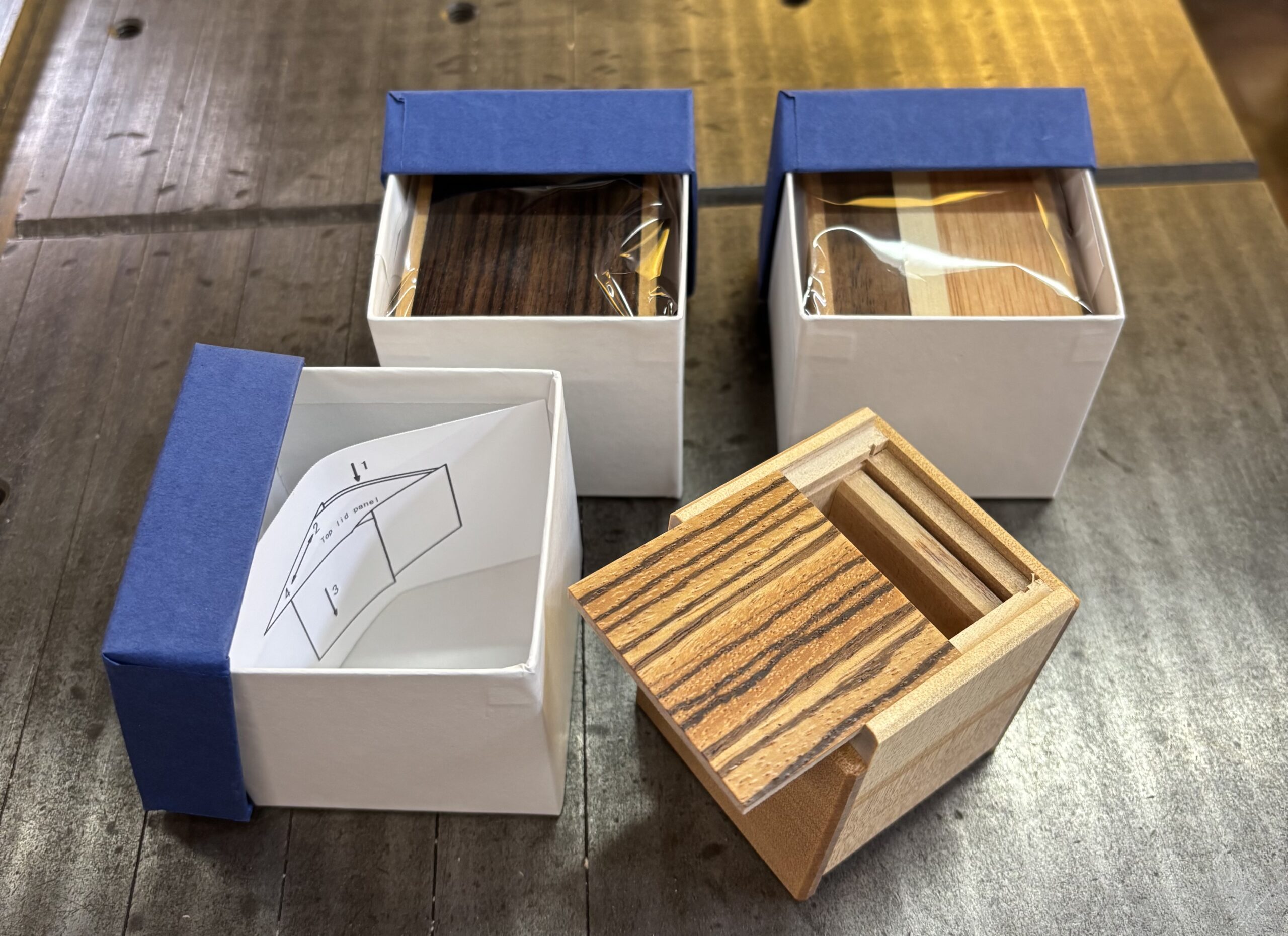
Yesterday, I needed some 4-step boxes, so I checked the movement of the 2-sun cube 4-steps puzzle boxes I had made earlier. I had not yet stamped my maker’s mark on them, so I did that while checking the panels. I originally made these boxes for the Japanese market, but that opportunity never came, so I had only been selling them online, like my other boxes. Now that they are needed, I have checked them again.
These boxes are small and open in just four steps, so they are relatively inexpensive to make. However, with shipping costs rising so much in recent years, it is difficult to keep the overall price low. With the high cost of overseas shipping, this box may not offer enough value to justify the shipping fee. Perhaps it is better suited to being sold in person.
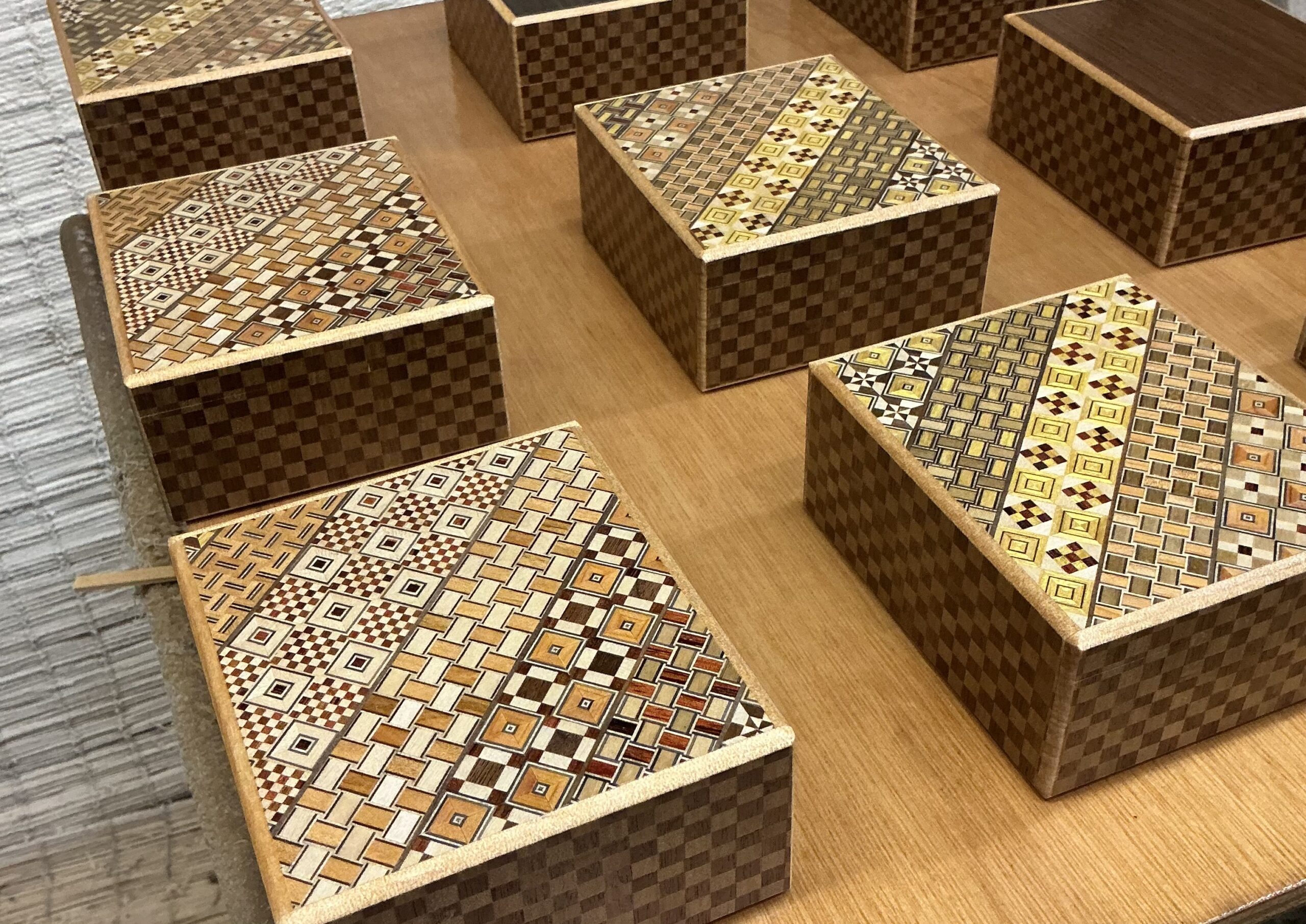
I do not make many 4-step puzzle boxes these days. In the past, I also made them in larger sizes, including 4-sun and 5-sun. One reason I make fewer now is that I can no longer produce as many boxes as I used to, but the main reason is the reduced supply of Yosegi sheets. With fewer sheets available, I prefer to use them for boxes with more steps, and customers also ask for those models. When I do make 4-step boxes now, they are often designs like this one, without traditional Yosegi.
You might think a 4-step puzzle box is easy to make because it has so few steps, but it is still a Japanese puzzle box, after all!..haha. There are a few things I need to pay careful attention to if I want the mechanism to move smoothly. The step that needs the most care is the first of the four moves. This box has no sliding key, so the side panel moves directly from the very first step. If it moves too freely, it might slide just from someone holding the box. Sometimes, a person accidentally pushes the panel while holding a corner and realizes, “Oh! This part moves!” Ideally, the panel should offer enough resistance that a light push will not move it. At the same time, it needs to slide smoothly for people with less finger strength, including children. Finding that balance is very important. When making these boxes, I fit the panel for the first move a little tighter than the others, then ease its movement slightly during the final adjustment. Various factors during production can change how tightly the panel moves, so I avoid adjusting it to the ideal resistance from the start.
Next is the movement of the panel in the third step. This panel moves out of the way so the top lid panel can slide open. It needs to move far enough for both the top Aruki panel and the decorative Yosegi panel to come out of the box, so it travels quite a long distance. In a box with a sliding key, this distance would usually be covered in several small moves. Here, the panel travels the whole distance in one move. I therefore need to adjust not only how much resistance it has, but also make sure it does not become harder to move partway through. With the top panel facing upward, this third-step panel slides downward. As it moves down, friction against the box frame can increase and make it harder to slide. I need to take this into account during production to prevent that friction from building up.
There is also a detail specific to the 4-step mechanism. Where the top Aruki panel joins the third-step Aruki panel, their upper edges need to be at exactly the same height. The projecting part of the top panel must also fit neatly into the groove in the third-step Aruki panel, without any play. This does not directly affect how much resistance the mechanism has, but it is an important sign of a well-made 4-step puzzle box. If this fit is not right, the panels may rattle before the box is opened, or they may not slide smoothly back into place afterward. Smooth movement when closing the box is just as important. I think difficulty returning the panels to their original positions is one reason customers sometimes become confused.