A new weekday in November started today. The mornings and evenings are now quite cool, and I need a jacket these days. It was cloudy this morning, and before long, it began to rain. It feels even colder when it rains. Since the rain had only just starte d, the humidity was still fairly low, so I took the opportunity to work on the Aruki sliding panels for the 5-sun puzzle boxes. These are 27-steps puzzle boxes, so there are more cuts to make in the stepped sections of the mechanism. I also need to prepare parts specifically for this mechanism.
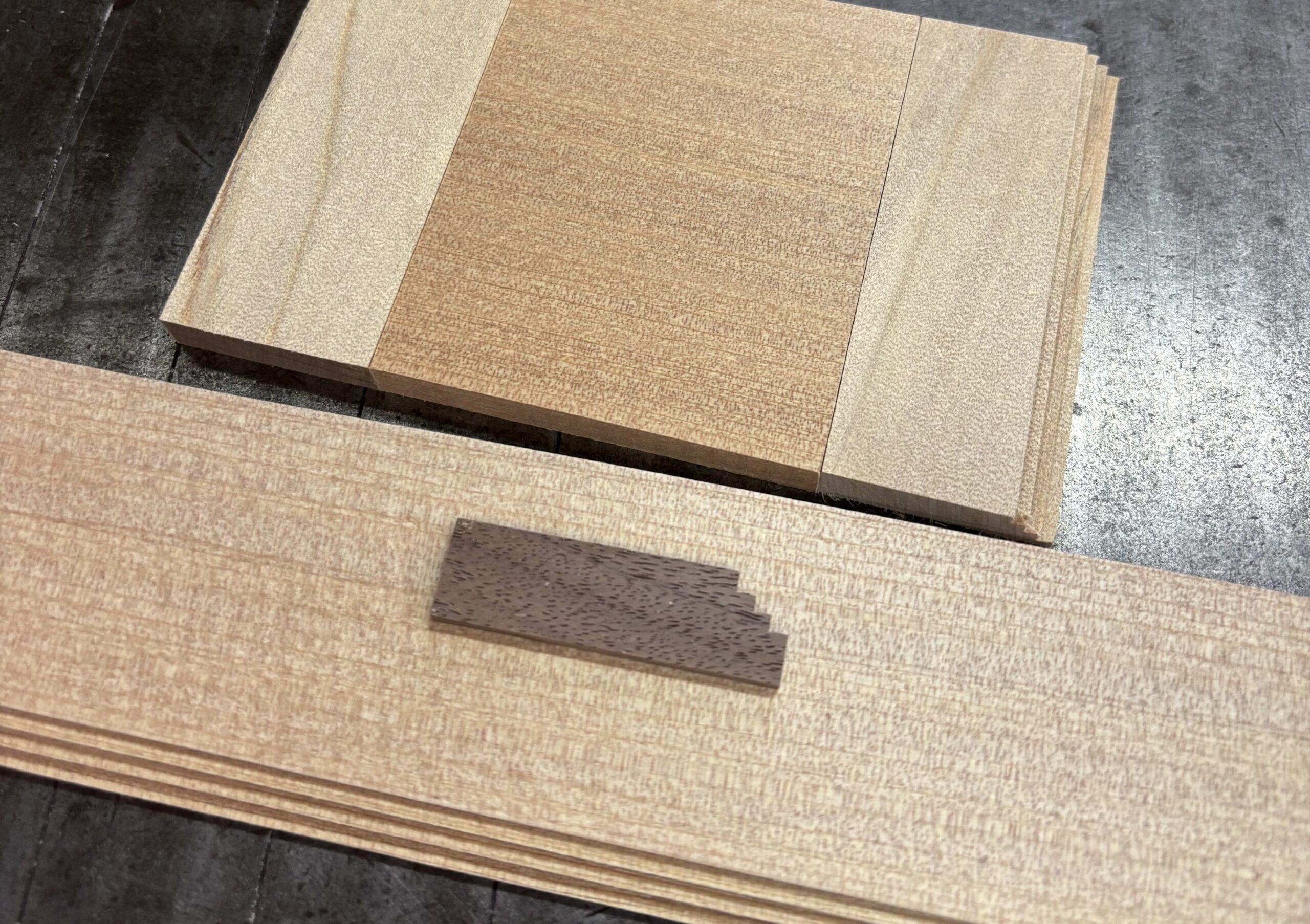
The photo shows the top and bottom Aruki panels, which receive a type of joinery called “hashibami.” Stepped notches have been cut into their ends. The small parts resting on the long panel are the internal parts that will be attached to the box’s axis panels. The panels below are the side Aruki panels, which also receive stepped notches. The stepped notches in the Aruki panels and the internal parts must work together smoothly. In particular, the notches in the side Aruki panels and the internal parts move during the same step, so neither should block the other. I need to make sure there is no situation where an internal part moves correctly, but a notch in the Aruki panel catches and prevents the movement.
However, making them move exactly together is quite difficult. Since I cut and assemble the parts by hand, small differences can occur. To allow for these differences, I give the internal parts priority when adjusting the movement. For example, if an internal part needs to move 1 mm, I give the side Aruki panel enough clearance to move about 1.1–1.2 mm. This allows the full 1 mm movement without either part catching too soon. However, I must not leave too much clearance in the Aruki panel’s notches. For example, allowing the Aruki panel to move 2 mm when the internal part moves only 1 mm would be too much. This could allow the mechanism to skip steps instead of following the correct sequence. The stepped notches in these three places therefore need to work together over the same distance. Rather than making every fit exactly the same, I leave just a little more clearance in the Aruki panels. Unlike something made entirely by machine, these boxes involve a lot of hand cutting and assembly, so making every part match perfectly is not possible. This small amount of clearance is necessary. Since the boxes are made entirely of wood, I also need to allow for shrinking and swelling. That is another reason for making them this way.