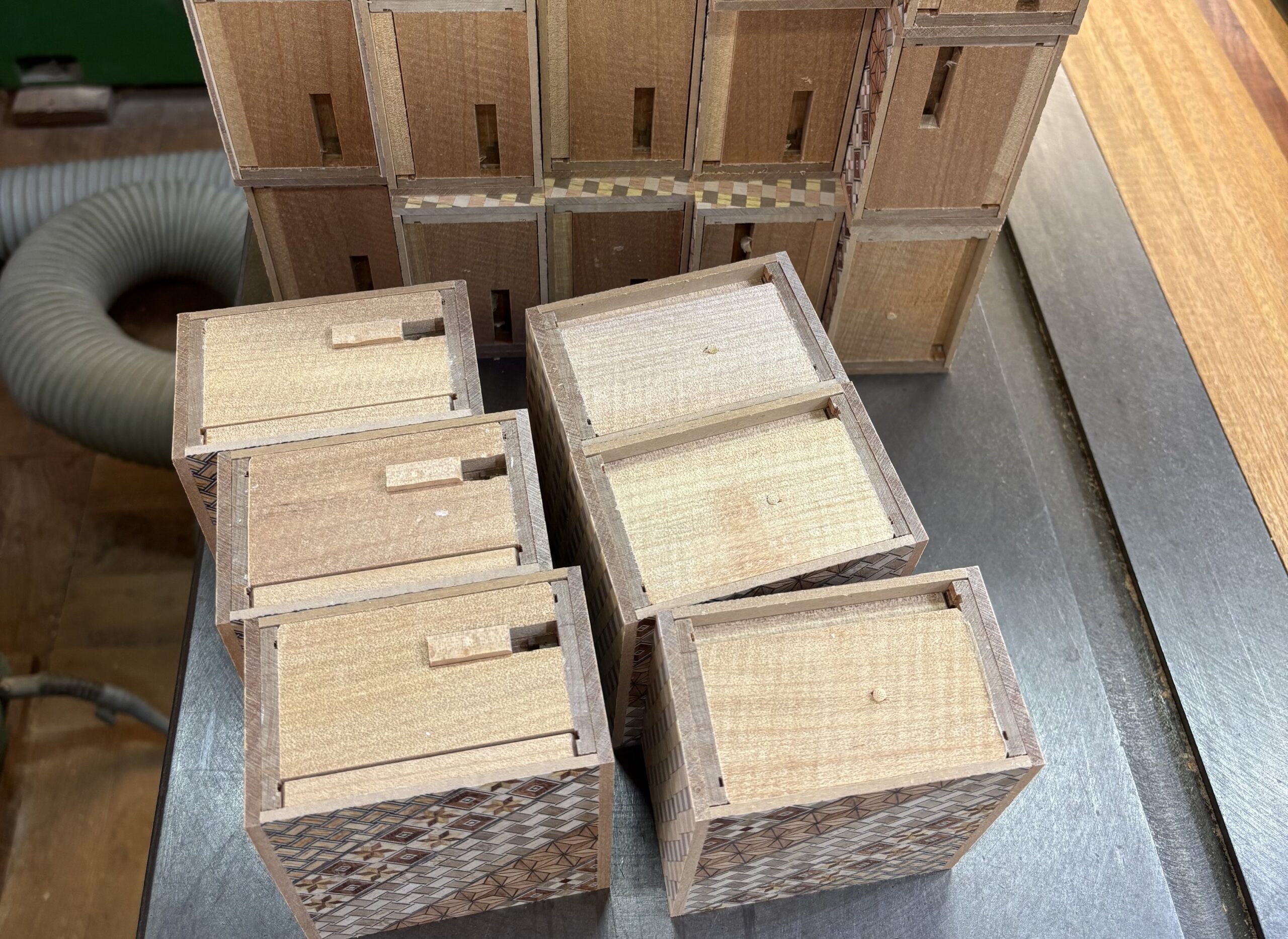
I arrived at the workshop a little later than usual today, but I still spent the day working as normal. It was sunny and quite warm. It would have been a good day to install the Aruki sliding panels for the custom puzzle boxes I worked on yesterday. Unfortunately, I had not finished attaching all of the internal parts yet. To make matters worse, I discovered that I was short of some parts halfway through the process, so I had to stop and make more before I could continue. Because of that, I did not get as far as installing the sliding panels today. Since these are high-step mechanisms, they require many parts, and each stage of the work takes time.
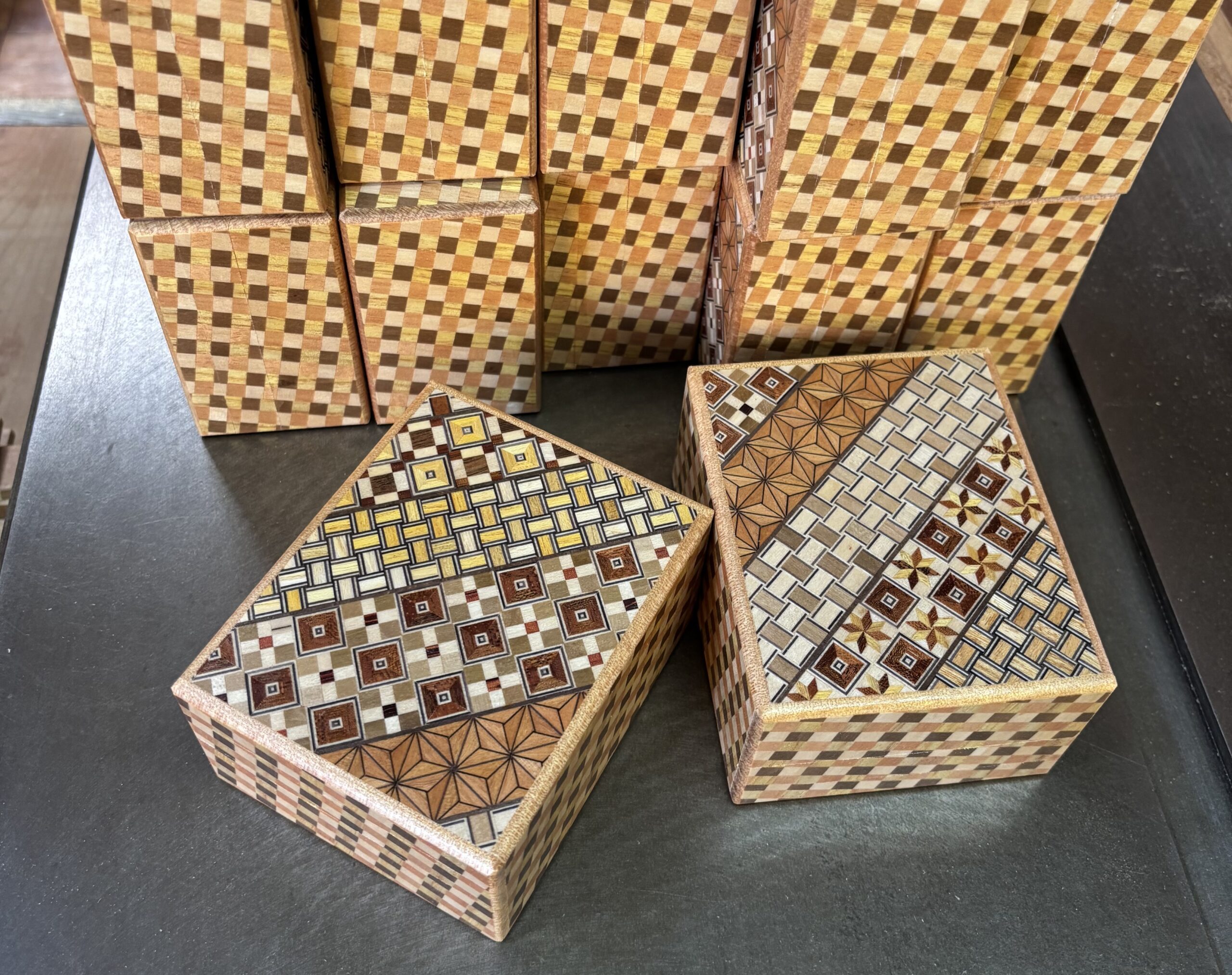
However, during the morning I worked on the finishing of the limited 11-step puzzle boxes that I completed assembling yesterday. In the afternoon, while taking breaks from attaching parts to the custom boxes, I also applied the undercoat finish. The gift boxes for these puzzle boxes will not be ready for about another week, so I plan to keep the boxes stored for now and complete the final finish in between my other projects. Once the undercoat has been applied, they are generally safe to store, but just to be sure, I have placed them in protective cases.
Related to these gift boxes, there was something I meant to write about the other day but never got around to. When making a new puzzle box design, there are several things that need to be considered. I would not really call them obstacles, since they depend on the environment in which each craftsman works, and for some makers they may not be an issue at all. The 11-step puzzle box I am currently making uses a mechanism and size that I have never combined before. When I first thought about making it, several things immediately came to mind. If I decide to use traditional yosegi, the size of the yosegi sheets becomes an important factor. Since the sheets are available only in certain sizes, the box must be designed to fit within those limits. For example, if I have a yosegi sheet that is 20 cm long, I can make one box that is 20 cm long, or I can cut the sheet in half and make two 10 cm boxes. If I were to make a box that is 7 cm long, I could only make two boxes, and the remaining 6 cm of yosegi would not be very useful. Because of this, one of the first things I consider is the size of the yosegi sheets and how they can be used most effectively.
The yosegi sheets I mentioned above are used for the top and bottom panels of the box, such as traditional yosegi patterns. The sheets used for the side panels may actually be even more restrictive. I often use checkered yosegi for the side panels, and the width of those sheets is always the same. They are about 6 cm wide, which happens to be just right for making the side panels of a 4-sun puzzle box. For that reason, I used the same checkered yosegi sheets for this project and made the box as tall as possible within the height normally used for a 4-sun box. If I wanted to make a 5-sun box instead, I would make a different set of yosegi sheets specifically for that size. Those sheets are about 7.5 cm wide.
The available wood is also a factor, although it is usually less restrictive. Since the pieces of wood I use are generally quite large, there is a fair amount of freedom when making small puzzle boxes. Even if I end up with a piece of agathis that is narrower than I need, I can often join pieces together and still use it. With other woods used for the outer parts of the box, such as ho wood or walnut wood, that is much more difficult to do. Because of that, those materials place greater limits on the possible dimensions and designs.
The final factor is the gift box. It may not seem directly related to the puzzle box itself, but depending on the production situation, it can impose quite a few limitations. Most gift boxes are made from paper, and there are workshops that specialize in making them. I usually order from one of several such workshops. In general, they do not particularly like small orders, so I normally order between 100 and 200 boxes at a time. That is more than I need at the moment, but I know I will use them eventually. There is a reason for this. In this area, the unit price is often the same whether I order one paper box or one hundred. Because of that, I usually design and produce puzzle boxes to fit the gift boxes I already have in stock, such as those for 3-sun, 4-sun, and 5-sun puzzle boxes. In other regions, things work differently. The limited 11-step puzzle boxes I am making now are a good example. I am making only 25 of them, and their dimensions do not fit any of my existing gift boxes. For this project, I asked a box maker in another region to produce the gift boxes. They are willing to make any quantity, whether it is one box, 25 boxes, or several hundred. Of course, a single box is expensive, 25 boxes are somewhat cheaper, and a few hundred boxes are much less expensive per piece. That makes it much easier to order exactly what I need, and the box maker is happy to take the job as well. I would like to make more Japanese puzzle boxes in the future without being constrained by these kinds of limitations.