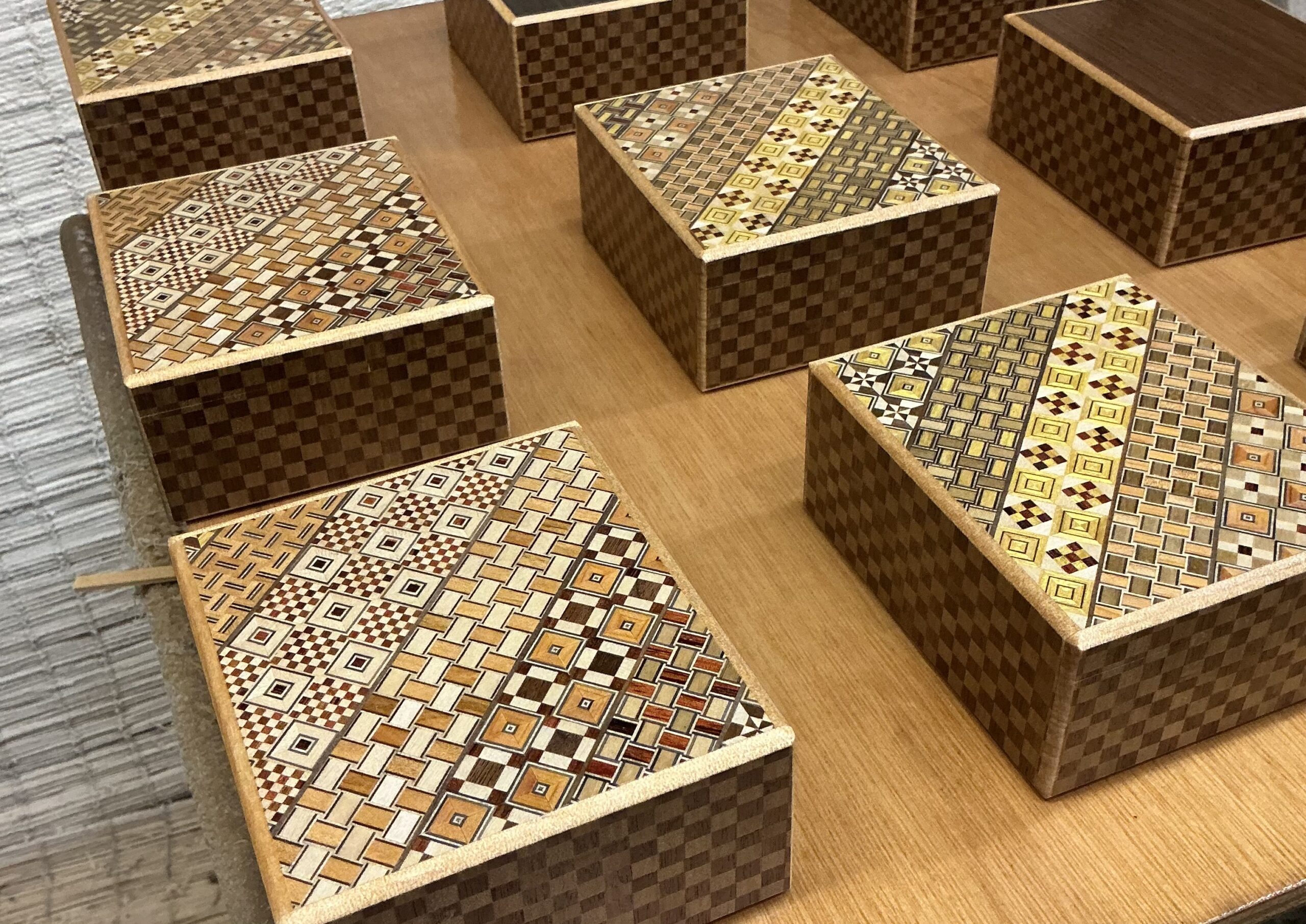
Today was sunny and dry from the morning. I spent a little time in the workshop this afternoon, tidying up and working on the Wide puzzle boxes. The only production work I did was the finishing work on these boxes. The dry air made me a little worried about the panels warping, but fortunately, the temperature was not very high, so they were fine. As I have written over the past few days, the sliding keys on these boxes warp and bend easily, making them difficult to handle. Now that I have applied the first coat, I can store them with a little less worry.
The photo shows the Wide puzzle boxes after the first coat. Coating Japanese puzzle boxes may be a little different from other woodwork. The aim is to protect the boxes and make them look beautiful, but I have to be careful not to go too far with either, as this can affect the movement of the mechanism. For many wooden items, building up a thicker coating is a common way to improve protection and appearance. With puzzle boxes, however, a thicker coating can make the moving parts stick together more firmly. There are different views on this, but some wood finishers also say that a thick coating can shrink over time, causing the box to contract or the panels to warp. In any case, I try to keep the coating as thin as possible, but making it too thin is not good either.
In the past, Japanese puzzle boxes were not coated with modern synthetic finishes. Instead, natural varnish or wax was applied by hand. A light finish like this is well suited to these boxes. Wax, in particular, may also help the mechanism move more smoothly as it works its way inside. However, as Japanese puzzle boxes began to be sold overseas, these light finishes were not always enough. Changes in climate could quickly cause the boxes to shrink and lead to problems. Makers therefore needed a coating that offered enough protection without affecting the mechanism. Spray painting turned out to be a useful solution. A spray gun applies the coating as a fine mist. This method is also used for cars and many other manufactured products. It allows many items to be coated efficiently and gives a beautiful finish. Another advantage is that less coating gets into the mechanism, so the moving parts do not stick together as firmly. Applying a finish with a cloth or brush tends to push more of it into the gaps inside the box. Spraying helps the coating stay on the surface, with less getting inside. Of course, it is still a liquid, so some does get in, but the mechanism is much easier to work with afterward. For my current boxes, I apply two coats: a first coat followed by a finishing coat. The coating is certainly thinner than on many other wooden products. I am always looking for the right balance—a beautiful finish that protects the box while allowing the mechanism to move smoothly.