It was a beautiful sunny day from the morning. It was certainly hot, but there was a nice breeze today. Some companies have already started their Obon holiday (summer vacation) today, but for most people, the holiday will run from the Japanese national holiday on August 11 (Mountain Day) through August 16.
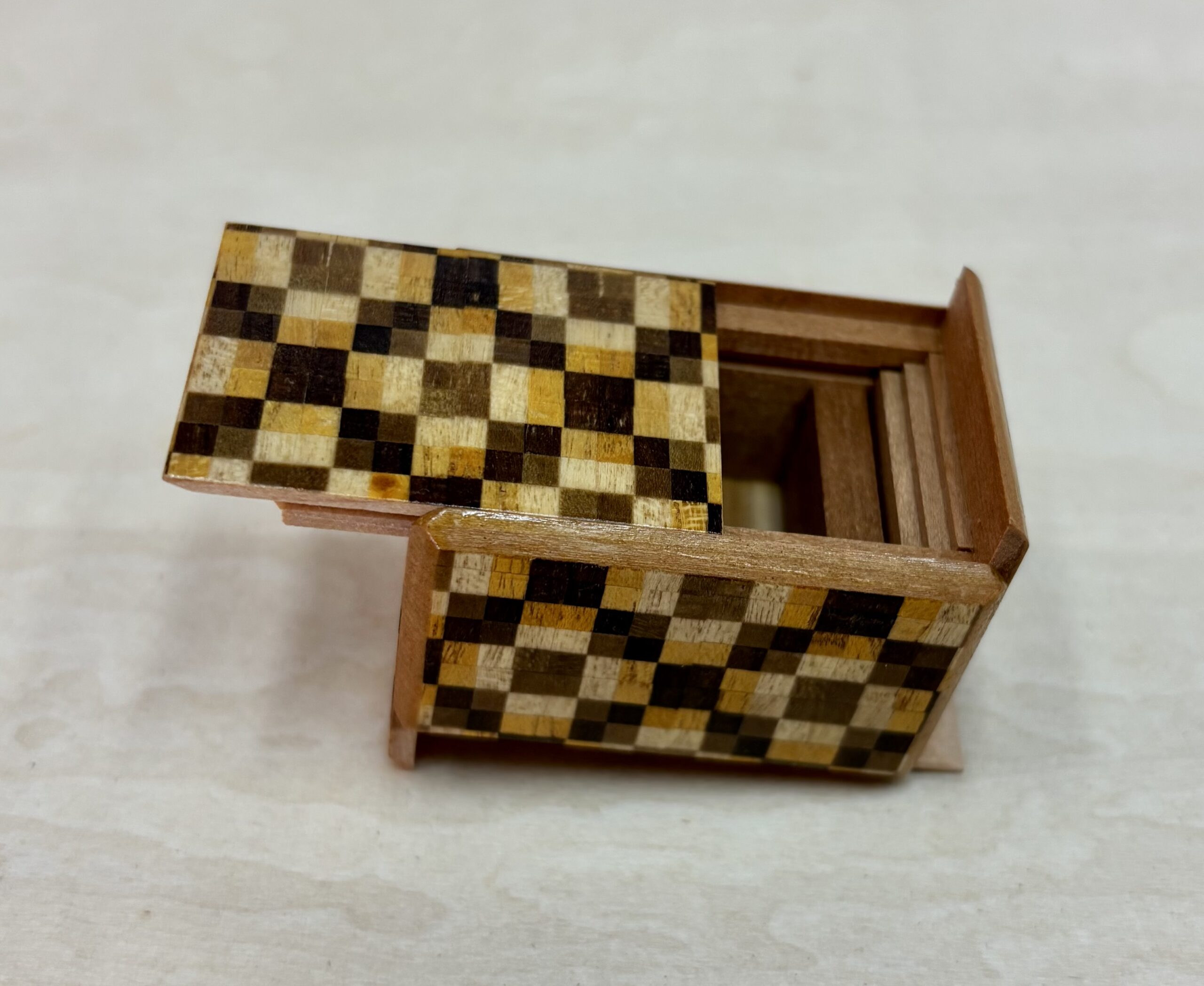
As I mentioned in my post on Tuesday, August 4, I would like to introduce a Mame puzzle box made by a master craftsman. The maker of this box was Yoshio Okiyama, who has sadly passed away in 2000. At that time, it seems that he produced many of the Mame puzzle boxes. Some were sold as fine craft pieces, while others were sold as ordinary Hakone souvenirs. Some of you may already know Mr. Okiyama. He specialized in making Japanese puzzle boxes and was truly deserving of the title of master craftsman. For him, it was simply the work he had been doing since he was young, but his skill was exceptional, and I believe he was an extraordinarily talented craftsman. In reality, making a highly precise Japanese puzzle box requires many small details to come together perfectly, and for some craftsmen, it can remain difficult even after many years of experience. In addition to his technical skill, I believe he also had a natural talent and an exceptional sense for this kind of work.
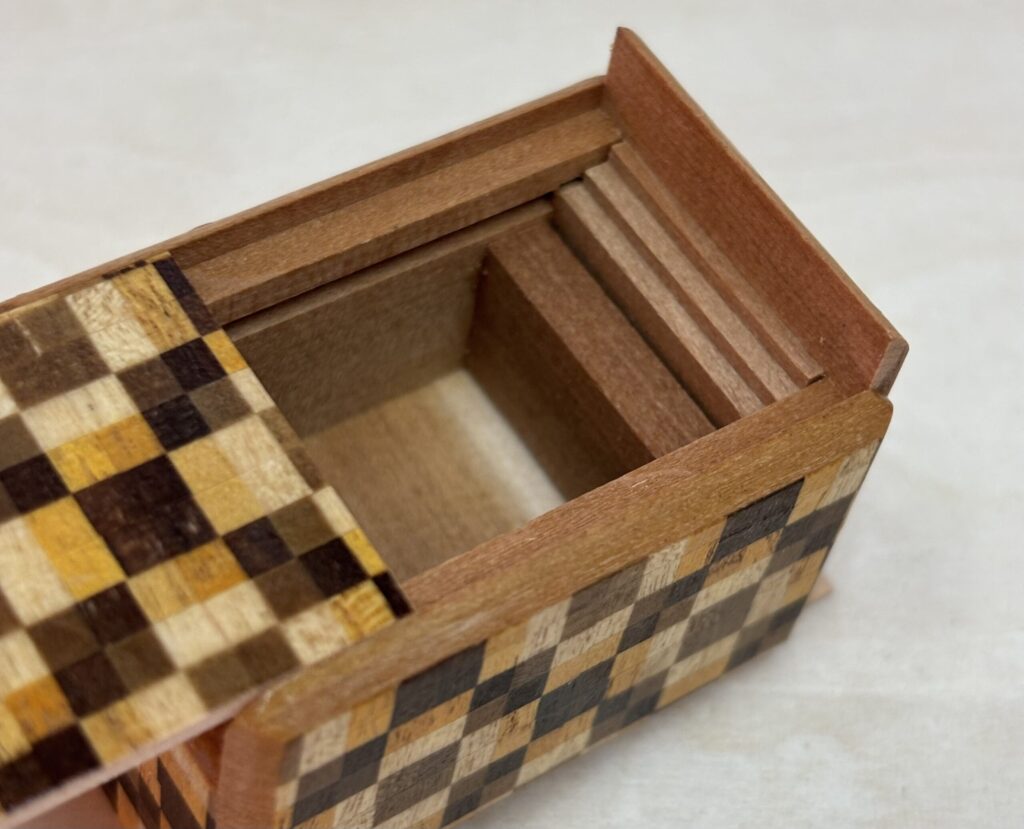
The first thing I notice is that the box is made from Katsura wood. Of course, many Japanese puzzle boxes from that period were made from Katsura, which gives the box a very light feel. It has a soft, almost weightless quality, and that is reflected in its smooth movement, giving it the simple charm that is so characteristic of traditional Japanese puzzle boxes. Long ago, these boxes were probably made entirely by hand, but by the time Mr. Okiyama was making them, the work was most likely done using a combination of machines and hand tools, much as it is today. People often say that modern woodworking machines are more accurate, but in reality, few workshops use the latest equipment. Most of my own machines are also several decades old. However, the machines available when he was a young craftsman were less precise than those I use today. Their cuts were rougher, and the dimensions were not as accurate, so after machining the parts, they had to be carefully finished by hand using chisels and hand planes. For example, I do not use a hand plane at all when making my Mame puzzle boxes, but craftsmen of his generation relied on those tools to achieve their remarkable precision. Craftsmen of that era often said that the quality of a finished puzzle box reflected how well they had set up and sharpened their hand planes, and this box is a perfect example of that. Like the Agathis I use today, Katsura is a soft wood that chips easily. To machine such tiny parts successfully, the plane blade had to be exceptionally sharp, and the tool itself had to be adjusted with great precision.
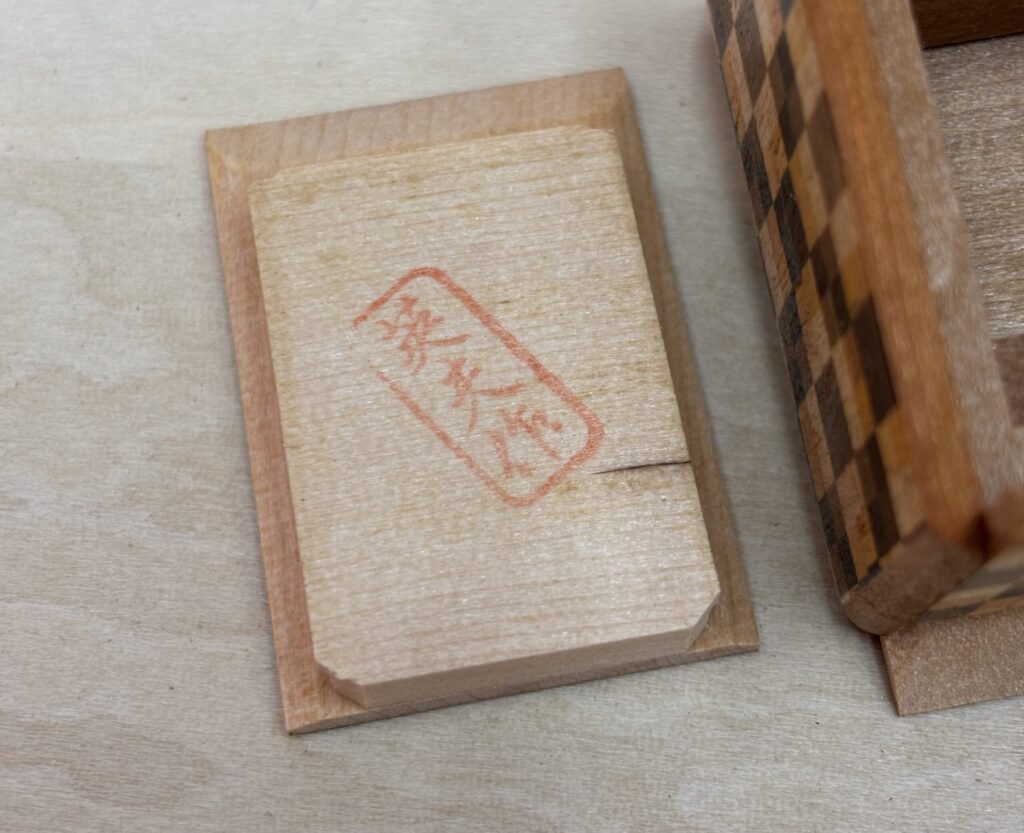
Unlike most Japanese puzzle boxes, Mame puzzle boxes do not use sliding keys. Instead, the mechanism works only by sliding the panels. Those panels are designed to stop partway through their travel. If all four panels could slide completely out, the box would simply come apart. To prevent this, the grooves that guide the panels are intentionally cut only part of the way, so the panels stop at the correct position. The stopping point must match the stepped mechanism inside the box precisely, otherwise the mechanism cannot move to the correct position. What is truly remarkable about Mr. Okiyama’s box is how smoothly the panels move. Every step has exactly the same feel and resistance. That may sound ordinary, but in most Mame puzzle boxes, the mechanism gradually becomes stiffer as you progress through the solution. To reduce this problem in my own work, I had a special cutter custom-made for machining the panel grooves. Even so, I have not been able to eliminate it completely. I believe the difference comes from whether the final adjustments are made by hand. No matter how much machine accuracy improves, it is difficult to match the results of careful hand finishing. However, with today’s production methods, finishing every single part by hand would be extremely difficult, both in terms of cost and the level of skill required. For that reason, I believe this Mame puzzle box will continue to be regarded as one of the legendary masterpieces. As proof that it was made by him, his personal seal is stamped on the underside of the lid. It reads “Made by Yoshio”. This is only part of my thoughts on the subject, but if I have the opportunity, I would like to continue and write more about his other Mame puzzle boxes as well.