It seems that some people have already started their Obon holiday yesterday. I noticed that there were more cars than usual heading toward popular tourist areas such as Hakone and Izu. However, I think most people will work one more day tomorrow before their holiday begins on August 11.
There was also a large summer festival in the town next to my workshop yesterday, and it looked very lively. I went last year, but not this year. As the summers become hotter every year, it is becoming difficult to spend time outside, not only during the day but even at night. I went in the evening last year, but it was still quite hot, so I decided to skip it this time.
One of the highlights of the festival is “Yosakoi”, a style of Japanese group dance. Teams of dancers perform original choreographed routines, and competitions are held all over Japan. At this festival, the performances begin during the day, and the winning teams are announced in the evening. I watched the competition last year. There are many food and drink stalls, so you can enjoy the performances while eating. Of course, everyone dances in the heat, but I was surprised to see not only young people but also many people around my age taking part!…😅
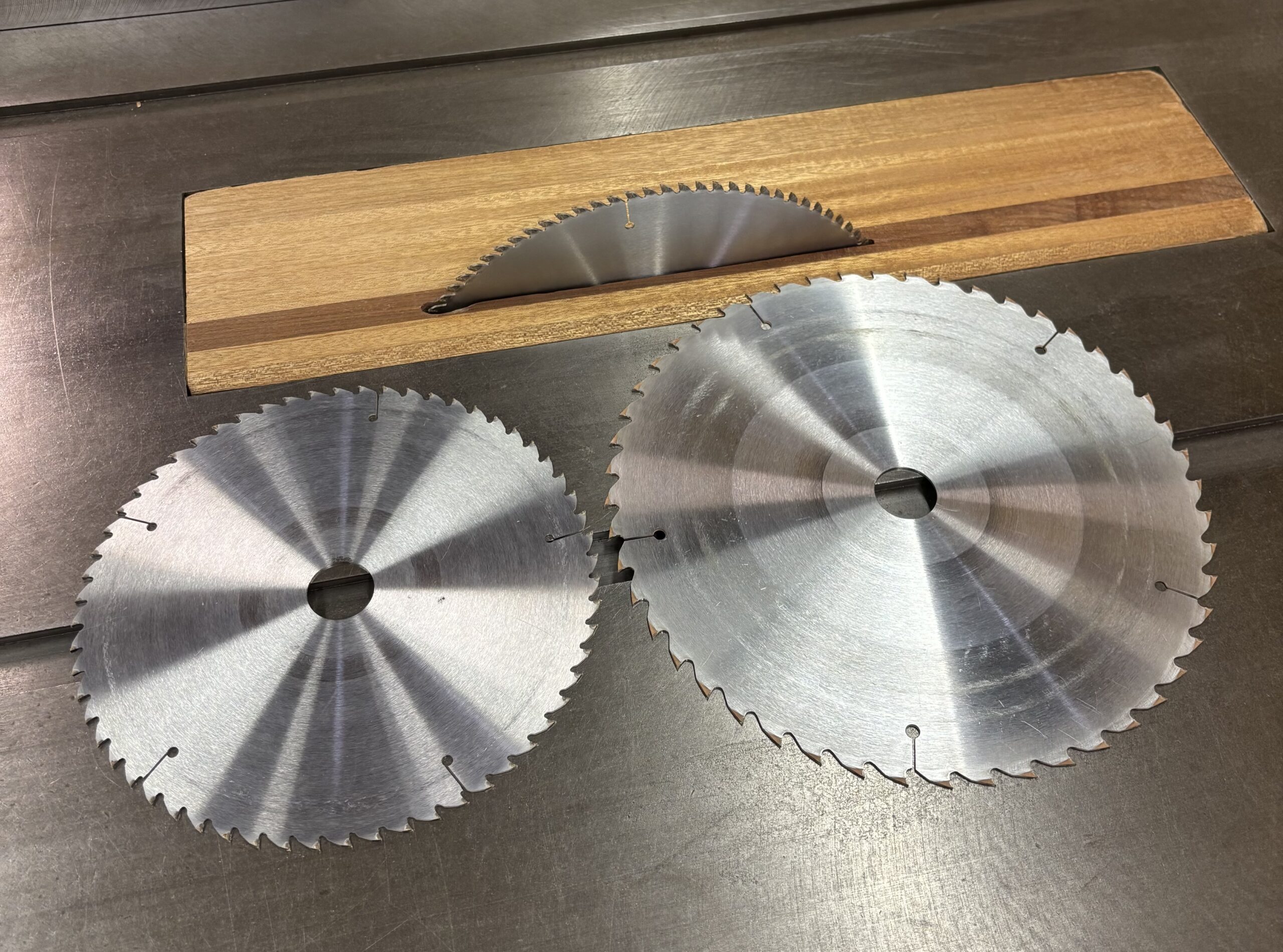
The photo shows one of the cutting tools that I normally use to make Japanese puzzle boxes. It is used for cutting wood—basically, it is a saw blade. I also use many other types of cutters, including ones for shaping curved edges and machining grooves. They come in a wide range of widths and thicknesses, depending on the job. After being used for a while, these saw blades gradually become dull. When that happens, they can be sharpened and used again. Small hand tools such as chisels and hand planes can be sharpened by hand with whetstones, but more complex cutting tools like these, which are used on machines, require specialized sharpening equipment. They cannot realistically be sharpened by hand.
Because of this, there are companies that specialize in sharpening woodworking tools. One of them visits my workshop every two weeks. I give them the blades that have become dull, and when they return on their next visit, they bring them back freshly sharpened. As the number of woodworking shops has declined, these sharpening companies have also become fewer. There are no longer any nearby, so the company that visits me now comes from the neighboring prefecture. The previous company also came from a different neighboring prefecture. They told me that they even travel to workshops nearly 300 kilometers away. It might actually be faster to send the blades by mail! 🤣 But they need to cover such a wide area to keep enough customers.
Every time one of these blades is sharpened, it becomes a little smaller. For that reason, after being sharpened about five to ten times, it is usually discarded. Some types can be rebuilt by replacing only the cutting edge, allowing them to be used again. Although the sharpening itself is done with specialized machines, the quality still depends on the skill of the company doing the work. Personally, I feel that the company I used in the past produced a sharper edge that cut better. Unfortunately, that company closed a few years ago because the owner retired and had no successor. The difference in skill is especially noticeable with the blades used for a bandsaw. It is often said that there are fewer highly skilled bandsaw blade sharpeners than there used to be. This seems to be another example of how times are changing and traditional skills are gradually disappearing.