Perhaps because of the typhoon and the autumn rain front, it has been raining since this morning. According to this morning’s news, the typhoon is expected to come closest to our area around Thursday, so the rainy weather will likely continue for a while. Although the amount of rainfall has varied, it has apparently rained to some extent every day for more than 30 days, making this an unusually rainy year.
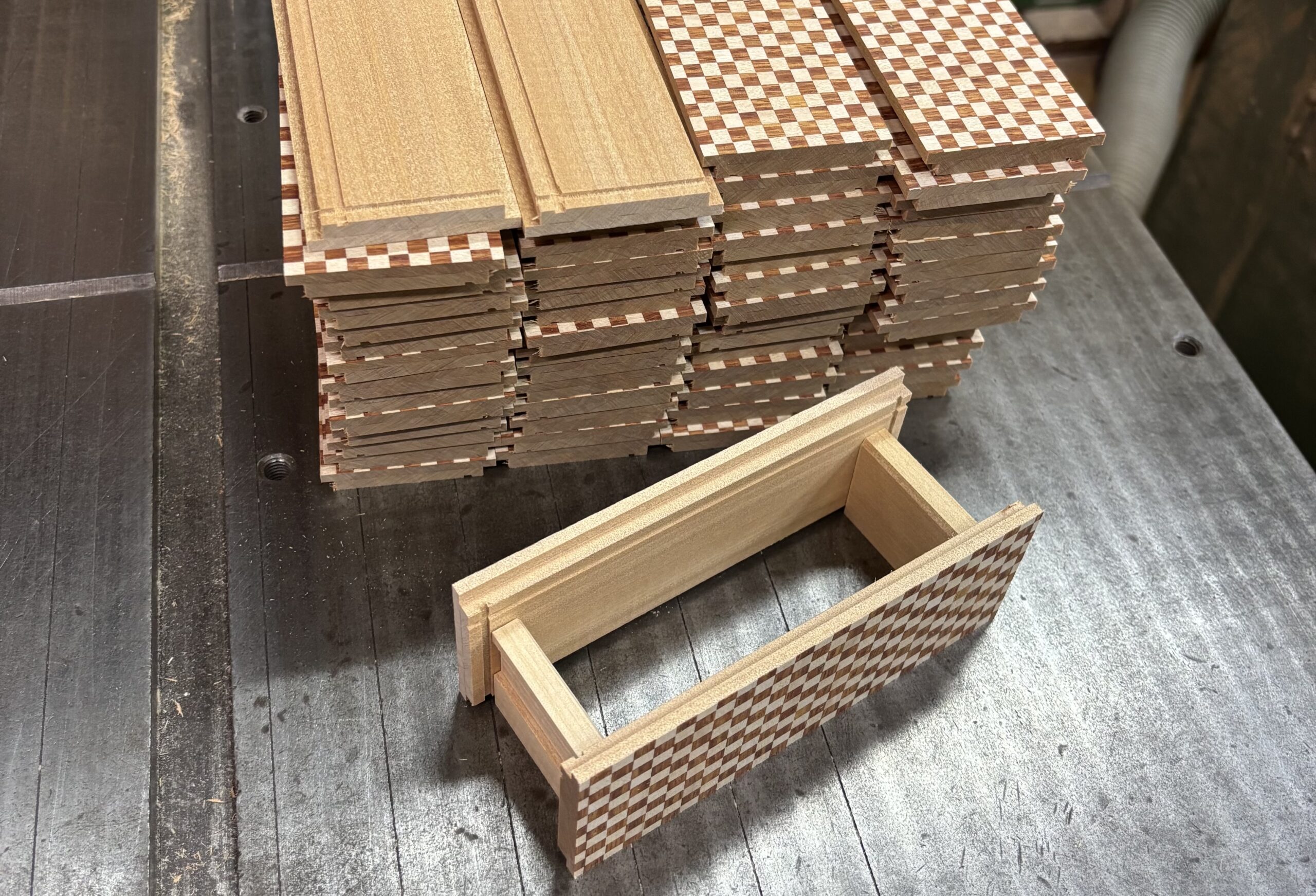
This morning, I continued working on the slightly slimmer puzzle boxes that I wrote about yesterday. Today, I made and assembled the frames. I also made some additional mechanism parts, as I did not have enough for this production run. These parts are frequently used for my 12-step and 14-step puzzle boxes, and three main types are required. Today, I made two of those types. I usually make extra parts and keep them in stock so that I have enough for several production runs. This box is slightly different in size from my usual boxes. As I wrote yesterday, its dimensions combine certain elements of my 3-sun, 4-sun, and 5-sun boxes. Making a box like this takes more time than usual. Although it has the same 14-step mechanism that I normally use, its non-standard dimensions require me to prepare new materials, jigs, and tools for production. To reuse as many existing materials as possible, I made the side panels the same size as those of my 4-sun boxes and will use the same yosegi sheets. However, I still need to prepare various other tools specifically for this box. This helps explain why so many Japanese puzzle boxes on the market are made in similar standard sizes: standardization makes production much more efficient.
Today, I also made a new discovery. When there is a problem with the movement of a puzzle box after it has been completed, there are several possible ways to correct it. As I wrote yesterday, replacing a slide-key panel is a last resort and is almost like rebuilding part of the box. This time, a box that had been stored for a while developed a small problem, and its movement became rather stiff. I could have removed the outer panel and readjusted the movement of the inner sliding panel, as I did yesterday. However, I discovered a new way to make the adjustment without removing it. Of course, this method will not work in every situation, but it is effective under conditions like these, and I am pleased to have learned another useful technique. I believe discoveries like this can only come from continuous trial and error. It reminded me once again of the importance of continuing to make boxes day by day.