A new week has begun, but it started with rain. Autumn is usually a rainy season, but we seem to be having even more rain than usual this year. The recent heavy rain caused flooding in some areas, so I hope the typhoon coming this week will not cause any serious damage. The high humidity may have made today a good day for the final finishing work. However, if the humidity is too high, the boxes can absorb moisture while I am working, so I needed to finish the work quickly.
This morning, I worked on the final finishing of the 4-sun 14-step puzzle boxes. I rounded the corners, smoothed the edges, and sanded the surfaces. After this, the boxes will move on to the base coating process. At the same time, I also replaced a sliding key panel on the 3-sun 12-step puzzle boxes. I did these jobs together because I could apply the base coat to both types of boxes at the same time. The replacement panels are still unfinished natural wood, so the replaced areas need another base coat. The final topcoat will then be applied to the entire box again. After a puzzle box is completed, I carefully check its movement. Sometimes I find a sliding key panel whose movement I really want to improve. In most cases, I can adjust it without replacing the panel. However, if the movement is extremely stiff, I may decide to replace it. I prefer not to replace panels because it takes a great deal of time and care. First, I must remove the panel without damaging the box. The removed panel cannot be used again, so I need to attach a new one. This time, I still had some new panels left, so I was able to do the work immediately. If no panels are left, I have to keep the box until I make the same model again. Sometimes it may need to wait for a long time, which is another reason I try to avoid replacing panels whenever possible.
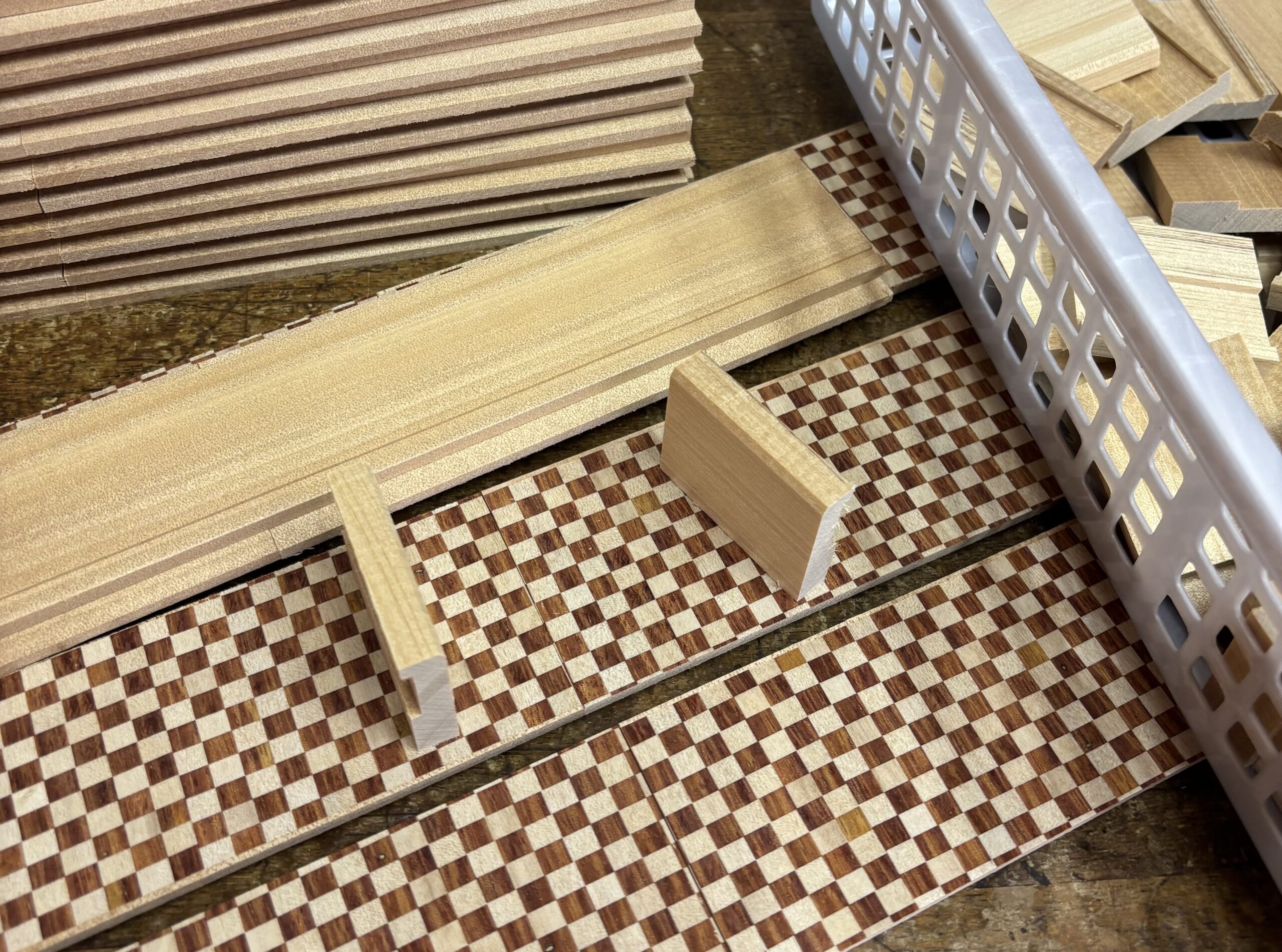
After that, I started working on puzzle boxes for the Hakone market. This time, I am making the boxes to fit some remaining Yosegi panels, so they will have slightly unusual dimensions. The length will be similar to a 5-sun puzzle box, while the width will be about the same as a 3-sun puzzle box. This will make the box long and narrow. Although this shape is a little difficult to make, I decided to use the same height as a 4-sun puzzle box. It seems to be a mixture of all three sizes! 😁 As shown in the photo, I will use the red-and-white two-color checkered Yosegi that I prepared recently for the side panels. Because of this, the height needs to be the same as a 4-sun puzzle box. The thickness of the Aruki sliding panels and the size of the mechanism will also be the same as those used in a 4-sun box. I have also decided to make about two extra boxes for my own stock at the same time. I cannot use the same Yosegi as the boxes for the Hakone market, so I plan to use something different for the top and bottom panels. I will look for some suitable materials left in my workshop. If I cannot find anything, I will probably use a random-grain design.