Today marks the start of another week. Over the past few days, the weather has been mostly cloudy or rainy. Yesterday, it was officially announced that our region has entered the rainy season. In Japan, the start of the rainy season is announced each year by the Japan Meteorological Agency. We will probably have more rainy days for a while. The humidity will also be higher, which may make puzzle box making a little more difficult. However, rainy seasons can vary from year to year. Last year, for example, there was relatively little rain. So it is hard to know what this year’s rainy season will be like.
The rain from yesterday continued into the morning, so the humidity was fairly high today. Although the weather cleared up a bit in the afternoon, I felt it was probably best to avoid detailed work. Instead, I checked the mechanisms of the 2.5-sun puzzle boxes that were completed yesterday and also prepared yosegi sheets and backing boards for other projects. This month, I am currently working on two different types of puzzle boxes. At the same time, or possibly a little later, I have decided to start preparing materials for a small batch of additional puzzle boxes as well.I still have some leftover yosegi sheets from a puzzle box I made previously, so I plan to make the boxes to match those sheets. I am also considering making the mechanism move a little differently than usual, although I have not made a final decision yet. For the design, I plan to use the remaining traditional yosegi sheets along with my usual four-color checkered pattern. When people read that, most will probably assume that I am simply making another traditional yosegi puzzle box. However, there is one major difference with this project. This time, I am making the puzzle boxes to match the remaining yosegi sheets. Normally, I do not work this way. In the past, I occasionally made limited runs of puzzle boxes that were different from my standard designs, but I have not done that very often in recent years. Even when I create a slightly unusual design, I usually make it in my standard formats, such as the square style or the usual 3-sun, 4-sun, or 5-sun sizes. There is a reason for this. This is a bit of a long story, so I will write about it another time..haha. So this time I plan to make a puzzle box that is a little outside my usual specifications. However, the leftover yosegi sheets happen to be about the same size as those used for a 4-sun puzzle box, so the final size will probably not be very different from a standard 4-sun box after all…
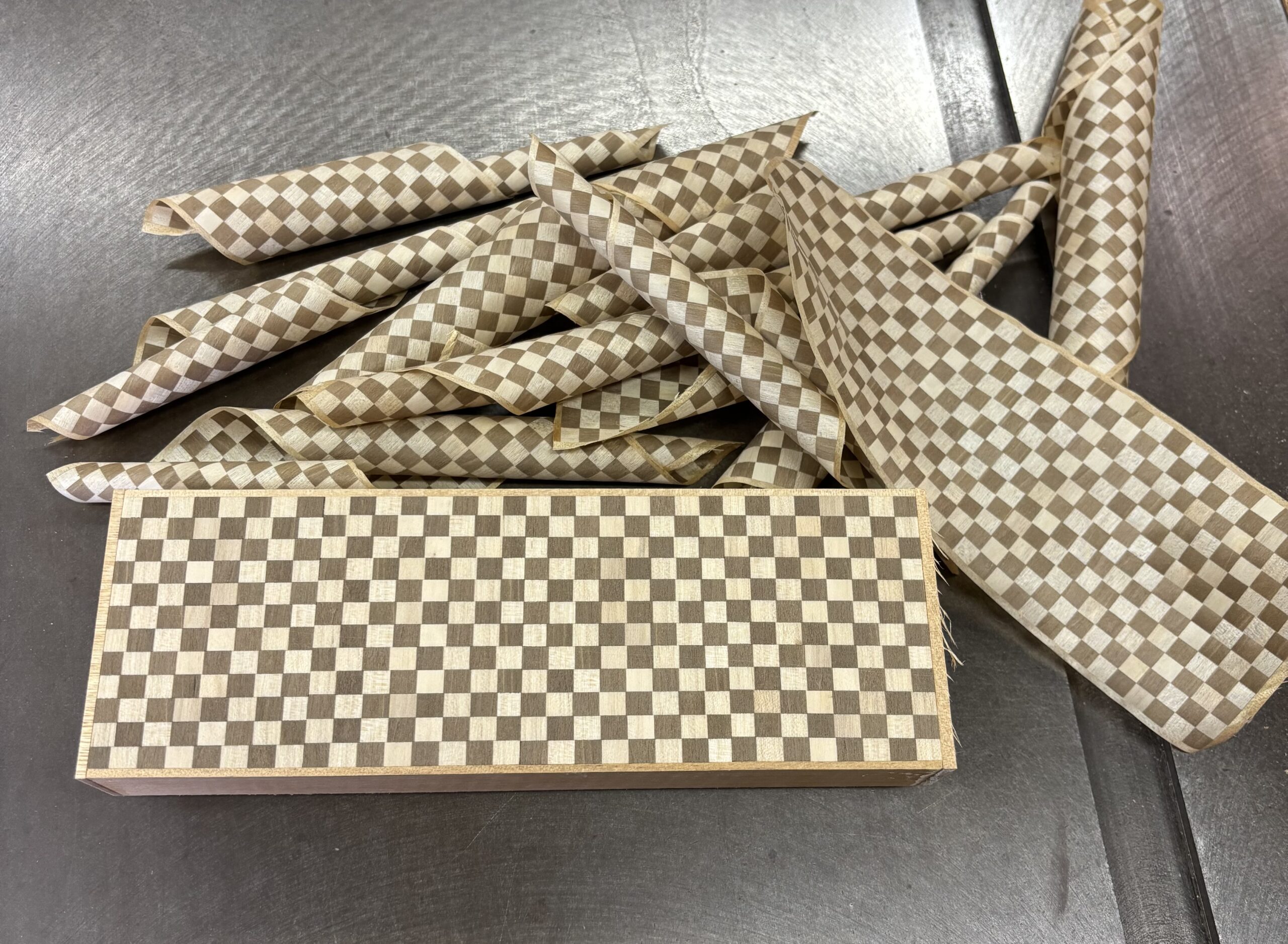
Later in the evening, I sliced the two-color checkered yosegi that I had been working on. It is generally better to slice a yosegi block sooner rather than later after it has been assembled, as the wood will gradually begin to lose moisture if it is left for too long. This time, I decided to make the sheets a little smaller and use two sheets for each puzzle box, just as I did last time. Smaller blocks are easier to work with when stretching the yosegi sheets. With larger sheets, there is a greater risk that they may tear while being stretched. After a yosegi sheet is sliced, it tends to curl naturally, so it needs to be flattened and stretched before it can be used. In this case, however, the woods are mizuki and hobo, both of which are relatively soft and easy to work with. Because of that, the sheets are easier to stretch and handle. I have already prepared the backing boards, so if everything goes well, I plan to glue the sheets onto them tomorrow. This checkered yosegi will be used for the 4-sun 4-compartment puzzle boxes.