The weather now feels completely like autumn, and it does not look like the temperature will rise very much today either. The cloudy skies are still continuing. Since the beginning of this month, most places do not seem very busy on weekends. There also seem to be fewer cars on the expressways. This is usually a quiet time of year at many tourist spots. One reason is that the summer holidays have ended, but another is that Silver Week, a series of national holidays, is coming up next weekend. This is a five-day holiday, including the weekend. In Japan, autumn is considered a popular season for sightseeing and day trips, so many tourist destinations are probably looking forward to the holiday.
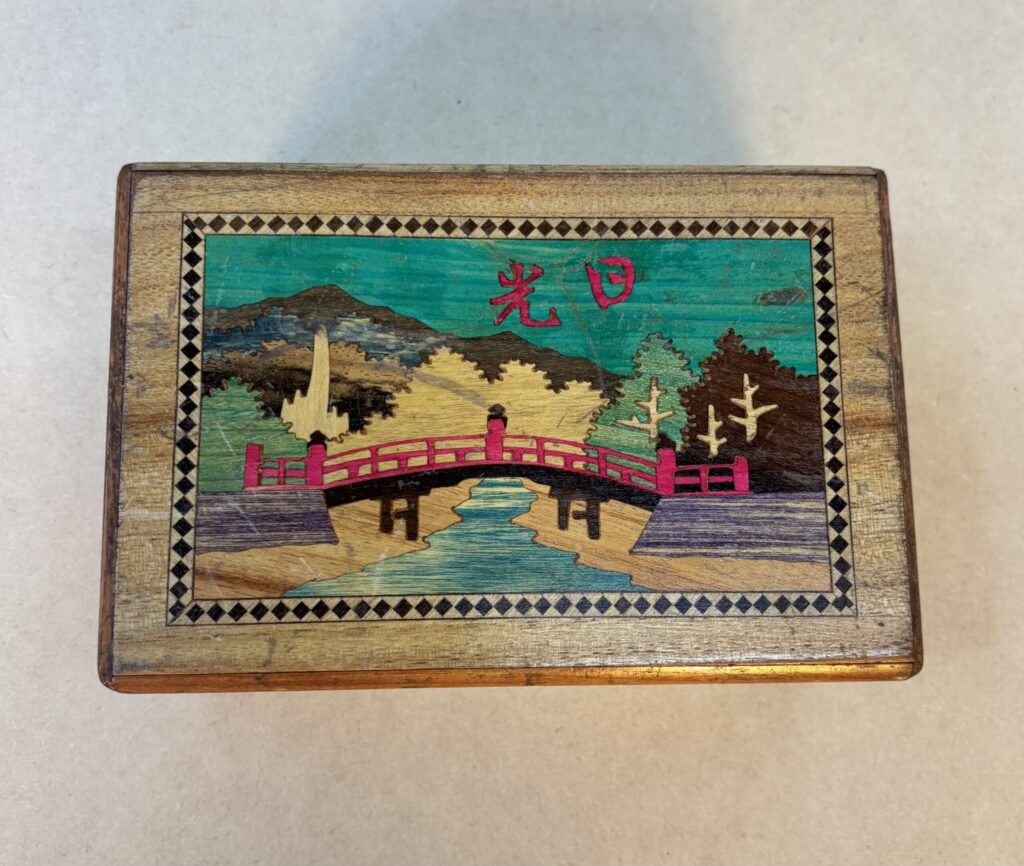
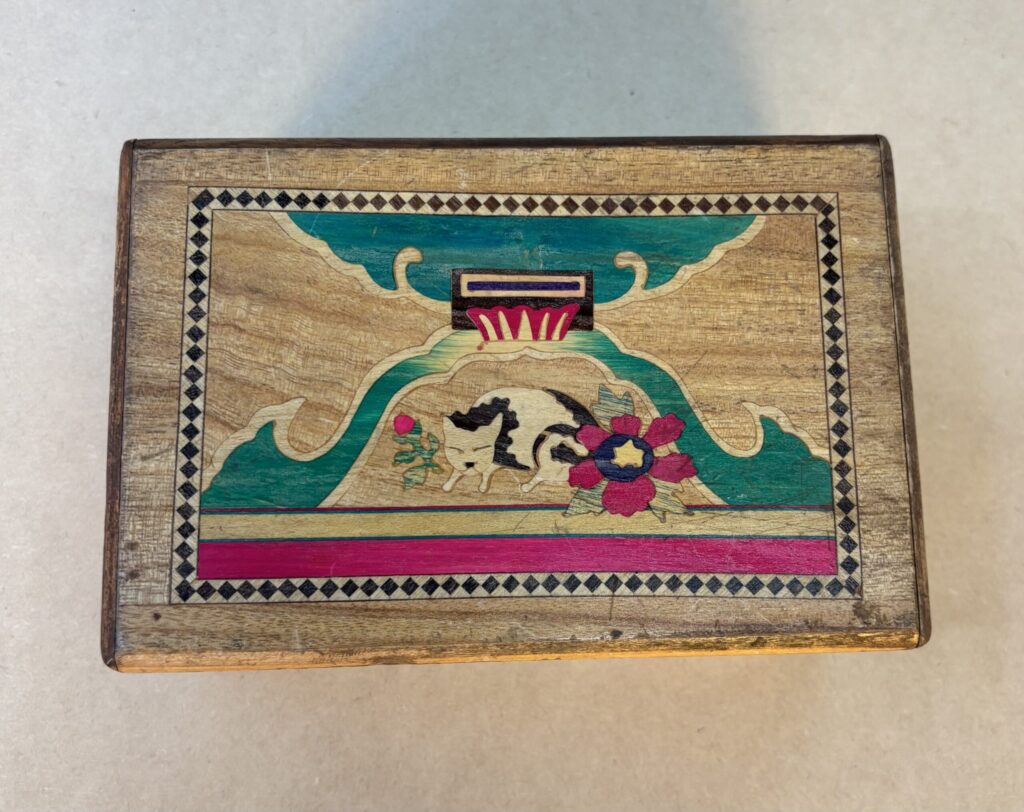
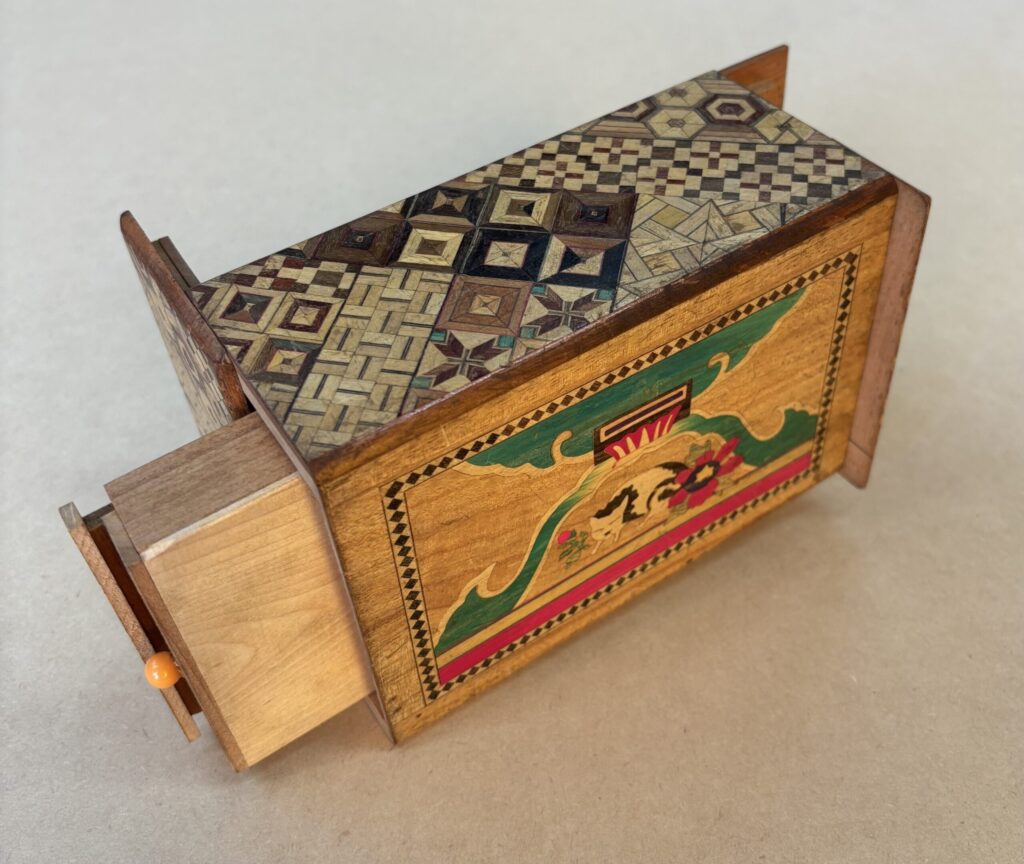
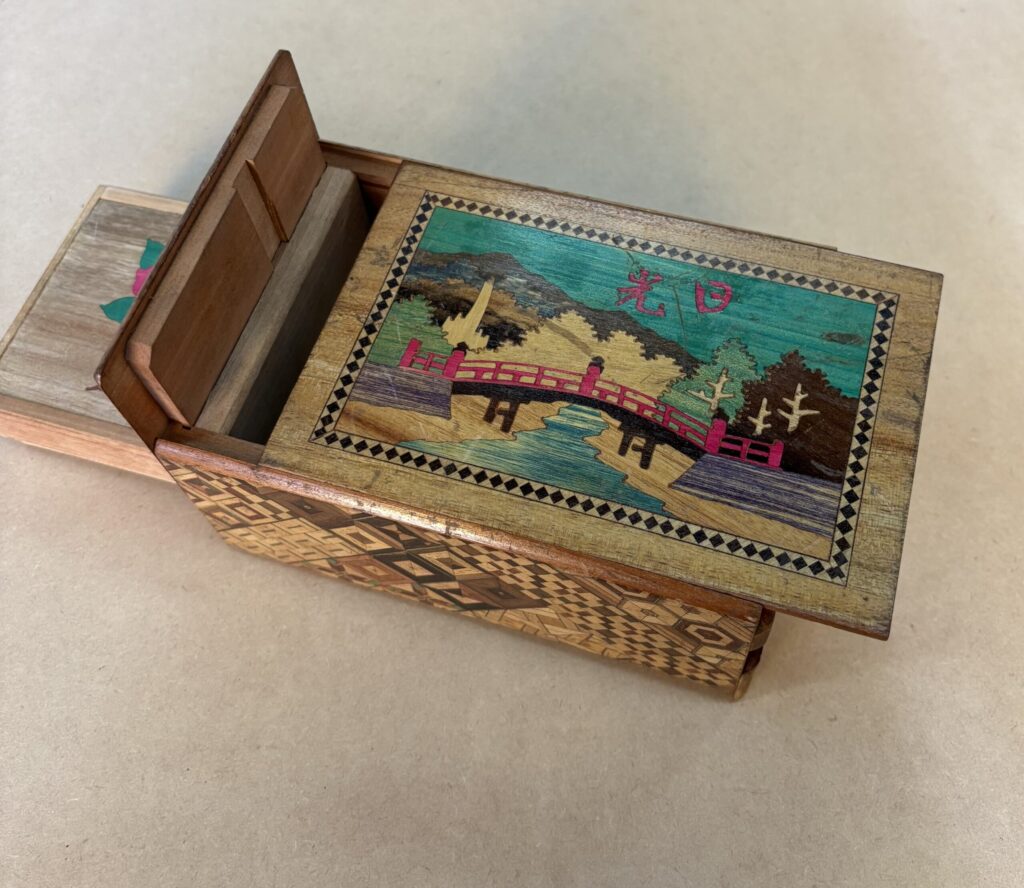
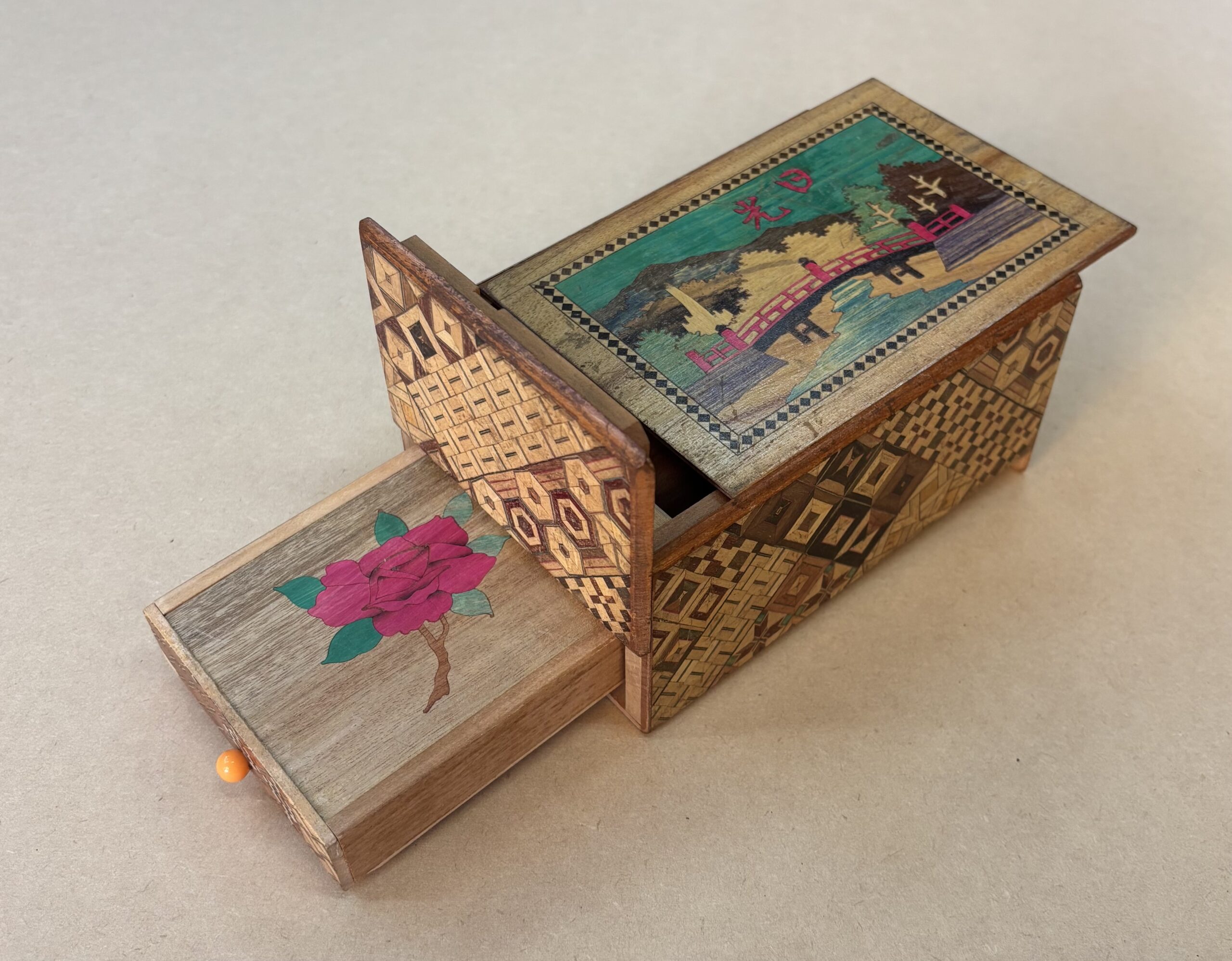
Today, I would like to introduce an old puzzle box. This is the familiar 5-sun 10-step puzzle box with a drawer, but its design is a little unusual. This box was probably not sold in Hakone. I think it was made for sale in Nikko, a famous tourist destination in Tochigi Prefecture. The front has a wood inlay design showing Nikko’s well-known bridge among the mountains. The word “Nikko” is also carefully made with wood inlay above it. It is quite common to see the name printed on souvenirs, but it is unusual to see it properly made with wood inlay like this. This box was probably made especially for sale in Nikko. The design on the back is also wonderful. It shows the famous “Sleeping Cat” carving and peony flowers at Nikko Toshogu Shrine, one of the best-known symbols of Nikko, recreated in wood inlay. Nikko is a very popular sightseeing destination, including among visitors from overseas. Nikko Toshogu Shrine, which honors Tokugawa Ieyasu, is also a common destination for school trips in our area. I visited it myself when I was twelve years old and in the sixth grade of elementary school. The wood inlay uses pink and blue colored wood, giving the box a very bright and beautiful appearance.
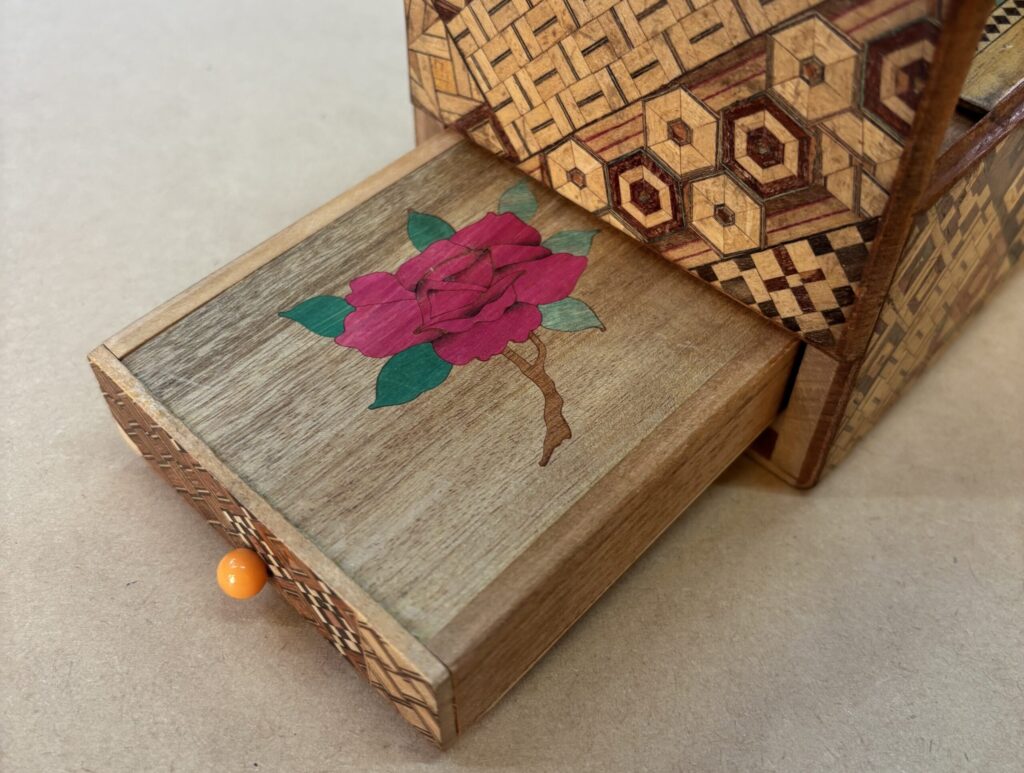
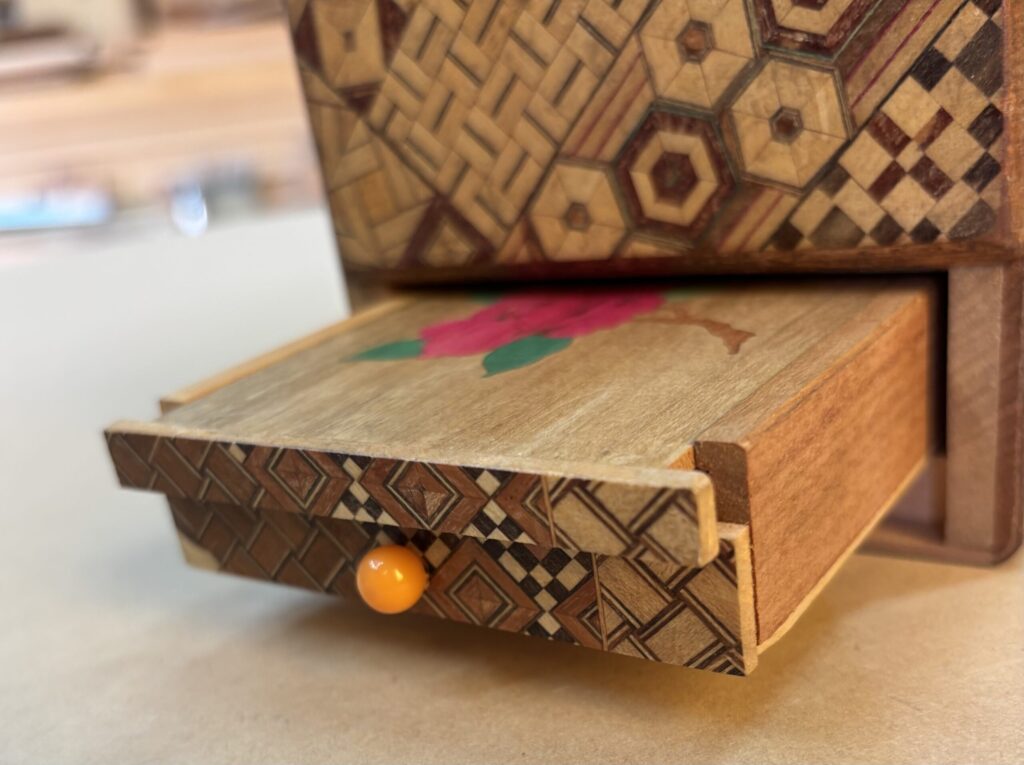
Traditional Ko-Yosegi is used on the side panels of the box and also on the front of the drawer. As with the familiar version, it makes a sound using piano wire. However, instead of the usual bird wood inlay, the top of the drawer has a flower design—perhaps a peony or camellia. One detail that especially caught my attention was the Yosegi on the front of the drawer. A single sheet of Yosegi was carefully divided between the upper part and the main body of the drawer, allowing the pattern to continue across both parts. This is a surprisingly detailed and time-consuming piece of work. Normally, Yosegi is attached only to the main body of the drawer and not to the upper part, so I was surprised to see this. This is quite a time-consuming process. It might be understandable for the main body of the box, but most craftsmen would probably not think of doing the same work on such a small drawer. With that in mind, although this has the usual 5-sun mechanism with a drawer, the decoration and careful construction show how much effort the maker put into it. It seems to have been made as a special souvenir for sale in Nikko, with great attention given to both its design and quality.
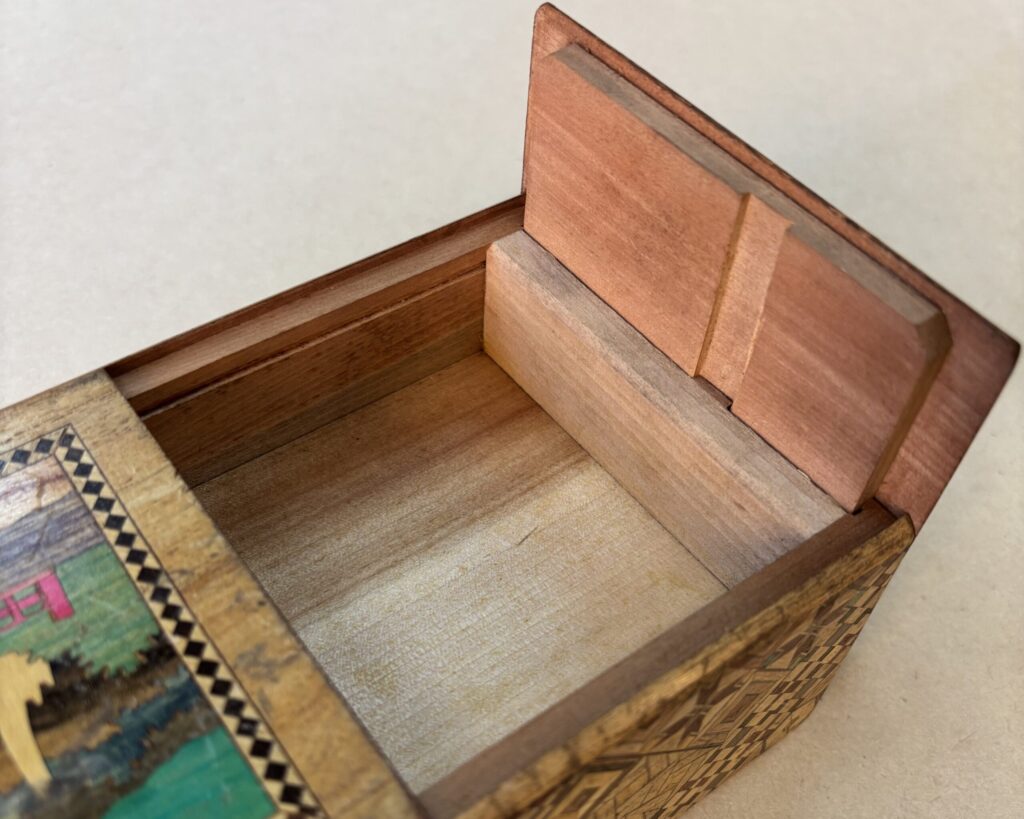
When I received this box, the person who gave it to me did not know how to open the mechanism, so it seems that they had never checked what was inside. Like many other puzzle boxes from this period, the movement had become quite stiff. Without knowing the correct opening sequence, there was a risk of damaging the box. When I carefully opened it, I found several of the original owner’s pay slips inside. They had probably been stored—or perhaps hidden—there. The dates on the papers were from Showa 30, which is 1955. This tells us that the box is at least about 70 years old.
The mechanism is very well made and shows how much care the craftsman put into the work. Its construction follows the standard style of that period. The panel stopper structure, the sound-making drawer, its round plastic handle, and the use of high-quality Katsura wood are all typical features of the time. The sliding key is also slightly narrower than those used today. For some reason, more craftsmen now make their sliding keys much wider than they were in the past. However, when I look at this old box, I feel that the narrower shape gives it a more refined appearance. As I mentioned in last week’s blog, the edges of the axis panels are rounded. This was probably done with a hand plane rather than a machine, giving the box a gentle shape and the simple warmth of handmade work. Finally, I will list the outside dimensions and weight of this box.
Outside dimensions: 155 × 103 × 68 mm (about 6.1 × 4.1 × 2.7 inches)
Weight: 320 g (about 0.71 lb)