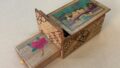
The autumn rain front, which brought heavy rain to many parts of Japan, seems to have passed its peak for now. It was still raining a little this morning, but it stopped around noon. However, the sky remained cloudy throughout the day. Since September began, I have had many requests to make in time for Christmas, but this rain has made it difficult to keep the work moving as planned. Autumn brings fresh air and comfortable weather, but it is also a difficult season because we often have long periods of rain like this.
However, yesterday evening I took advantage of the rainy weather and sliced some Ichimatsu Yosegi sheets. It is the usual two-color checkered pattern, but this time I tried using white and red. The red wood is Rengas, so some parts have a deep red color, while others are more yellowish—or perhaps orange. The part I used this time was not bright red, but I think its softer color has its own charm. I plan to use these sheets for the side panels of some boxes requested for the Japanese market. There will still be plenty left over, so I will probably use them for some of my own boxes as well. I hope to show them here another time.
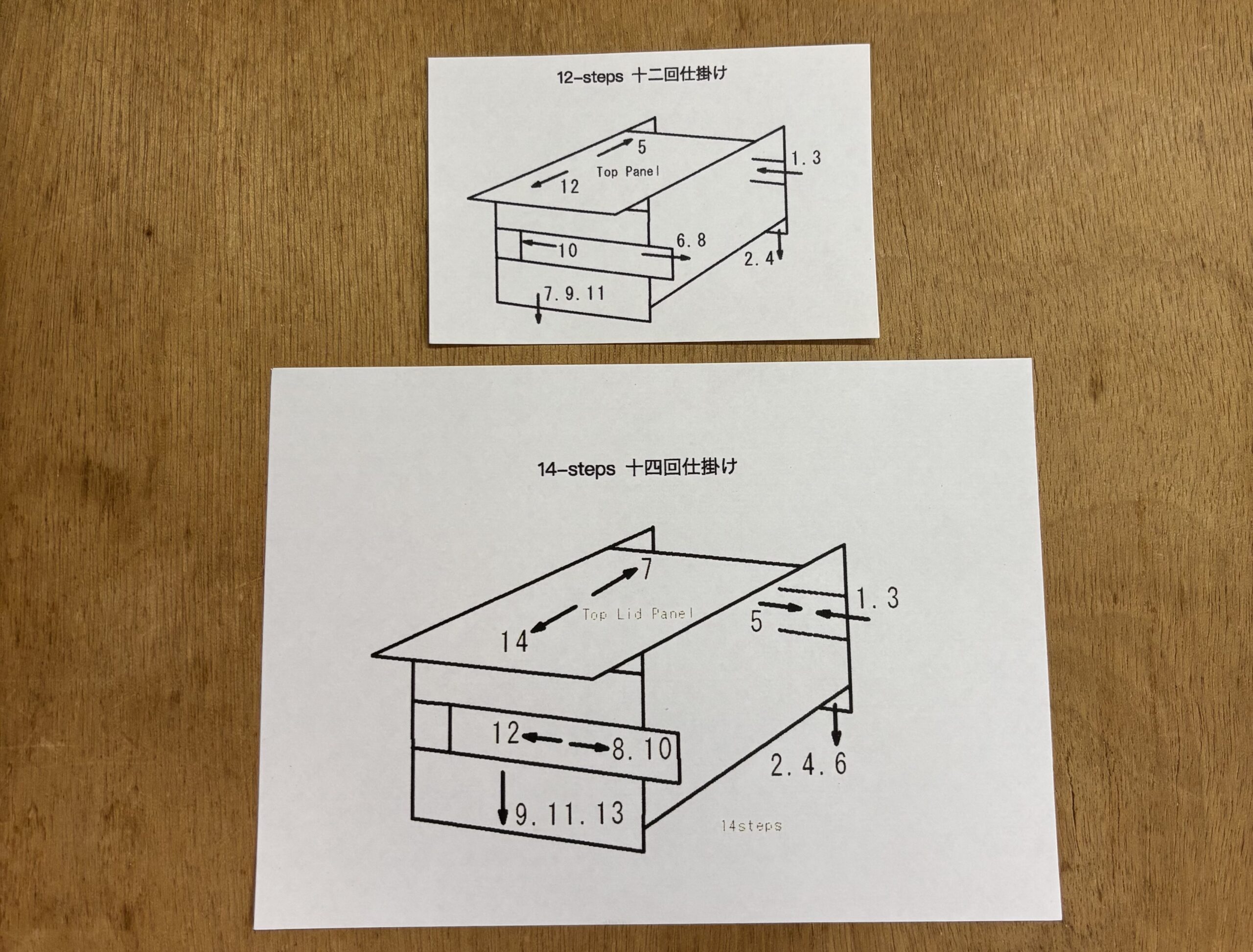
Recently, I made a small change to my instruction sheets. The printed information inside is almost the same, but I changed the type of paper. Over the years, I have used different paper sizes for the opening diagrams depending on the type of puzzle box. For example, I used Japanese business card-sized cards for the 3-sun and 4-sun boxes, and A6-sized cards for the 5-sun boxes. I have now decided to print all of them on regular A4 copy paper instead. In fact, I used this kind of paper until about ten years ago, but over time I gradually changed the paper to match the size of each box.
Along with this change, I have also decided to replace the A6-sized card that I include with each order. This card introduces my workshop and Japanese puzzle boxes, but from now on, I will print it on thinner copy paper as well. Since the paper will be larger, I should be able to include more information than before. The old A6 cards were quite small, so adding too much information meant that the text also had to be small. I was worried that this might be difficult to read for people like me, whose eyesight is not as good as it used to be! 🤣 From now on, I plan to make the text a little larger, so the instructions should be easier to read. Recently, I have mainly used copy paper for printing DHL and postal shipping labels, but it looks like I will be using it for more things again. There are many different grades of copy paper. Cheaper paper is often not a very clean white and can also be quite thin, so I plan to use a slightly better grade.