It was cloudy all day today, but the temperature was just right and it was a comfortable day. Today is Culture Day, a public holiday in Japan, so many people have the day off work. I was out all day for some personal plans, so I did not do any work in the workshop. I am currently making the 5-sun 27-steps puzzle boxes, and the Wide puzzle boxes will also be finished soon. The final check is an important part of the process.
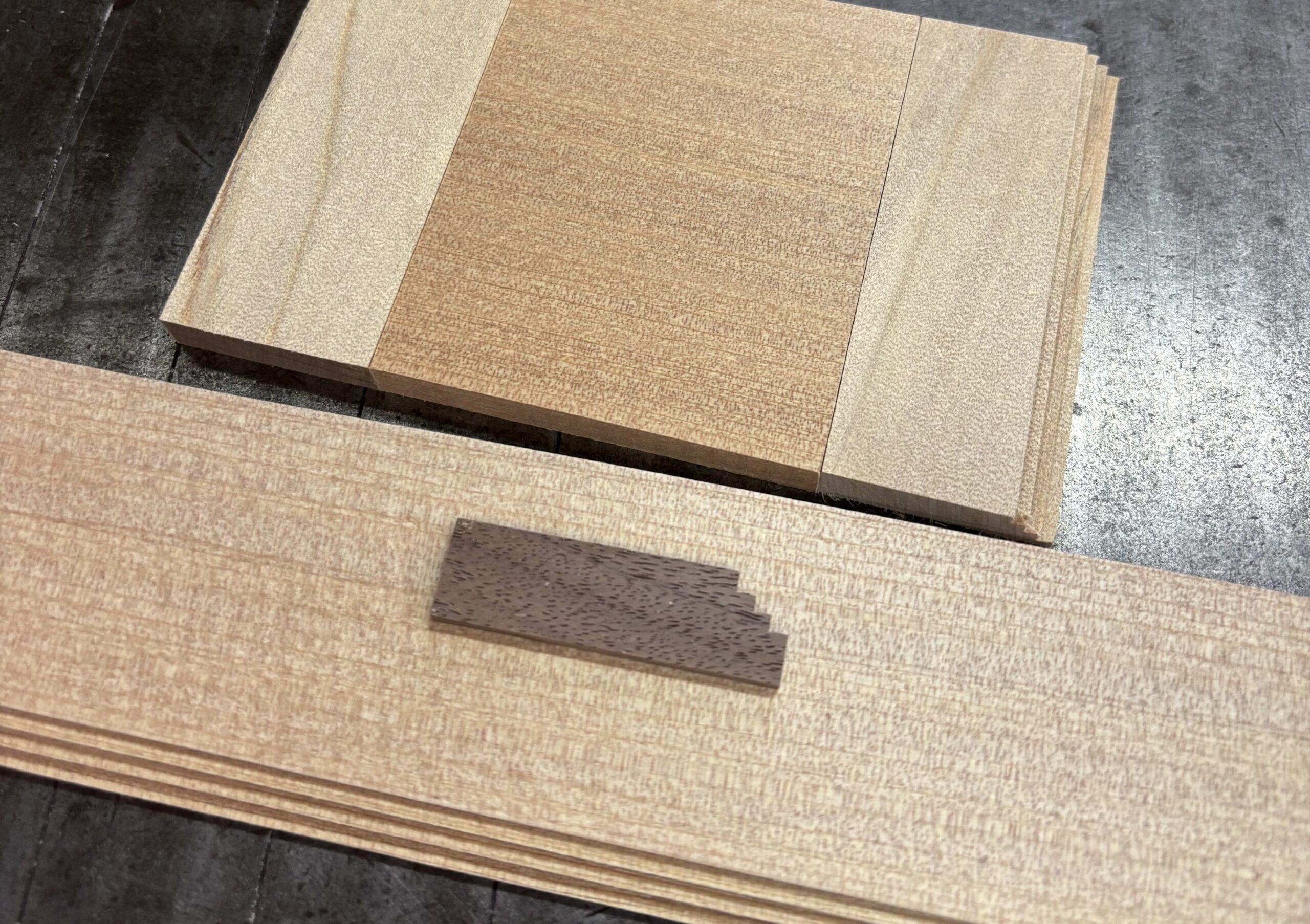
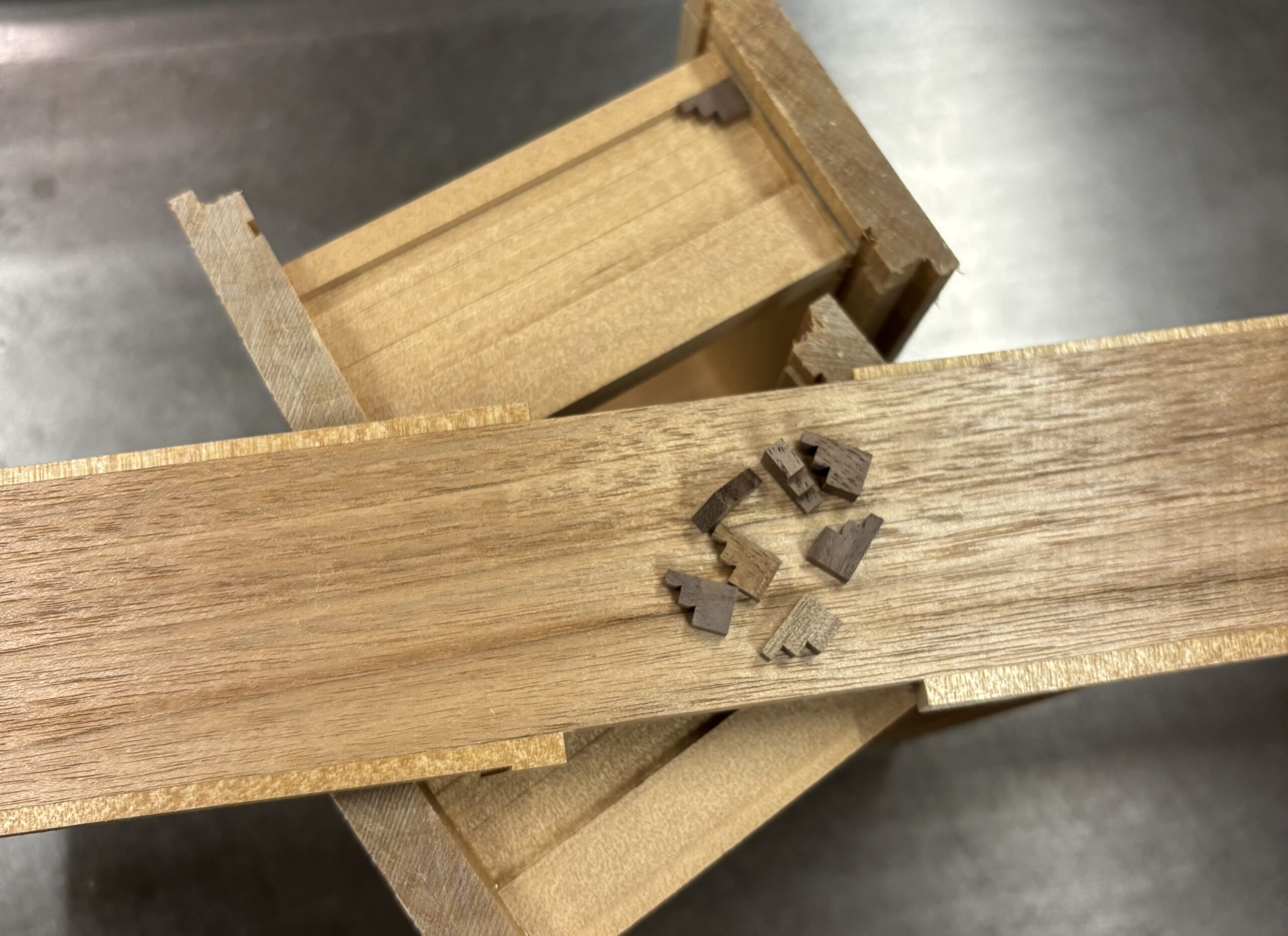
The photo shows the parts for these 5-sun 27-steps puzzle boxes. I will attach them inside the boxes, but I do not have enough of the small stepped parts in the upper-right corner, so I need to make more. I have already prepared the wood. The board shown below those parts is the material I will use. I make these parts in a slightly unusual way. First, I cut the stepped shape into the board, then slice it into pieces of the required thickness. The dimensions of the steps are very precise, with measurements set to the nearest 0.1 mm, so I need to work just as carefully. Shaping them together in one board and then slicing it into individual parts gives me more consistent dimensions than making each part separately. The thickness does not need to be quite as precise. Whether a part is 2.5 mm or 3 mm thick, it can still be used.
I deliberately use slightly harder wood for these parts. It may be difficult to see in the photo, but this time I am using walnut from a section with less attractive coloring. Walnut is relatively hard compared with the woods commonly used for Japanese puzzle box parts. The main reason is strength. When the sliding key moves sideways, the small wooden peg inside, called a “bocchi,” hits this stepped part and stops. The sideways force may be a little weaker than the force of a panel moving downward. Still, after repeated contact, wood that is too soft could wear down or split. Another reason I use walnut is that it resists splitting even when made into small parts like these. Hardness alone does not prevent splitting. Some hard woods can be brittle and may break when cut into small pieces. Walnut has a good balance of hardness, fine grain, and toughness, allowing it to withstand this detailed work. Walnut is popular as a decorative wood on the outside of boxes, but I also find it very useful for the parts inside. Since it is natural wood, some sections have irregular grain or less attractive coloring. I use those sections to make internal parts.