Today also began with rain. The typhoon is expected to come closest to our area tomorrow, but the rain will apparently begin to ease today. I am not sure what will actually happen, but after so many rainy days, the humidity remains high. It was also very cool this morning—almost cold. Tomorrow marks the beginning of October, and I can certainly feel the seasons changing.
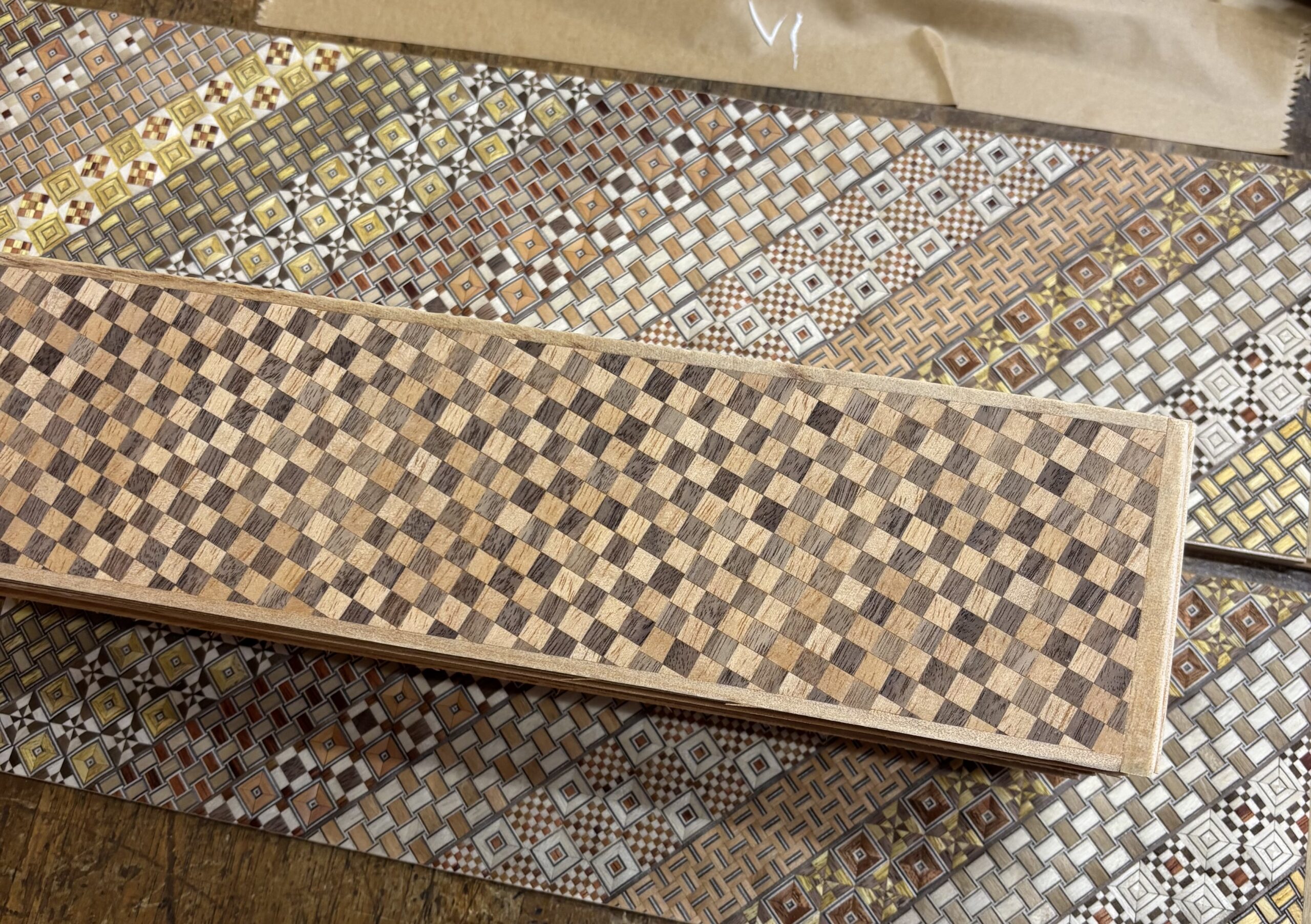
Because it was such a humid day, I attached the mechanism parts to the custom-order boxes for the Japanese market that I assembled yesterday, but I did not make their sliding panels. If possible, I plan to do that tomorrow. Instead, I have been gluing yosegi sheets onto panels for my October production since yesterday. I am preparing them for several different production runs, so there are many panels to complete. I decided to divide the work between yesterday and today because doing everything at once would be too tiring 😅 Gluing the sheets is not strenuous work, but I have to remain bent forward, which puts a strain on my lower back after a long time. The yosegi sheets I prepared this time are for my 3-sun, 4-sun, and 5-sun puzzle boxes. In addition to the traditional yosegi patterns that I attached today, the photo also shows the checkered yosegi sheets for 5-sun boxes that I made last year. This production run will use up my current supply, so I will need to make a new batch if I want to use this design again. This checkered pattern is made from Walnut and Nyatoh, but next time I may replace the Nyatoh with a different wood. The amount shown is enough for two production runs of 5-sun boxes, provided that I keep each run relatively small. Using these sheets, I also plan to make 5-sun puzzle boxes with drawers for wholesale orders.
The sheets I attached this time were standard yosegi sheets, with all the patterns arranged diagonally. While working with them, I was reminded of how easy they are to attach 😅 Recently, I have often used the vertically arranged checkered yosegi sheets that I made, so the diagonal sheets feel much easier to handle. This is because I do not need to pay as much attention to the precise alignment of the pattern. Of course, I still position each sheet so that it fits the prepared base panel properly, but even a misalignment of about one millimeter does not cause a serious problem. With a vertically arranged checkered pattern, however, even a one-millimeter tilt can result in a noticeable misalignment later. For that reason, I must carefully align the pattern along one edge of the base panel before attaching the sheet. Repeating this process carefully for many panels takes a considerable amount of time. Diagonal sheets require less of this precise alignment because the pattern is already angled. Once again, I was reminded of the practical advantage of arranging yosegi patterns diagonally.