Over the past few days, it has suddenly started to feel like summer all across Japan. We are still in the rainy season, and the news says that rainy weather will continue for about another week, but even a cloudy day like today feels hot. Still, the highest temperature is only around 30°C, so I suppose it is different from the real heat of midsummer. The high humidity makes it feel even more tiring.
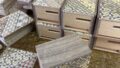
I am currently making about 140 3-sun 12-step puzzle boxes, and I have finished attaching the sliding panels. After making the top and bottom panels, I plan to start attaching them early next week. I wrote the other day that I had some trouble attaching the sliding panels this time, and the main reason was the quality of the wood. It is usually better to use soft wood with some flexibility, but in recent years, I have rarely found Agathis wood that is soft enough. It seems that Katsura wood is still the better choice for the delicate mechanisms of Japanese puzzle boxes. However, even good-quality Katsura wood seems to be difficult to find now…
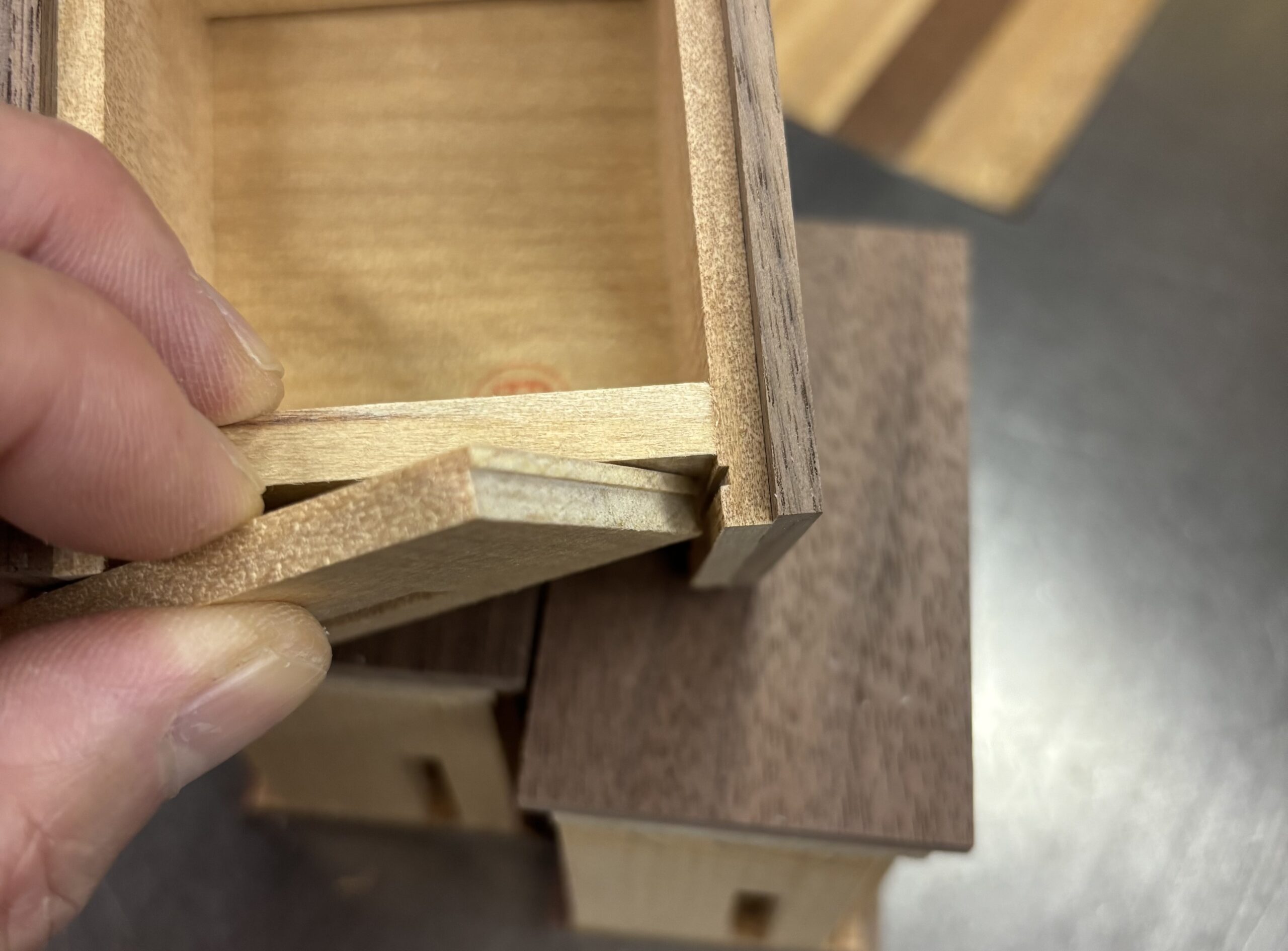
When attaching the sliding panels to the frame of the box, I press the wood slightly so that its fibers are compressed. This is not my own method, but something that has been done for a long time. I think the purpose is not only to adjust how tightly the panels move, but also to prevent them from becoming loose later. Wood has many tiny spaces inside it, and when it is pressed, those spaces are crushed. This makes the wood slightly narrower or thinner. If the same thing happens later to the foot parts of the sliding panels, their movement will become loose. So, the wood is compressed in advance to help prevent that. This is similar to a traditional woodworking process used in construction called “Kigoroshi,” where the wood is compressed before the parts are joined. In that case, however, the purpose is for the wood to expand again later so that the joint fits tightly.
I used the same method when attaching the panels to these 3-sun puzzle boxes. This is because even when the panels and frames are made by machine, they are not all exactly the same, so I need to attach them one by one while carefully adjusting how each panel moves. However, although this process was commonly done in the past, it is often skipped on lower-priced Japanese puzzle boxes today. In many cases, the machine-made panels are simply attached without adjusting each one. Because of this, the panels may become loose later, or sometimes become too tight. The reasons are the cost and the amount of time and work required. Of course, both are important factors, so it is not an easy problem.