The rain that began yesterday continued into this morning, making for a very humid and uncomfortable day. It finally stopped before noon, and at times the sun even appeared. However, the humidity remained quite high, so I decided once again not to attach the panels for the special-order boxes. The weather forecast for tomorrow is not particularly good either, but it should be less humid than today after the rain. For that reason, I am planning to do the work tomorrow instead. At this time of year, rainy days are common, so it is probably unrealistic to expect the kind of dry, crisp weather that would be ideal for this work.
Today, our local community held a disaster preparedness drill. These drills are organized by the city and are usually held about twice a year. At 8:30 in the morning, the disaster prevention broadcast was transmitted throughout the area, signaling the start of the drill. After that, each neighborhood association carried out its own activities, including evacuation practice to designated shelters. These shelters are usually located on higher ground or in large buildings such as schools and gymnasiums, and their locations have already been determined in advance. Local community officers take the lead in organizing the evacuation. Elderly residents and children are assisted as needed, and transportation is provided for those who require it. When I served as a community officer in the past, I was involved in these activities as well. This time, however, my household was assigned to remain at home, so I did not go to the evacuation site. Instead, we placed a flag outside our front door to indicate that we were safe. The neighborhood leaders then went around checking these markers. Each community is free to choose its own method of indicating safety. Because our area is close to the sea, tsunami evacuation is considered particularly important. Since the Great East Japan Earthquake in 2011, local governments have placed much greater emphasis on tsunami preparedness and evacuation planning.
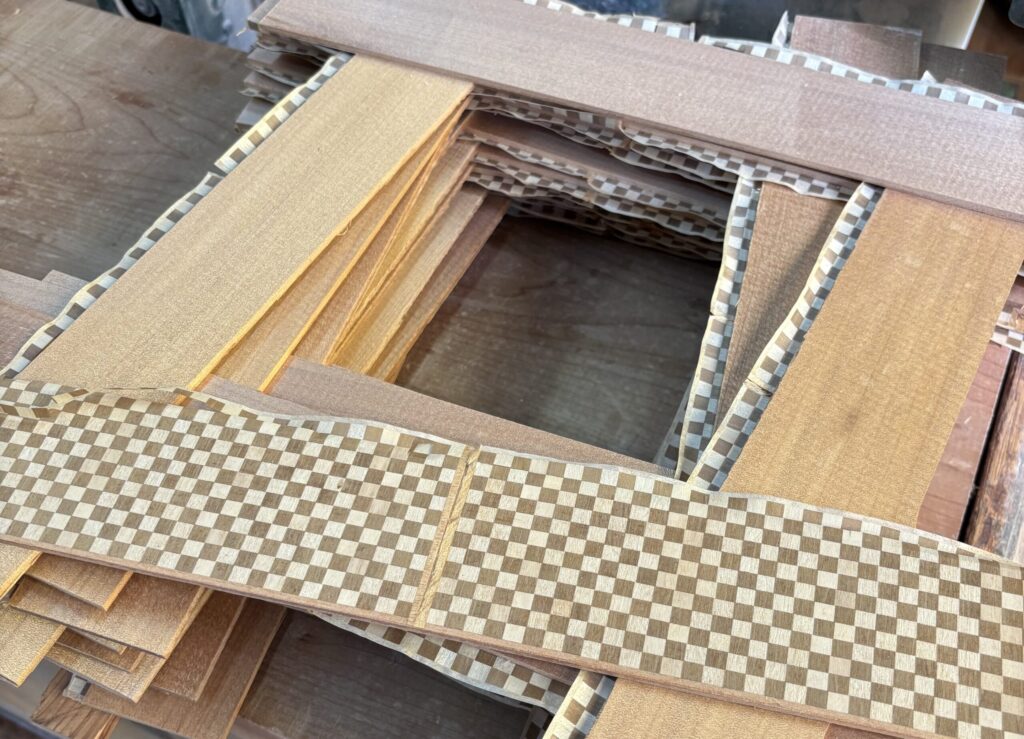
With that in mind, I did not come to the workshop until the afternoon today. Most of my time was spent on workshop maintenance tasks and making progress on the 4-Compartment Boxes. Because the humidity was still quite high, I did not attach any Aruki sliding panels. Instead, I sanded Yosegi panels and prepared the top and bottom panels for the limited-design version that I mentioned yesterday. The Yosegi panels for the side surfaces use a two-color checkered pattern. They were glued up about two weeks ago and have been stacked in a crisscross arrangement to dry. While still in board form, I sanded them once more and then stacked them again. Newly made Yosegi sheets cannot be used as they are, because the surface is rough from a mixture of glue and wood fibers. They require careful sanding before they are ready to use.
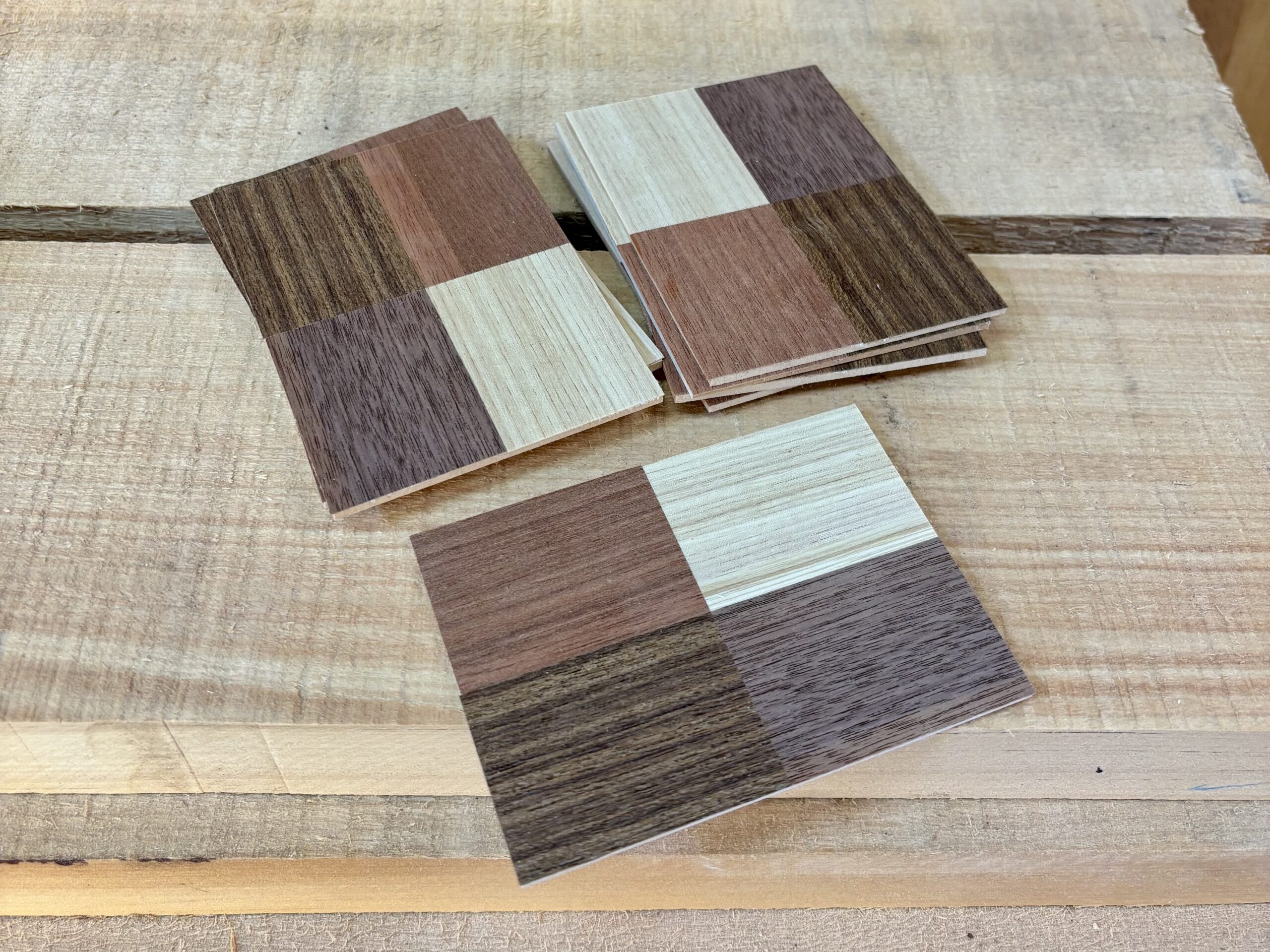
The photo shows the top and bottom panels for the limited-design version, of which only four boxes will be made. Since the 4-Compartment Box uses the same mechanism on both the top and bottom, there is no true “top” or “bottom,” so I chose to use the same design for both panels. To reflect the four compartments, the design incorporates four different wood species. Several years ago, I made a Square Box featuring four woods arranged in a square pattern, and this design follows a similar idea. The colors may be a little more subdued this time, though..haha. The construction method, however, is different from the earlier version. One advantage of this random-grain design is that it allows me to change the grain direction and join different sections together in ways that would be difficult with a traditional layout. These panels were glued only yesterday, so they are still prone to warping. After sanding them, I placed weights on top and left them to rest.