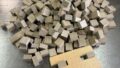
The rain that began last night continued through the morning, just as the forecast had predicted. It finally eased around noon, but the unstable weather and high humidity remained throughout the day. Today, I set aside the special-order boxes for the Japanese market and continued working on the 4-Compartment Boxes instead. The main tasks were making the Aruki sliding panels and several internal parts. As expected, these parts are a little different from those used in a standard Japanese puzzle box, and the construction process is somewhat unique as well.
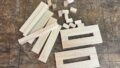
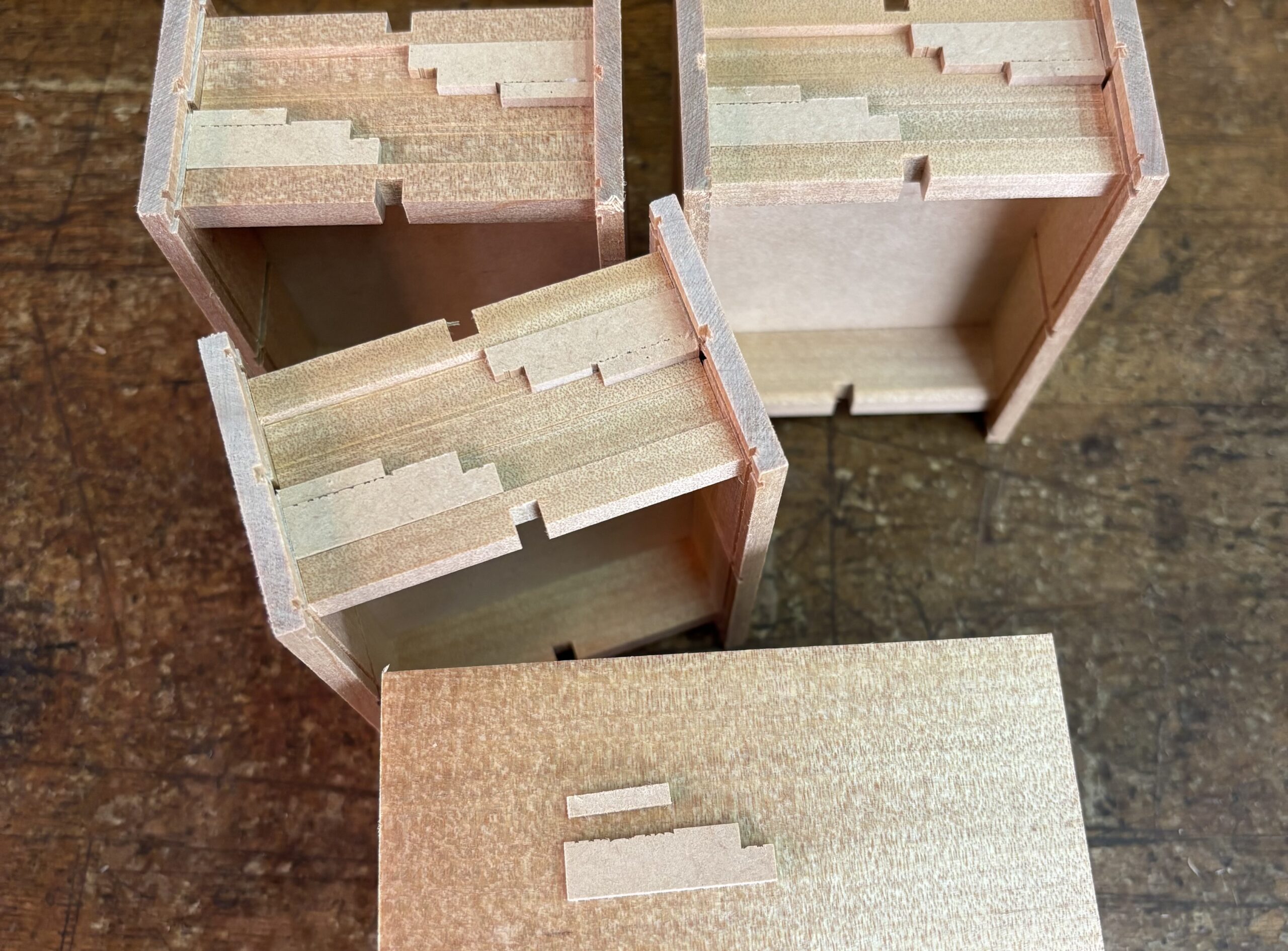
The internal parts are actually fairly large and do not require many small components. Since the mechanism moves to both the left and right, the same parts are installed on both sides. However, because the Aruki panels move in opposite directions, the orientation of the parts must also be reversed on each side. It sounds a little confusing, but please take a look at the photo. At first glance, it may look as though there are only two parts, but there are actually four. Each part is made from two separate pieces. It would be possible to make each one as a single piece, but the accuracy would be slightly lower. The reason is that the section that contacts the internal small wooden block (bocchi) must be made to a very precise dimension. If the part were made from a single piece, that area would need to be carved and adjusted after cutting. Even after cutting with a saw and refining the shape, achieving consistent accuracy down to 0.1 mm becomes a little less reliable. To avoid that problem, I leave the contact surface exactly as it was cut by the saw and then attach a second small piece afterward to complete the part. This method gives more consistent and accurate results. It may sound a little complicated, but the basic idea is simple: cutting is more accurate than carving or sanding. By relying on the precision of the saw cut whenever possible, I can achieve more consistent results.
As for the Aruki panels, there is actually an extra step required for this box. The top Aruki panel is made in the usual way from a single piece, but the side Aruki panels have a different shape than those used in a standard Japanese puzzle box. I plan to show the details tomorrow, but these panels must first be assembled from four separate parts. Only after they are assembled can the usual machining and fitting work begin. Today, I prepared the parts to the required thickness and assembled them. The assembly is done by hand, and once it is complete, the thickness is not adjusted any further. Because of that, all four parts must be perfectly flat and aligned during this stage. That was the main point I paid attention to today. Tomorrow, I will begin fitting these assembled panels to the completed frame structure.