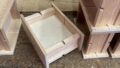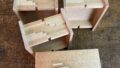
We had another beautiful day today, just like yesterday. However, the weather is expected to change soon, with rain on the way, so I placed all of the special-order puzzle boxes currently in progress into storage cases to help control the humidity. At this rate, I may not be able to work on these boxes tomorrow. The top and bottom panels have already been attached, and the next step will be attaching the sliding key panels. Before that, I spent today making the sliding key panels and the small internal wooden parts, and then attaching them.
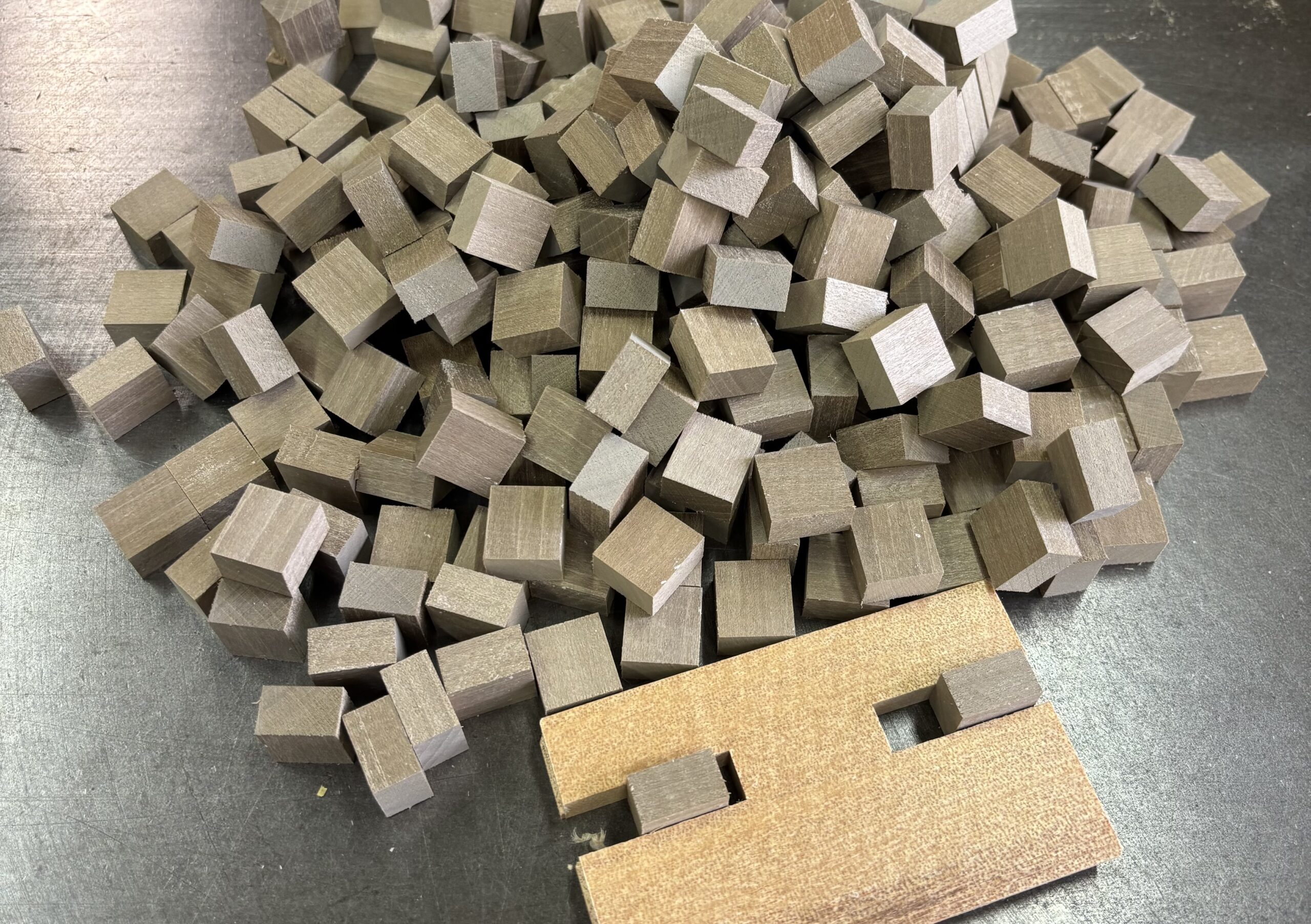
Normally, I can complete this entire stage in a single day. However, these boxes have a more complex mechanism than usual, and I am making quite a few of them, so each step takes more time. Because of that, this was as far as I could get today. In particular, attaching the small wooden blocks (bocchi) shown in the photo took the entire afternoon. Each box requires four of them, so there are quite a lot to install. Some of you may be able to tell from the Aruki sliding panels in the photo what type of mechanism this box uses. The sliding key is split into two sections in the middle and moves to the left and right. This type of mechanism requires a great deal of care when attaching these small wooden blocks. They need to be fitted slightly loose, but if they are too loose, the mechanism will rattle during the first moves. Finding the right balance between smooth movement and stability is the difficult part.
Normally, a sliding key passes all the way through the panel from one side to the other, so it can be pushed from behind in the direction it needs to move. However, with this type of sliding key, which is divided into two sections in the middle, that is not possible. As a result, it is more difficult to apply force when moving it. Instead, the sliding key panel must be pressed from the surface while also being pushed downward as it slides. If the movement is too tight, your finger tends to slip, making the mechanism difficult to operate. That is why these parts need to be fitted slightly loose. Because I check the movement of each mechanism individually while attaching the small wooden blocks, this process takes a great deal of time. This time, I also used magnolia (ho) wood for these small blocks so that the adjustment will remain stable for a longer period. Magnolia is dense and retains its elasticity well, making it an excellent material for delicate mechanisms like this one.
After that, I had planned to spend a little time working on the 4-Compartment Boxes, but I ran out of time. I left the workshop a bit earlier than usual because I needed to go to a neighboring town to do some shopping and take care of a few errands. Since tomorrow’s weather is expected to be rainy, I may end up focusing mainly on the 4-Compartment Boxes instead.