The sky was cloudy from early this morning, and it was clear that the weather was going to get worse. As expected, a typhoon is currently moving along the Japanese archipelago, bringing heavy rain and strong winds to the areas near its path. It is unusual for a typhoon this strong to approach the Japanese archipelago at this time of year. I heard that it only happens about once every five to ten years.It looks like the typhoon will come closest to our area between tonight and tomorrow afternoon, so I would like to make some preparations a little earlier than usual.
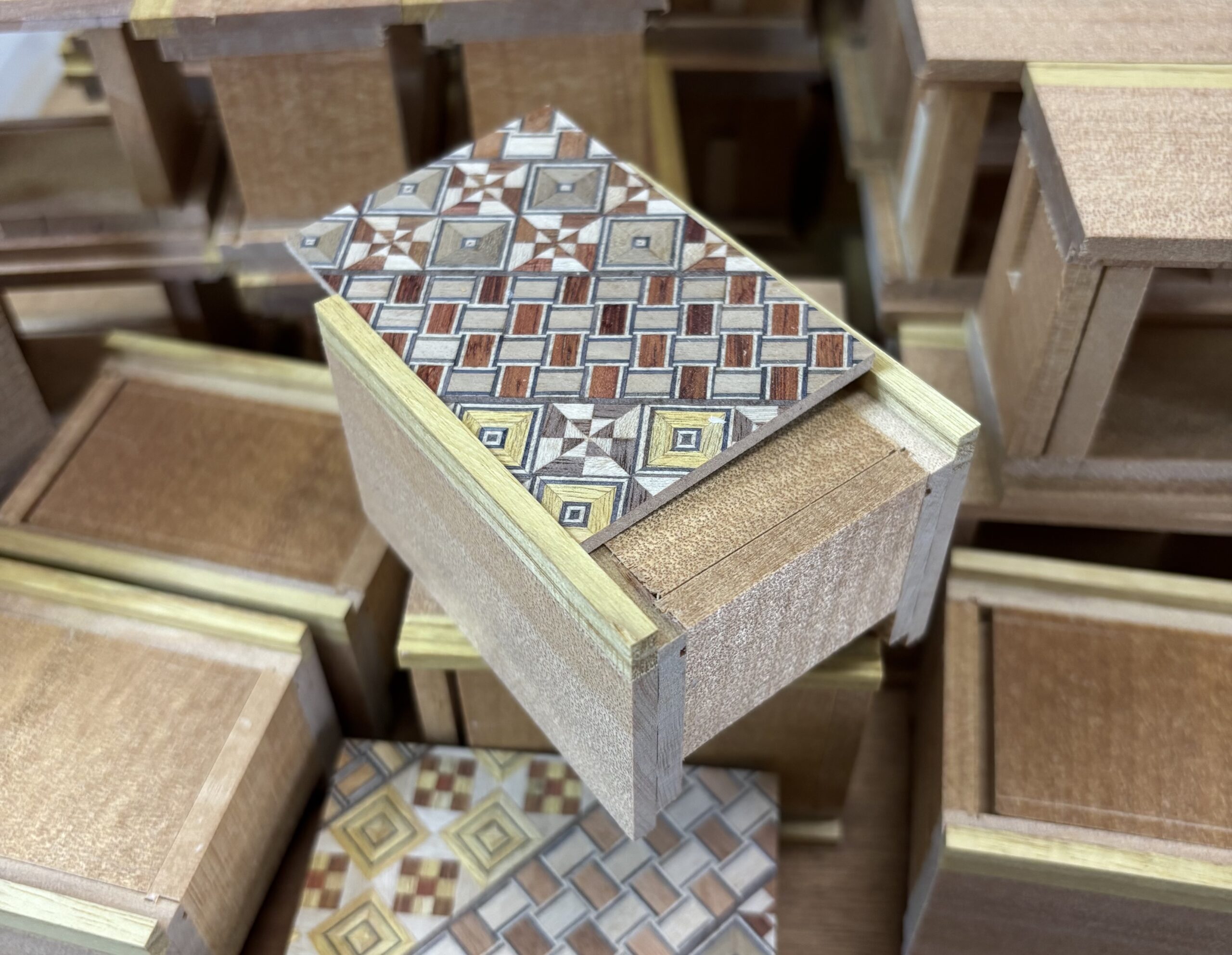
Because of these weather conditions, the humidity has been gradually increasing. As a result, I will probably not be able to do any work today or tomorrow that involves adjusting the delicate movements of puzzle box mechanisms. Instead, I spent the morning cutting and fitting the top and bottom panels for the 2.5-sun puzzle box. This process also requires very careful adjustment, as even small differences can affect the final fit. As expected, when the humidity is high, the wooden parts absorb moisture, so it is not a good time to carry out this kind of delicate work. This morning, however, the humidity was still relatively low, and the panels had dried sufficiently by yesterday, so I decided to cut them to size. The panels are fitted while being checked against the box bodies, which already have their Aruki sliding panels installed. Since each box is slightly different, I always fit the panels to several boxes rather than just one. This time I used about ten boxes. The differences between individual boxes are extremely small, probably less than 0.1 mm. Even so, those tiny differences can have a noticeable effect on how the panels move. For this design, the top panel slides while the bottom panel remains fixed, so it is better to cut the top panel slightly on the tight side. If it ends up being too tight, I can remove the top panel and adjust it later. On the other hand, if it is much too tight, attaching the panels later becomes difficult, and the side panels may be forced apart more than necessary. So when I say “tight,” I mean only enough to provide a moderate amount of resistance. I try to find a middle point where the panel fits all of the boxes I have prepared while still having the right amount of movement. I did not have enough time to glue the panels in place yet, so after finishing the fitting work, I stored both the box bodies and the panels in a humidity-controlled case.
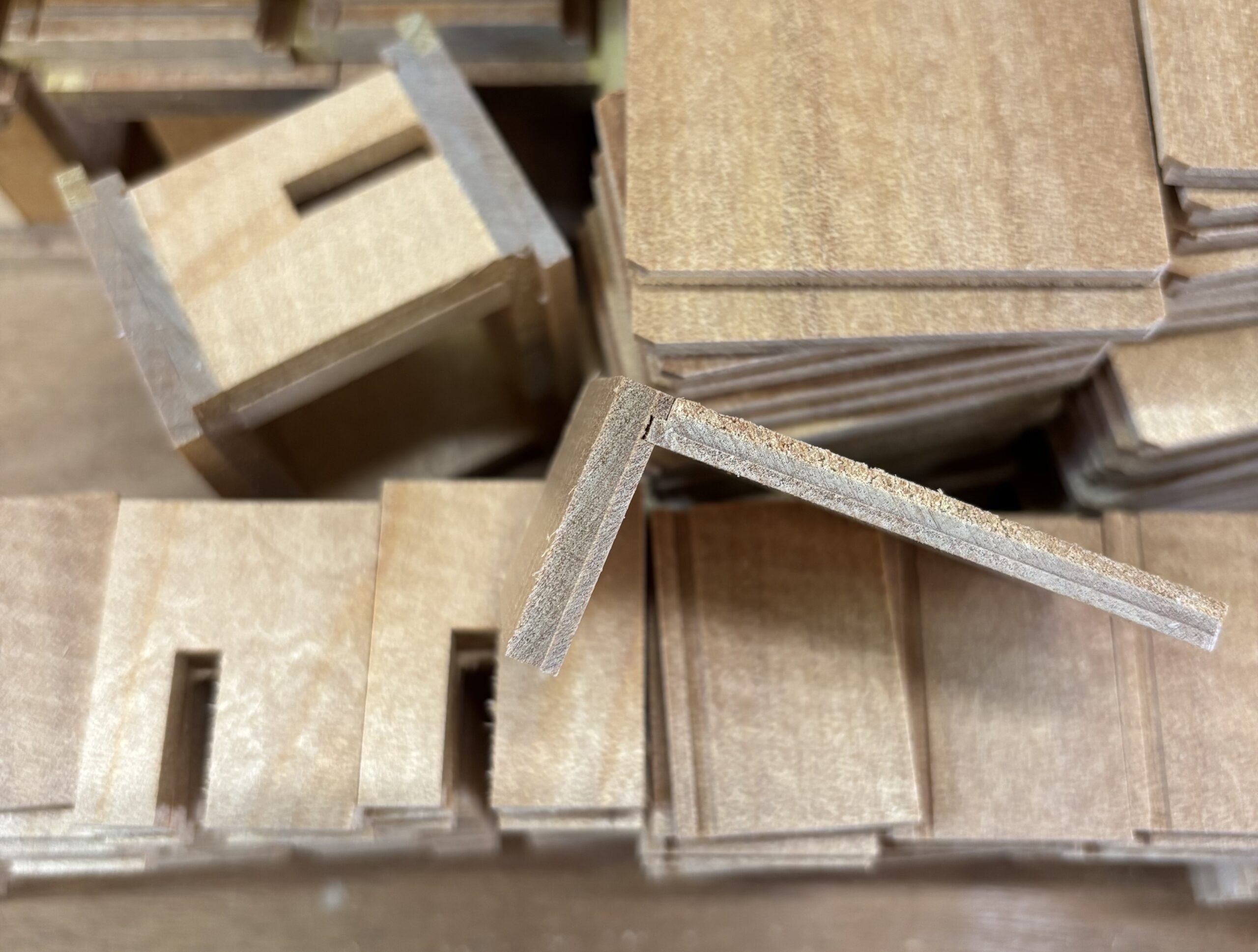
After that, I worked on preparing the Aruki panels for a custom-order box that is being made alongside my other projects. I have not yet made the side panels or the axis panels, but I first completed the “Hashibami” process on the top and bottom Aruki panels, which helps prevent warping. I also made the stepped cuts where the top and bottom panels will later meet the side Aruki panels. This is a type of work that can be done without worrying too much about humidity, and since it does not yet depend on the final dimensions of the box, I decided to do it in advance. If I wait and do these stepped cuts at the same time as making the Aruki panels later, the work session becomes much longer and I start to lose concentration 🤣 For that reason, I often divide the process into separate stages. The top and bottom Aruki panels are first assembled as panels, including the Hashibami construction, and are then fine-tuned later to match the actual frame of the box.