It was sunny again from the morning today. The temperature was a little low and it felt cold at first, but during the daytime it became very comfortable. As I posted on Instagram (@okapuzzlebox), a shipment of lumber (agathis wood) arrived this morning. Because of that, I spent much of the day carrying the wood, organizing it, and rearranging the workshop. My workshop is not very large, so I cannot use a forklift to move the lumber. Everything has to be unloaded and stacked by hand. First I unload the wood outside, and then I carry it again into the workshop and stack it in its storage place, so the boards have to be moved twice. Usually I do the second part on the following day, but today I decided to finish everything at once. So by the end I was already exhausted 🤣 But maybe it is good exercise for my health.
Even so, I found a little time to continue working, such as assembling parts for the 3-sun 12-steps puzzle boxes. I wanted to attach the top and bottom panels for the Mame 10-step puzzle boxes, but I did not have enough time today. By the way, when I wrote the article about these small panels the other day, it reminded me of something.
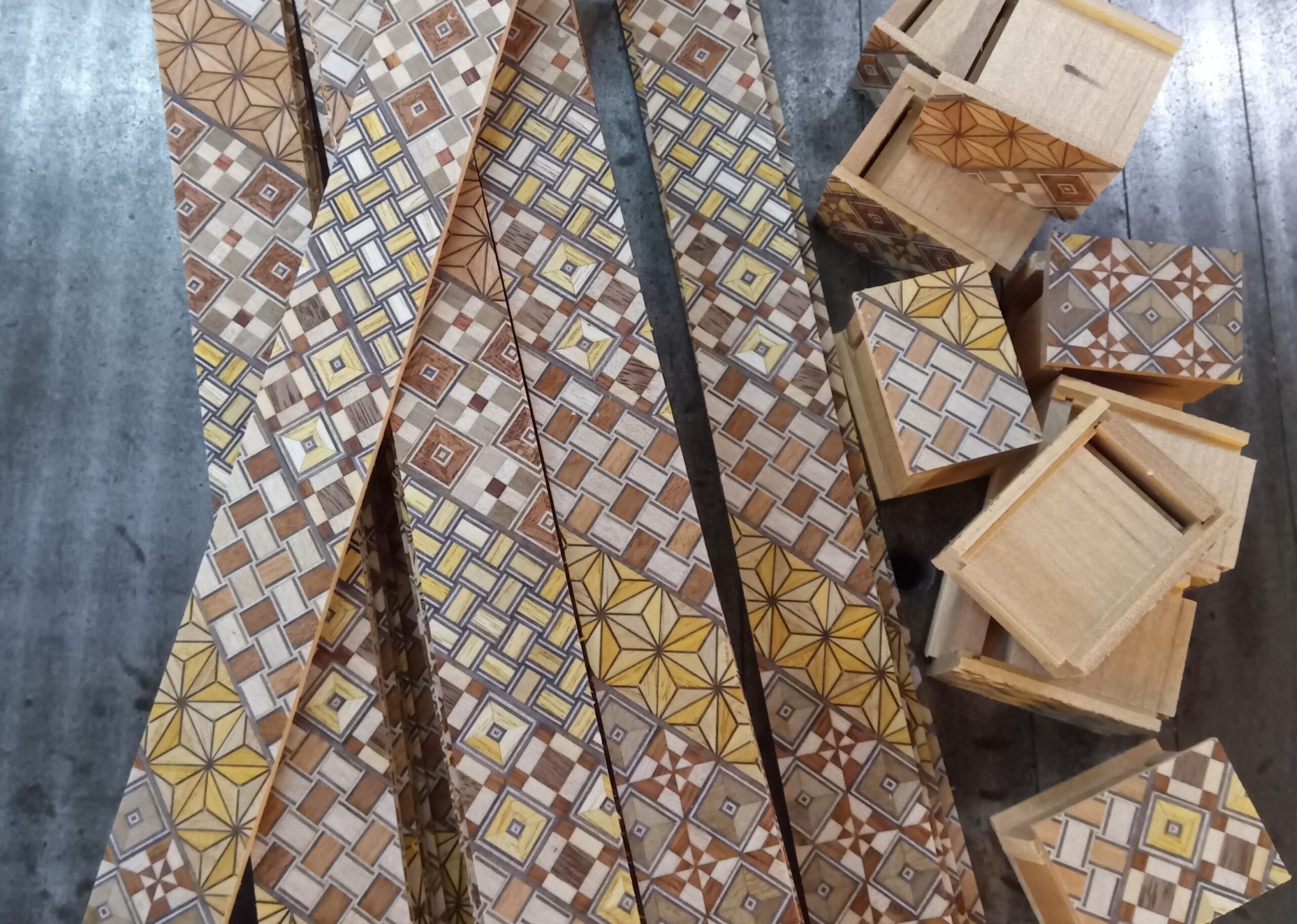
Now it has become so common that I almost forgot about it, but when I first began making these Mame puzzle boxes about 25 years ago, some experienced craftsmen were a little opposed to using the pattern that is now standard, the “Koyosegi pattern,” which mixes many different yosegi designs. The reason was that the Mame puzzle box has such a small surface area that the yosegi patterns cannot be fully shown. The patterns often stop halfway, so they thought it would not look beautiful. In fact, only two or three patterns can fit on such a small panel, and some of them are cut in the middle, making it difficult to see what the original pattern was meant to be.However, I once heard that the Mame puzzle box was originally not considered a main product, but rather a small box that puzzle box craftsmen made in their spare time. At that time, after discussing it with the shops that sold the boxes, we decided that it was more important that the same yosegi craftsmanship was used, even if the pattern could not be shown fully. So we chose to make them using traditional yosegi, as we do now. Indeed, the Mame puzzle boxes made by the old master craftsmen did not seem to use the traditional Koyosegi patterns. Instead, they used single patterns such as Kuzushi patterns or Ichimatsu patterns. It also seems that those patterns were specially made smaller just for Mame puzzle boxes. This may simply be a matter of preference, but nowadays customers seem to enjoy the Koyosegi patterns as well. In the past, I also made a smaller Kuzushi-pattern yosegi specifically for Mame puzzle boxes and created a limited edition. If I have the opportunity in the future, I would like to try something like that again.