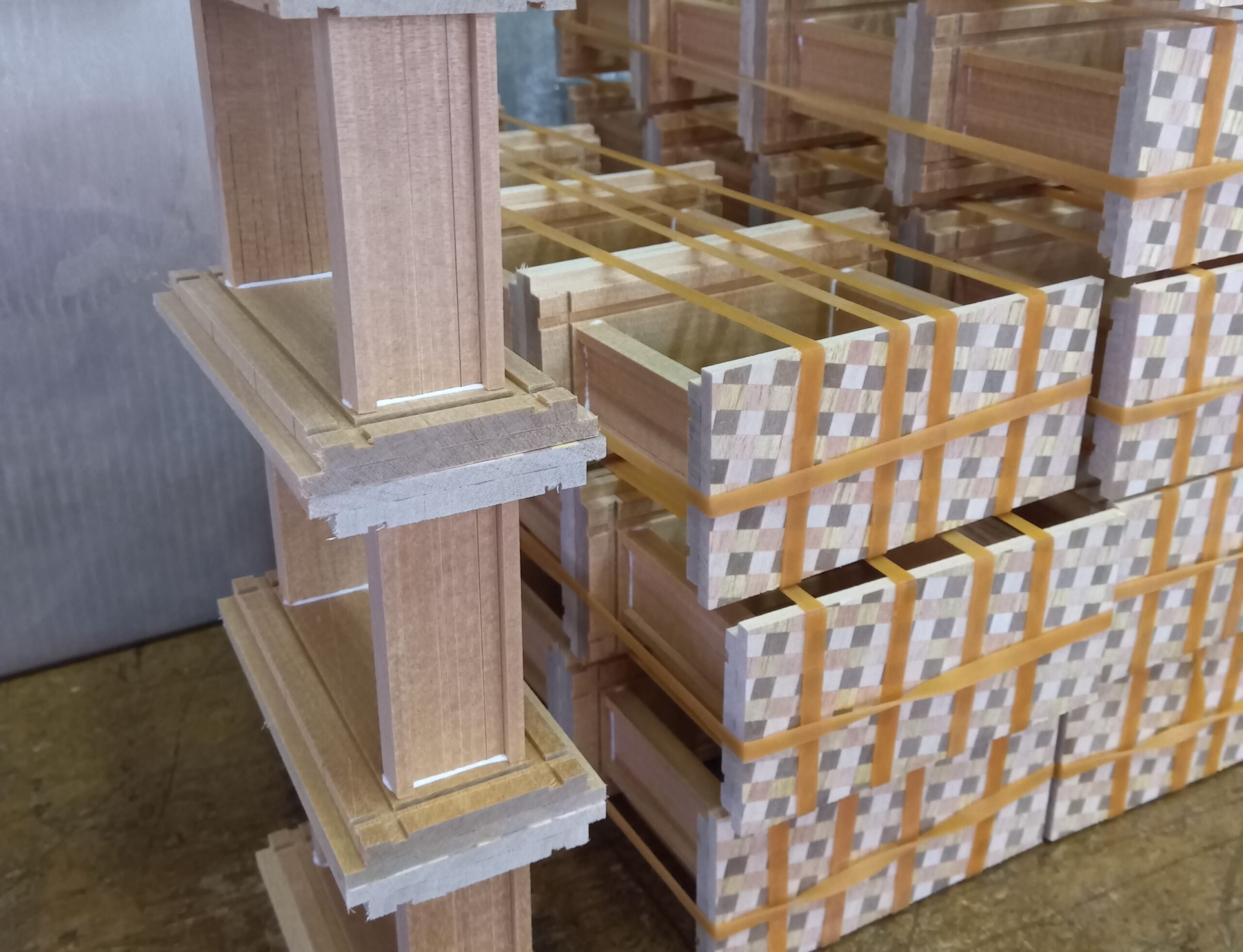
A new week has started, and it is still a little warm today. However, it seems that this mild weather will end today, and the forecast says that rain or snow may fall tonight. The second half of February has begun, and I have started working on the 4-sun 27-steps puzzle boxes. Now that I have begun, I feel again that making 70 of the 27-steps puzzle boxes is quite a large number. Still, making a slightly larger quantity after some time may be good training for me 😅
Today, I finally started the assembly work. I focused on that during the morning and was able to complete the process up to attaching the parts. Several different types of parts need to be glued in place, and I had already made and prepared the missing pieces last week. This type of box has a slightly larger number of parts, and each part must be attached in a specific direction. Because of that, it takes a little more time compared to boxes with fewer steps. Also, one movement of the mechanism is only 2.2 mm, which is very small. If the parts are not placed exactly in the correct position, they may catch or cause the mechanism to stop working later. It is a very important stage in the process. Once the parts are attached, the next step is making the Aruki sliding panels. I have roughly prepared the materials, so tomorrow I will start by shaving them down to the correct thickness of 8.5 mm. According to my plan, I will probably spend the whole day on this task. If things go well, I may even be able to attach the Aruki panels I make… but since the quantity is large, I am not sure how far I can go.
I do not think I mentioned this before, but for this 4-sun 27-steps puzzle box, I will also use katsura wood for the side Aruki panels. I found pieces in just the right size, so I decided to use them. Recently, I used katsura wood for some Mame puzzle boxes and for part of the 5-sun puzzle boxes with drawers, and the result was very good. That is why I decided to use it again this time. It is not easy to buy a large amount of katsura wood at once, but buying enough for one production run is not so difficult. Surprisingly, lumber shops sometimes have it. However, if I need a large quantity of good-quality wood, most shops do not keep that much in stock. This time, there was just enough material for about 70 boxes, so I will use it. For the top Aruki panels, more material is needed and the thickness is greater, so I will use agathis wood again because its quality is stable. When the quality of the wood is good, attaching the Aruki panels goes very smoothly. There is definitely a sense of “the right material for the right place” in making puzzle boxes. A long time ago, when I had just started working independently, I made puzzle boxes as a subcontractor for another workshop. That company did not usually produce puzzle boxes, but I made them under their name. They supplied all the materials, and I only did the making. However, the materials were not chosen with the right purpose in mind, because they did not know much about puzzle boxes. For the Aruki panels, they provided very hard wood, which made the work difficult. Still, I managed to complete the boxes, and in a way, it was good training for me. Materials are truly important. I often remember that when a certain master craftsman was still alive, he was once asked what was most important in making Himitsubako (Japanese puzzle box), and he answered, “First, the materials.” I always keep that in mind while working. The final quality of the box depends greatly on the quality of the materials.