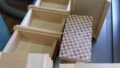
It was raining from the morning today, but as I am writing this, the rain has stopped for now. By the way, today is “National Foundation Day,” which is a public holiday in Japan. I was a little worried about the humidity rising, but I have finally run out of stock of the puzzle boxes with drawers, so I am working a little faster than usual. Even when it rains at this time of year, the humidity does not seem to rise to 70% or 80% like it does in other seasons. At the same time, I am also making a new design type, a combination of traditional yosegi and ichimatsu yosegi, which I have recently been using for other sizes. Today, I made and attached the side panels, which are the outer panels of the Aruki side. The 10-steps puzzle box with drawers has a single solid panel on one side, so it can be glued together at the same time as the sliding key panel on the other side. The 6-sun 7-steps puzzle box I made last year had the same specification, but with such a large size like 6-sun, it was not possible to glue them at the same time. This time, however, since it is 5-sun size, it can be done.
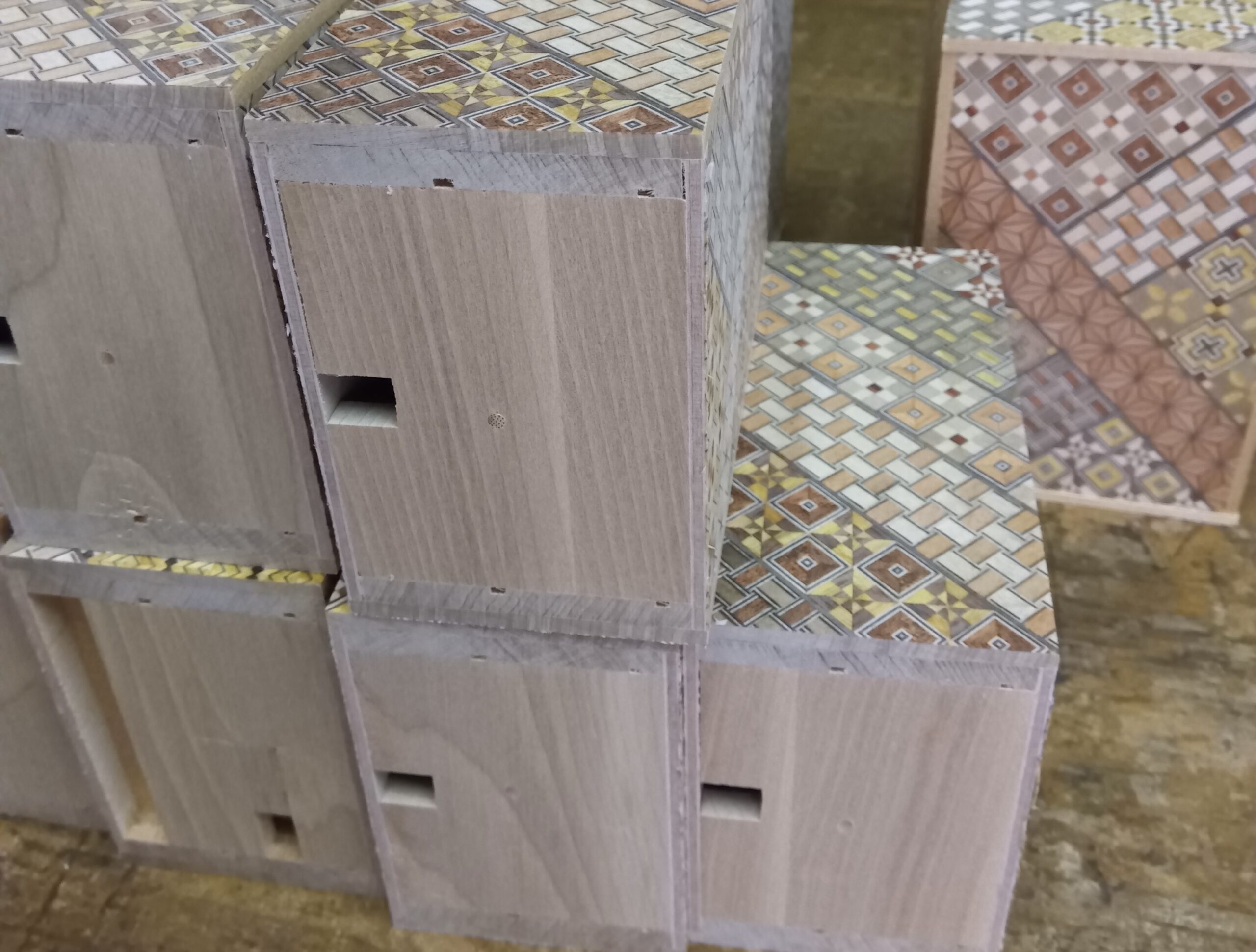
In the photo, you can see a small dot in the center of the side panel of the box before it is glued. This is the stopper that makes the panel stop partway. A 3 mm round rod is used for this. In the past, I used round rods made of natural wood, but there are not many shops that sell them, and it was difficult to find and buy them. So now I use 3 mm rods made of bamboo. The bamboo type is available at most home improvement stores, and it is inexpensive. The natural wood round rods are usually sold one by one, but the bamboo ones are sold in packs of about ten. The price is about one-fifth of the natural wood type. I do not feel much difference between the materials. If I have to say one thing, bamboo splits more easily, so it requires some care when processing. The position of this pin is carefully calculated. It is set so that the panel stops exactly at the point where the drawer can move in and out. There is a small notch cut into the shaft part beside the panel, and the bamboo pin moves only within that range. In some old traditional puzzle boxes, this kind of pin was not used. Instead, a small wooden piece would hit against another part and stop the movement. When attaching the outer yosegi panels, it is also important to make sure that glue is applied firmly to this pin as well.By the way, the square hole in the panel shown in the photo is the space where the drawer handle fits. By placing the handle into this space, I can make the drawer itself longer.
Today, in addition to that work, I also attached some ichimatsu yosegi sheets. This is the process of gluing the sheets onto agathis wood boards. I prepared about 80 pieces. These are for the next project, which will be 4-sun 27-steps puzzle boxes. This time, I am planning to make about 70 boxes in two different designs. The 4-sun 27-steps puzzle boxes are a popular model, but I have not made them recently. It will be the first time this year. These ichimatsu yosegi sheets are for the side panels. Since the side panels need to be completely dry, I attach the sheets at an early stage. When the sheets are glued onto the boards, the boards tend to warp. So it is necessary to let them dry well until the warping settles down.