After yesterday’s cooler weather, today turned hot again. It was not as extreme as a few days ago, but the temperature reached about 32°C (90°F), and the sunshine was strong.
However, since I had planned to attach the sliding key panels for the Walnut design puzzle boxes today, the sunny weather and relatively low humidity were actually ideal for this work. As planned, I attached the sliding key panel to one side of the 14-step puzzle boxes. I will post a photo of it on my social media today. Unlike the usual sliding key panels covered with Yosegi sheet, natural wood panels like these are attached only when the weather conditions are especially good. Because the humidity was low today, I decided to attach the more difficult side first. This side is usually done on the second day and tends to be less stable because it has a smaller gluing area. I plan to attach the other side tomorrow.
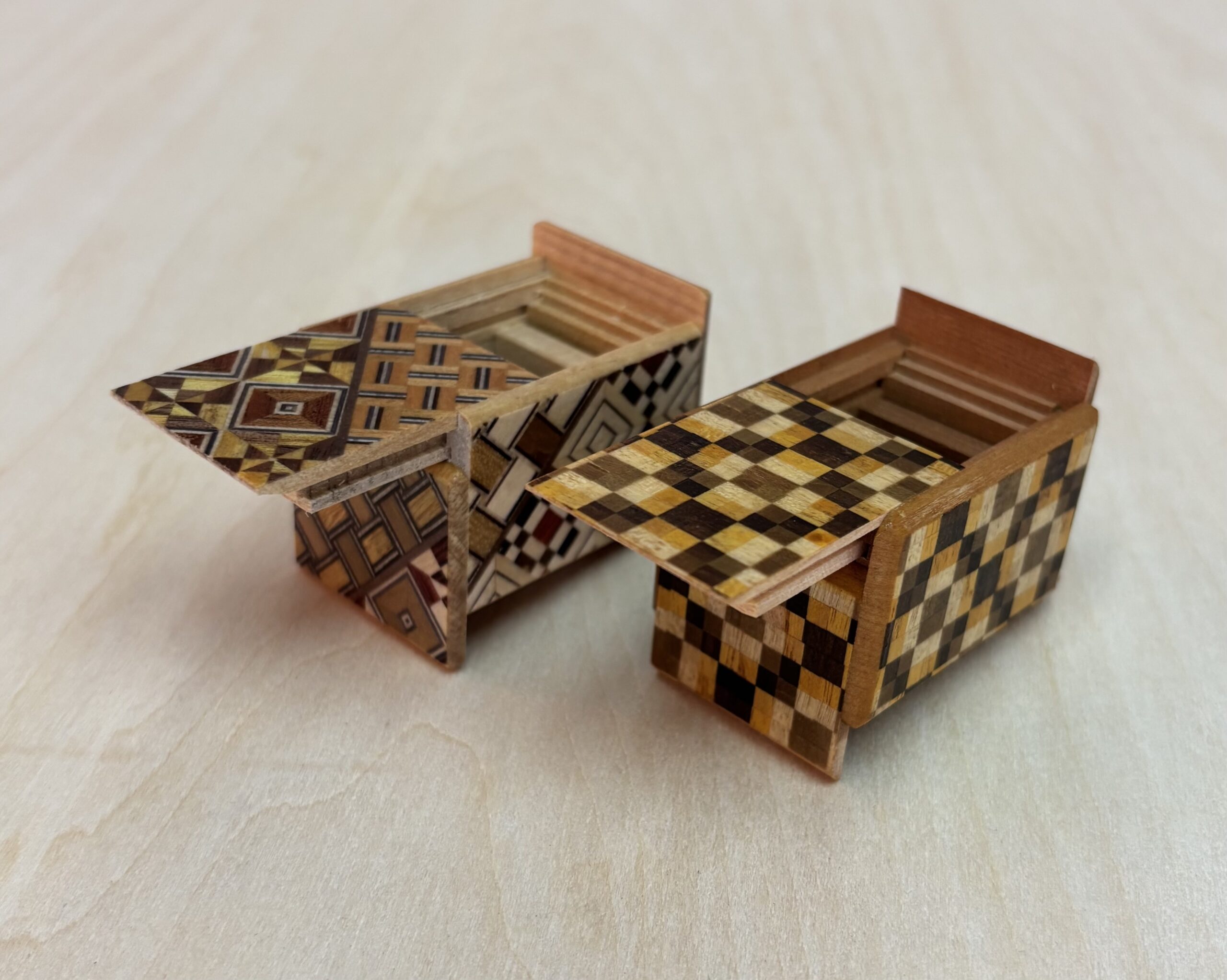
When I made the 14-step Mame puzzle boxes last month, I mentioned that I would write about some Mame puzzle boxes made by a master craftsman. I touched on this topic before, but I would like to share a little more today. The checkered box on the right in the photo is a legendary 14-step Mame puzzle box made by a well-known master craftsman. His seal is stamped on the back of the top panel, but I will leave his name unmentioned. The box is still in excellent condition, and needless to say, its movement is outstanding. Every time I look at it, I cannot help but admire it. The movement is on an entirely different level. I often wonder how someone could make a box that moves so smoothly. It may sound like a rare antique, but when it was made, it was apparently sold as an ordinary mass-produced souvenir, just as puzzle boxes were at that time. In a way, that almost feels like a waste..haha. Calling it a work of art seems more appropriate than simply calling it a souvenir. Looking at it again this time, I was reminded that, despite its tiny size, it is built remarkably well. One of the secrets seems to be not the thickness of the axis panels, but the thickness of the long side panels. Because of that, the inside of the box—especially its width—is slightly smaller than that of my own Mame puzzle box shown on the left. After studying this box again, I am thinking about making the long side panels of my own Mame puzzle boxes a little thicker in the future. I also have other Mame puzzle boxes made by this master craftsman, so I hope to introduce them another time.