It was a rather cold and cloudy day today. I spent the whole day working in the workshop. This morning, I was able to deliver the 10-steps Mame puzzle boxes that I had just completed. It had been a while since I last made the 10-steps version, but the weather conditions were good during the production, so everything went smoothly. I may have forgotten to mention this earlier, but for this batch of the 10-steps Mame puzzle boxes, I used katsura wood only for the side Aruki panels. I was not able to prepare enough katsura wood, so this time I used it only for those side panels. The top and bottom Aruki panels were made from agathis wood as usual. At first, I wondered if using katsura wood only on the sides would be enough. However, the elasticity of katsura wood is especially suitable for the side panels of Mame puzzle boxes. So I decided to use it at least for that part. In fact, adjusting the side Aruki panels is more delicate and difficult than adjusting the top and bottom ones. Because of that, choosing the right material is very important.
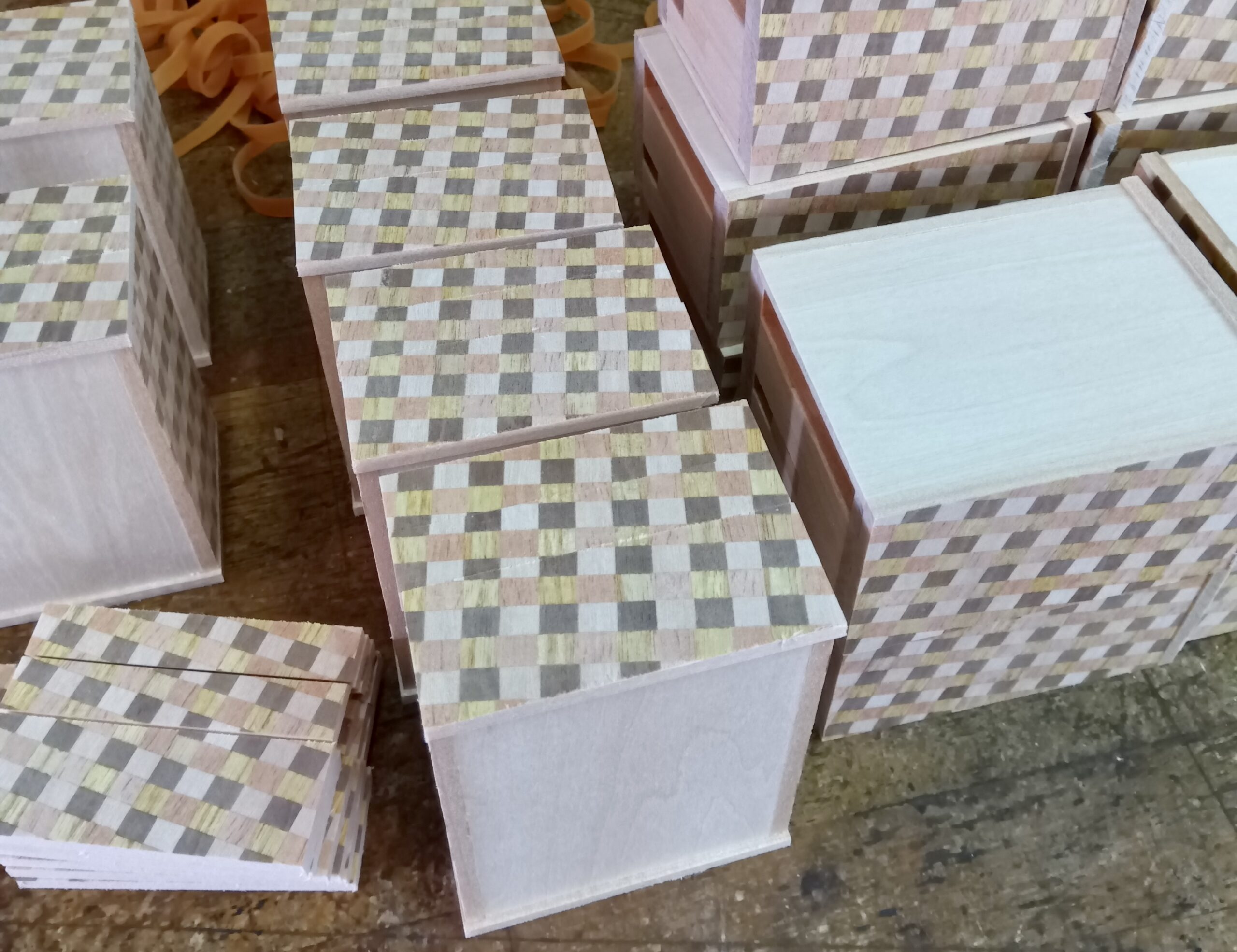
After that, I attached the sliding key panels for the 3-sun 12-steps puzzle boxes that I had been working on since yesterday. With that step completed, the assembly of these 3-sun boxes is now finished. As you can see in the photo, this time I am making not only the traditional yosegi model but also a one-point yosegi model. The photo shows the one-point yosegi version with plain top and bottom panels that do not yet have any pattern attached. The small piece of yosegi for the one-point design will be attached after the finishing work, just before the coating process. That is why, at this stage, the panels are still plain white boards. These white boards are made from shina plywood. Recently, this type of plywood has also become harder to obtain. In the past, a thickness of 3 mm was common, but now it has mostly been replaced by 2.5 mm. For small boxes like this, 2.5 mm is still fine, but for larger boxes around the 5-sun size, it feels a little less reassuring. However, one advantage is that compared with MDF boards, the color of the yosegi sheet appears much more beautiful when it is attached. I clearly remember being surprised by the brightness of the colors when I first began using this shina plywood. Before that, I used only solid wood, and the top and bottom panels were made from agathis wood. As you may know, agathis has a light brown color, so when a yosegi sheet is attached on top, the pattern becomes slightly darker. In contrast, this shina plywood is very white, so the colors of the yosegi stand out more clearly. Although shina plywood has become less common recently, I still use it for larger boxes. If the box becomes too large, however, the 2.5 mm thickness can feel a little too thin. There are also thicker boards such as 4 mm, but for puzzle boxes that thickness is a little too much because of the mechanism inside.
There is one disadvantage. Even though this plywood is made with natural wood veneer, it is built from three layers glued together. Because of that, it does not “breathe” as much as solid wood. Normally, wood absorbs and releases moisture from the air and balances itself with the surrounding environment. Since plywood does this less, humidity can sometimes stay inside the box more easily, and mold may appear on the shina plywood surface. Under normal conditions this rarely happens, but if the box is handled and oils from hands or small food particles remain on the surface, mold could appear if it is left that way for a long time. Please keep that in mind. If you notice any stains, it is best to wipe them gently with a clean cloth that is slightly damp.