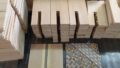
Today is Saturday, but I came to my workshop around 10 a.m. and have been working. Since it’s the end of the year, my production schedule is getting a bit tight, so I’m trying to make as much progress as possible. This morning was very cold, and the weather was not good. Even during the day the temperature stayed around 9°C, and it felt cold. There was no sunlight, and it seems it will rain tonight. So today I worked a little faster than usual and attached the first side of the sliding key panels for the square puzzle boxes I have been making. Since these are 14-steps mechanisms, one side tends to warp more easily. The humidity today was only 30%, so it was a good day to attach that side. Because it will rain tonight, the humidity will probably rise tomorrow. I plan to attach the other side tomorrow, but if the humidity becomes too high, I may delay that side by one more day.
It’s true that I haven’t made a 14-steps mechanism for a while, and even though it has fewer steps than the recent 18-steps or 27-steps boxes, it has different points that I must pay attention to during production. In this way, it is quite a difficult box to make. The distance that the sliding key moves at one time is larger than in the 18-steps mechanism, so problems with the movement can happen more easily. Also, the gluing surface of the sliding key panels is smaller, so I have to be very careful, and I need to pay even more attention to humidity control.
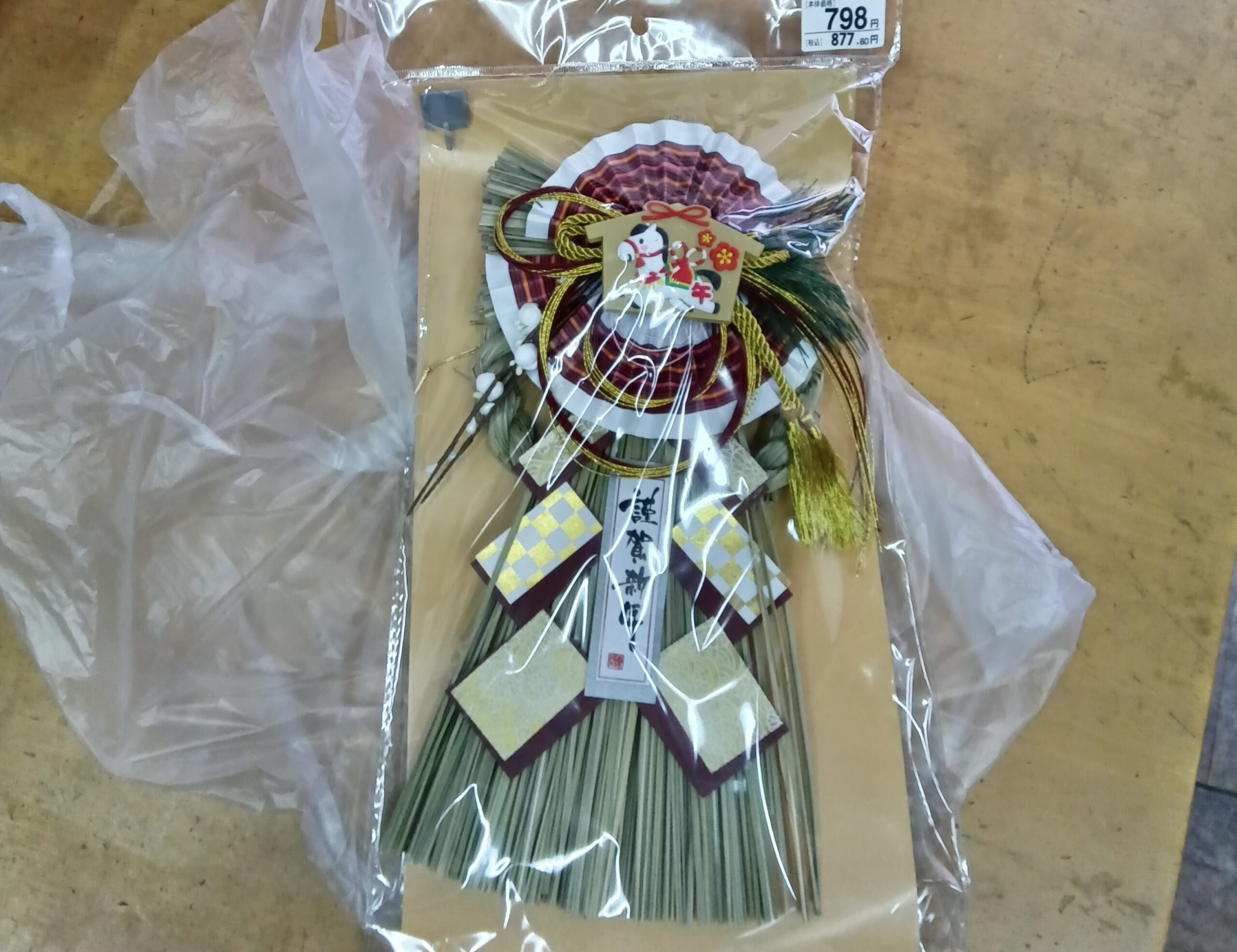
Since it is the end of the year, I also bought New Year decorations (Shogatsu-kazari) for my workshop the other day. By the way, as you can see in the photo, it costs 877 yen including tax. At this time of year, supermarkets and home centers everywhere sell many kinds of decorations, and many people buy them. Normally, these decorations are placed at the entrance of a building, on the outside, but there are also versions made for cars or for gates instead of buildings. It is a little difficult to explain what these decorations are, but they come from old Japanese customs. They are not exactly the same as Buddhist religious items. I feel they are more like a cultural tradition that has become part of everyday life, without strong religious meaning for most people. Still, the original idea is that the decoration is a sign to welcome the New Year’s god. So in that way, it is connected to a form of Japanese belief, which includes Buddhism. However, today the meaning is broader, and people see them more as a New Year decoration to celebrate the season. Because of that, many modern designs are available, including ones with manga or anime characters, or even Disney characters. The one I bought is not so unusual, but it is quite cute. It keeps the traditional New Year decoration style, but it also has a character of next year’s zodiac animal, the horse. The horse is made in a very cute way. These decorations are not put up on New Year’s Day, but a little earlier, sometime in December. The exact timing depends on the region. This year, I plan to put mine up on the 26th (Friday). In my area, it is normal to keep the decoration displayed until January 7, which is called “Matsu-no-uchi.”
After the New Year, these decorations must be disposed of in the proper way. They must be used only for that year and then removed. The usual methods are to take them to a shrine, where they will be offered and then burned, or to burn them at a local New Year fire festival, such as “Dondo-yaki” or “Sagichō.” This is considered part of the New Year ritual, and it carries the meaning of praying for happiness and good health for the coming year 😊