I came to my workshop in the afternoon today and spent some time working and organizing. Recently, I’ve been thinking more about old puzzle boxes and have had more chances to see them, so I took out some sample boxes I made in the past, as well as puzzle boxes made by other craftsmen, and spent some time looking at them. I haven’t yet decided what to do with the old box that came into my hands, but I do feel that I would like other people to have a chance to see it as well.
If you take a look at my Facebook, you may notice that I received several messages about the box with drawers that I recently posted on Instagram and Facebook. Some of those messages were about the sound it makes when the drawer is pulled out. More than 20 years ago, when I had just started making puzzle boxes, I once took apart a drawer-type puzzle box that had this sound feature. At that time, I also checked the structure of the sound mechanism. However, I cannot find that box now, and I am not sure where I put it. I don’t think I threw it away, though. If I find it someday, I would like to show and explain how it works. The sound mechanism is completely glued, so if you try to check the inside, it will most likely be destroyed 😅. So I would not recommend doing that. I sacrificed one box for the sake of learning how to make puzzle boxes. In the end, I did not make a sound-producing drawer box, but this experience led me to create a 7-step box and a 10-step box with drawers.
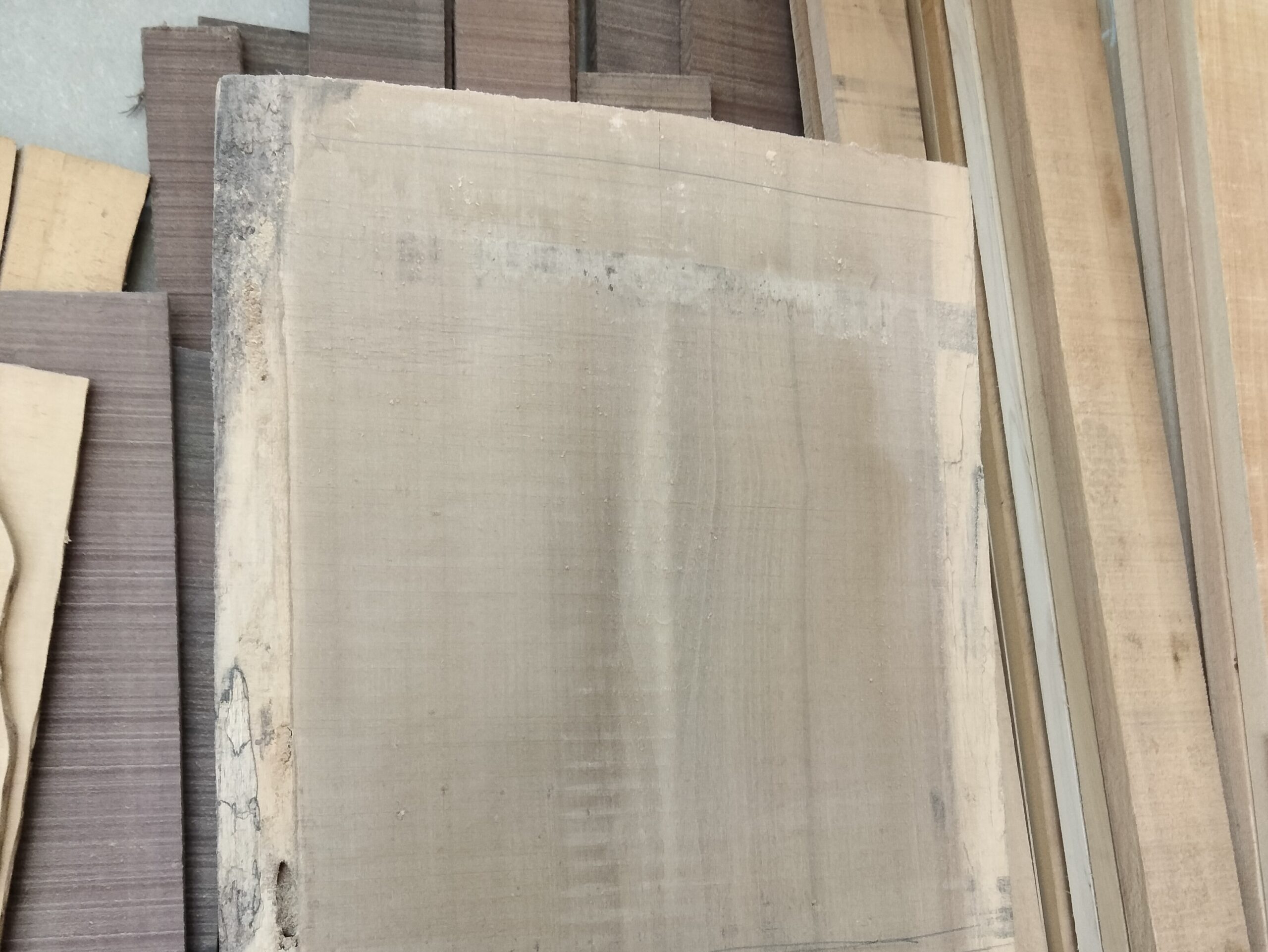
Today, I did the final check on the completed 5-sun 27-steps puzzle box, and also prepared for my next work. As I mentioned before, after finishing the 4-sun 18-steps box that I am currently working on, I will make Mame puzzle boxes with a 14-step mechanism. I already had materials prepared with yosegi sheets attached, but I decided to add a model that combines traditional yosegi and Ho wood, so I prepared additional materials for that. The photo shows the Ho wood that will be used. This wood was cut from logs into large boards about 3 cm thick, and has been left standing to dry in this state for about 10 years. So it should be well dried. From there, I cut it into pieces about 36 cm long, 3 cm wide, and 2 to 4 mm thick. These pieces will be used to make the small parts for the Mame puzzle boxes. I carefully measured the thickness of the boards with yosegi sheets, and made the long side panels, including the structural parts, 4.2 mm thick, and the smaller side panels 2.3 mm thick, matching exactly the thickness of the yosegi boards. Otherwise, it would not be possible to process everything together at the same time. In addition to this 3 cm thick Ho wood, I also have well-dried Ho wood that is about 4.5 cm thick. The 3 cm boards have a slightly grayish tone, almost like a gray-green color. The 4.5 cm boards, on the other hand, have a more vivid green color, which is quite rare. So when making the main body of the box, like this time, I use the more gray-toned wood, and when I want to emphasize the color in yosegi work, I use the greener wood.
By the way, this Ho wood is known as magnolia in other countries, and it seems to be widely used around the world because it is easy to work with. While it belongs to the same general type of tree, it is not exactly the same, as each country has its own variety. The one I use is Japanese magnolia. Overseas, it is called “Japanese big leaf magnolia”, and as the name suggests, it has very large leaves. Even today, these large leaves are used for things like serving food or for various other purposes. Long ago, it is said that the leaves were even used as a substitute for toilet paper… at least according to tradition…. But since the leaves seem to have antibacterial properties, maybe it was not such a bad idea after all 😅