It was another beautiful day, and I worked in the workshop all day. The yosegi boards for the 10-steps Mame puzzle boxes that I glued yesterday still need more time to rest, so I did not work on them today. Instead, I glued the other sliding key panel for the 4-sun 14-steps puzzle boxes while also preparing for the next project. The next boxes I will make are the 3-sun 12-steps puzzle boxes. I plan to make about 70 pieces this time, and most of them are custom orders. However, I will make a few extra, so I think I can keep some as my own stock. Today, I started by gluing the yosegi sheets for these boxes. Just like yesterday, I continued with the gluing work again today.
At the same time as preparing the boards for the yosegi sheets, I also prepared the structural parts for the 3-sun 12-steps puzzle boxes. This time, I will make two types. One is a combination of traditional yosegi and ichimatsu yosegi. The other is a combination of one-point yosegi and ichimatsu pattern. All of them will have ichimatsu pattern side panels, so today I mainly worked on gluing for those panels. I also glued a small number of traditional yosegi boards. For the one-point yosegi type, I use plywood panels for the base. Then, just before the final coating, I attach a small piece of yosegi sheet as an accent. I have been making this one-point yosegi type for quite a long time. Originally, I started this model because I wanted to create a box at a slightly lower price. It is like an introduction model. I hope that first-time customers will buy this box, learn what a puzzle box is, and understand how it works. Then, if they like it, they may choose a box with more steps or a larger and more expensive box in the future. However, because of changes in the world economy, the price of wood and many other materials has increased. It has become difficult to make this box at the same price as before. Even so, this model is still popular. Now, the price is almost the same as the other 3-sun 12-steps puzzle boxes, but I still receive orders for it. Surprisingly, some people prefer a model that does not have traditional yosegi on all sides. That may be one of the reasons why I continue to receive requests for this type.
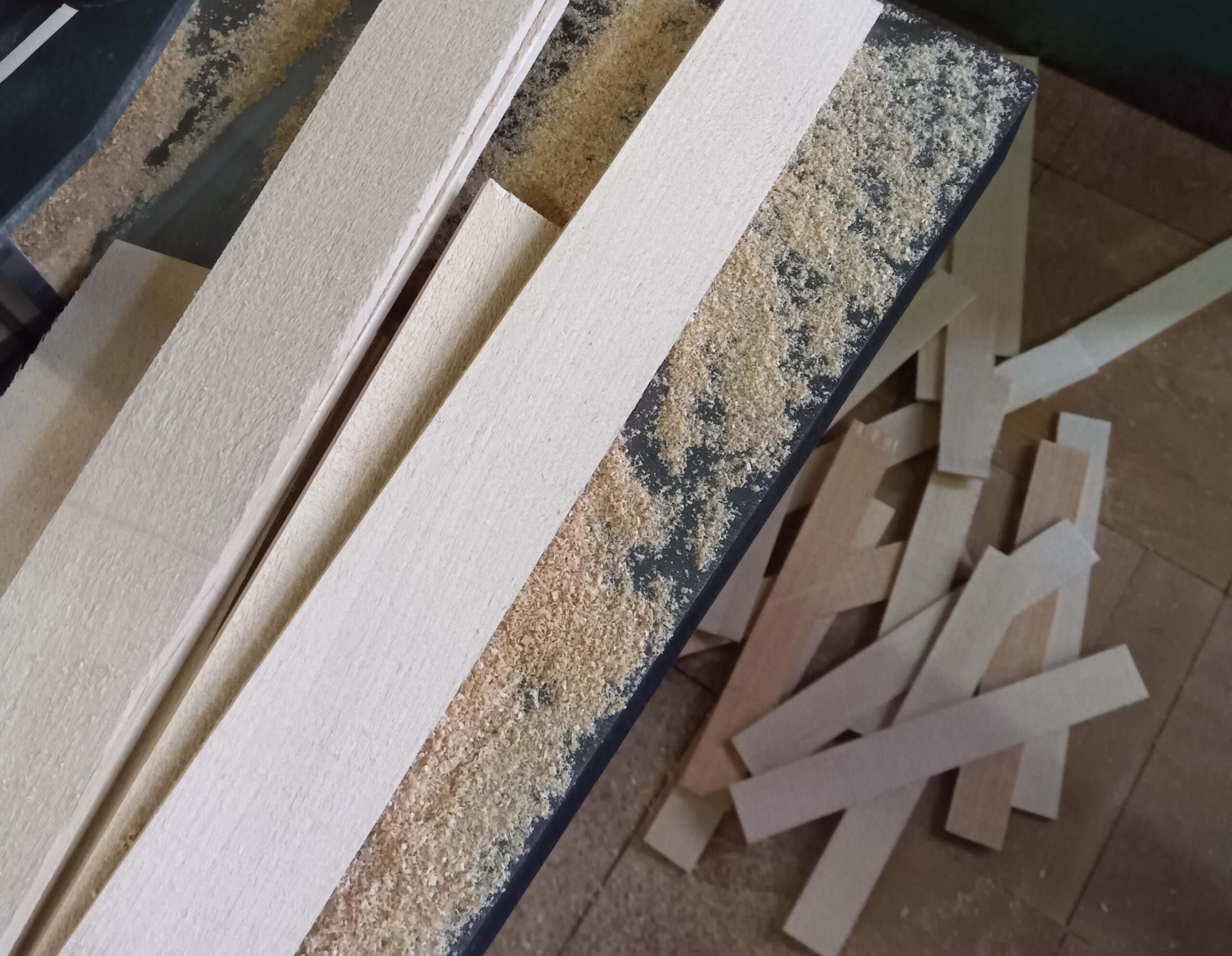
The photo shows me preparing the boards for the ichimatsu yosegi sheets (for side panels) that I will use this time. I will use the usual four-color ichimatsu yosegi sheets. Today, I prepared about 70 boards. It does not mean that I need 70 boards to make 70 boxes. In fact, 70 boards would be slightly more than necessary. To make 70 pieces of the 3-sun puzzle boxes, I need 63 boards for the ichimatsu side panels in the long form shown in the photo. The reason is this. From one board of about 34 cm, like the one in the photo, I can cut four long sides for the 3-sun boxes, each about 8 cm. And I can cut five short sides from a board. So, 4 × 35 boards gives 140 long pieces, and 5 × 28 boards gives 140 short pieces. That makes a total of 63 boards. Each box needs two long sides and two short sides, so I need 140 pieces of each. In reality, I prepare a few extra pieces just to be safe. In most cases, preparing materials for Japanese puzzle boxes is done with careful calculation like this.
Have a wonderful weekend! 😊