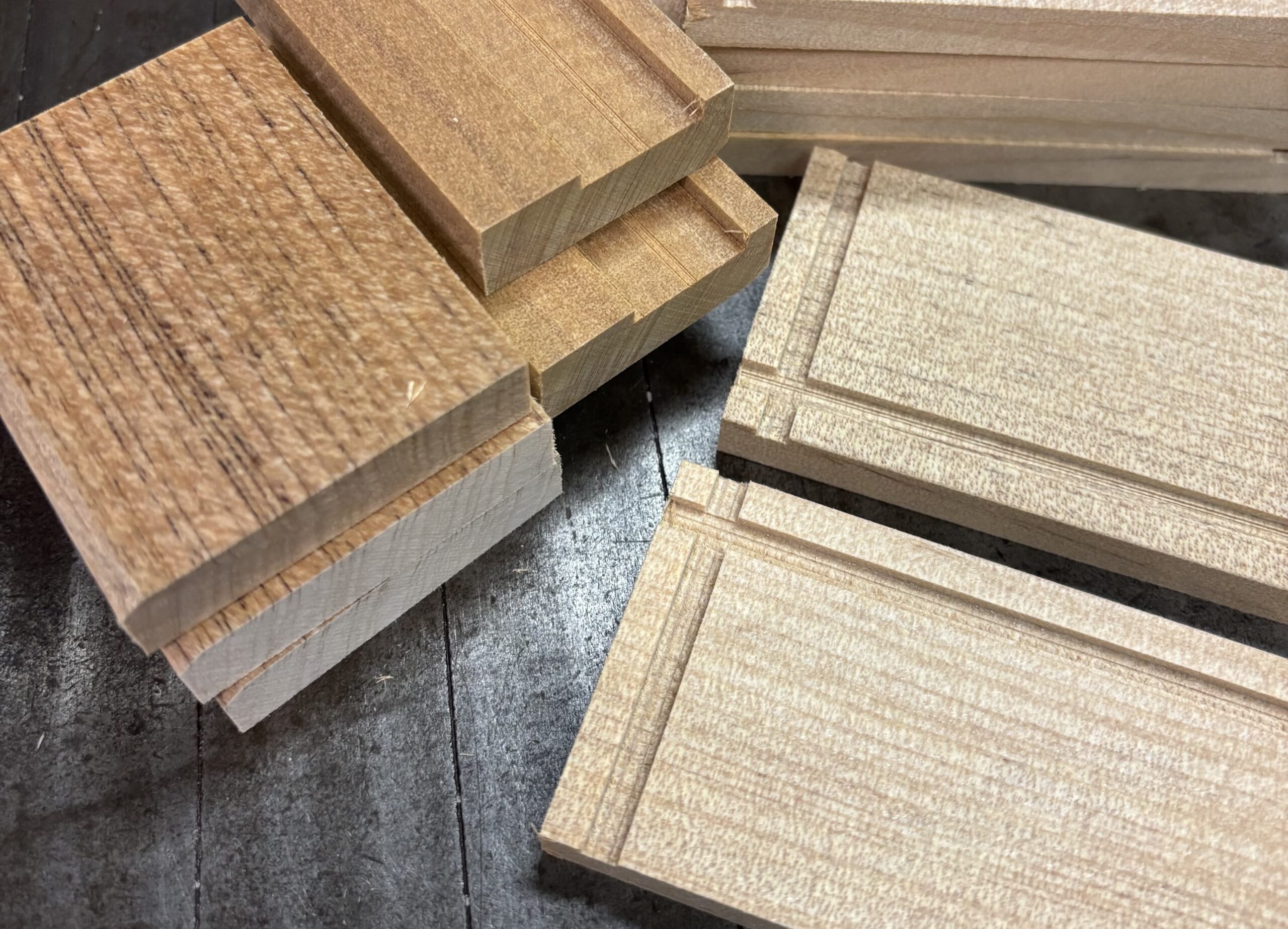
The weather was poor from the morning, and it began to rain before noon. Once it rains, it feels quite cold, making me miss the slightly warmer days!..haha. I worked a little quickly to finish the top and bottom Aruki panels during the morning. After that, I cut out the outer Yosegi panels for the top and bottom. With these ready, I will be working on assembly for a while.
The top and bottom decorative panels for this batch all have traditional Yosegi. However, I use different base boards depending on the side panel design. For the boxes with traditional Yosegi side panels, I use Shina plywood, which I have often used in the past. Its price has risen sharply, and fewer shops now carry it, so I currently use it only for this traditional Yosegi model in the 5-sun size. For the boxes with checkered side panels, I use traditional Yosegi sheets attached to MDF boards. This is because the Yosegi sheets are a different size. This yosegi sheet (for MDF) is not specifically made for 5-sun boxes; I also use them for 4-sun and 3-sun boxes. Something I always notice is that the Shina plywood panels fit slightly more tightly, even though both types of board are about 3 mm thick. I cut them to the same dimensions in exactly the same way, but they feel a little different when fitted into place. So, after setting the cutting guide for the Shina plywood panels, I adjust it very slightly when cutting the MDF panels to make them a little wider. I think this difference comes from how firm or soft the two materials are.
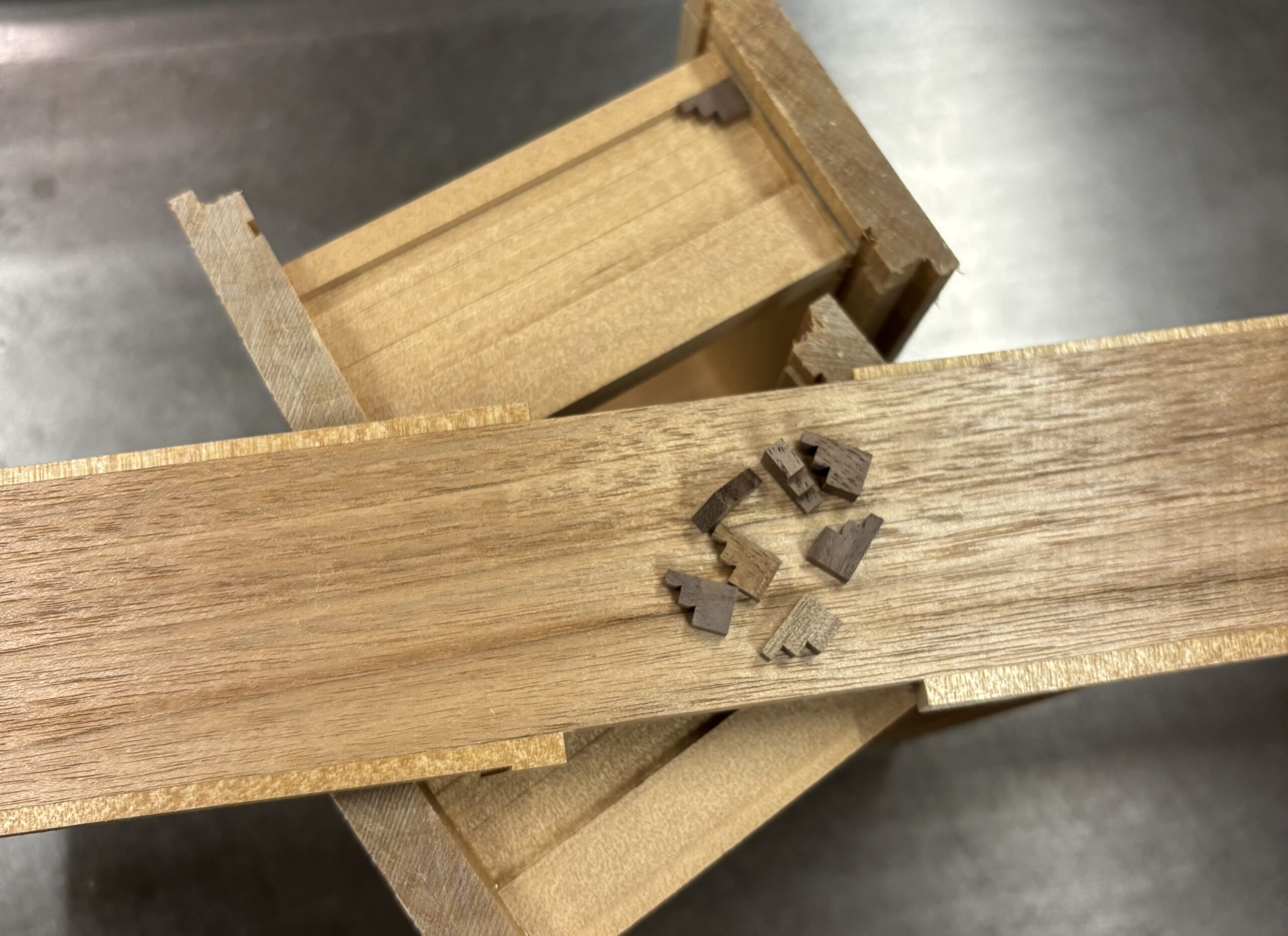
After that, I needed to make a slightly unusual box. The photo shows this box. It is a simple sample, so I decided on the dimensions as I worked. You can see the long side panels in the photo, each with two grooves cut into it. Since this is a simple build, I cut these grooves all the way through to the edges. As I mentioned briefly in a recent article, older Japanese puzzle boxes had these shorter grooves stopped before the edge, regardless of the number of steps. I feel that cutting the grooves all the way through makes it much harder to keep the Aruki panels moving evenly. So why use this method? Mainly because it makes cutting the grooves more efficient. With stopped grooves, I need to work on each long side panel separately. With grooves that go all the way through, I can cut several panels together. This saves time when making a large number of puzzle boxes. However, it makes adjusting the movement more difficult later, so I still wonder which method is better overall. There is another reason, and this matters more to me. Grooves that go all the way through allow me to remove the Aruki panels later. Normally, there is no need to do this. But if a problem develops and I need to adjust or repair the movement while keeping the original panel, being able to remove it is very useful. With a stopped groove, removing an Aruki panel without breaking it is extremely difficult.