Today is Sunday, and Japan is currently in the middle of a three-day holiday, with tomorrow also being a holiday. Because of this, the town seems a little busier than on a usual Sunday.
Festivals are also often held in many areas at this time of year, and I happened to see one while passing by. These are traditional local festivals with portable shrines and festival floats. Today is another very hot day, but the dates of these festivals have been fixed for many years, so it is difficult to move them to a different time. Fortunately, the festival in my area is held in spring, so I feel a little relieved. With the extreme heat continuing every year, holding these events outdoors can be dangerous.
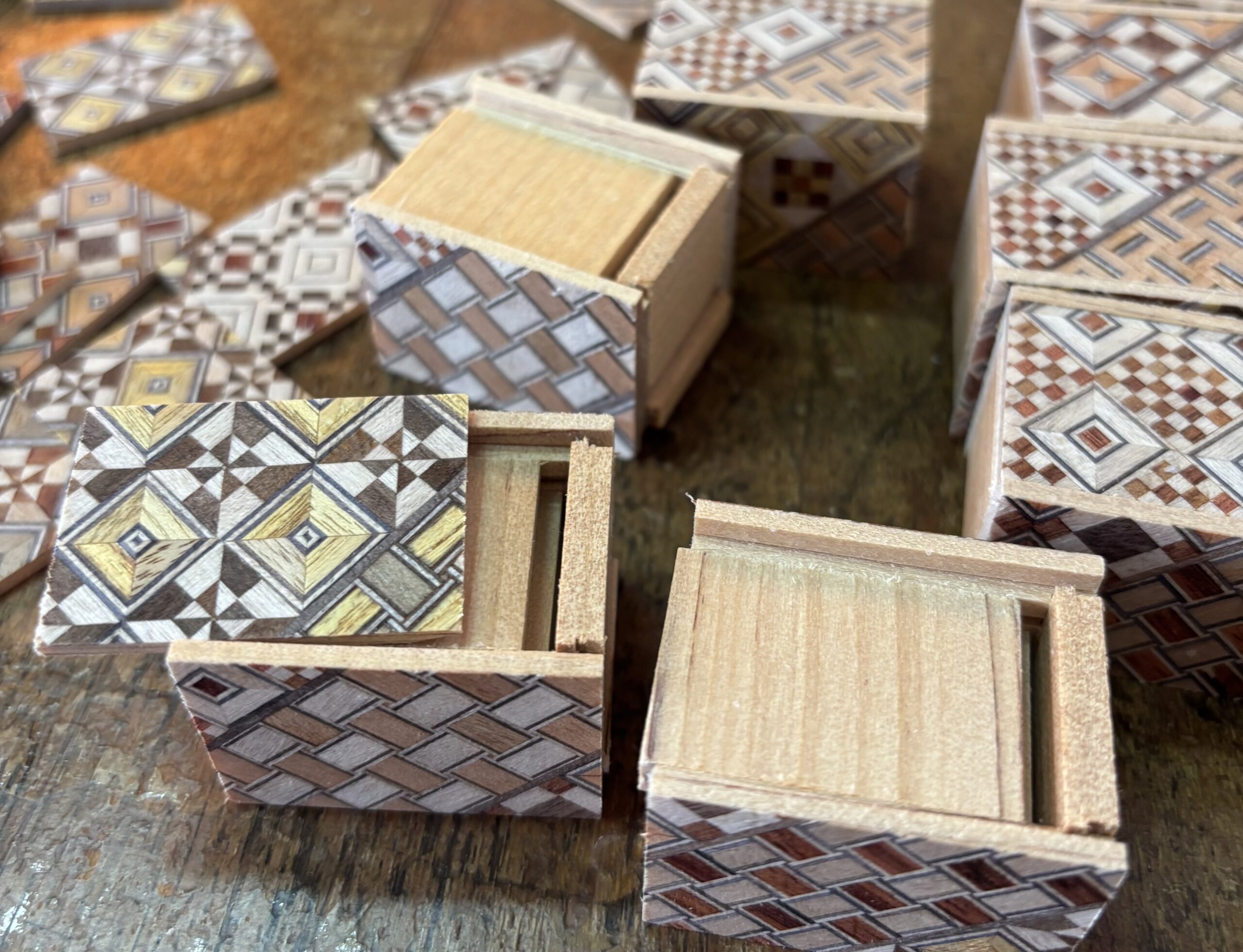
I am currently making Mame puzzle boxes, and this time they are the standard 14-step type. The Mame puzzle box was the first box for which I started using the one-piece side panel method that is now commonly used in my production. Since the production cost was very low, I had to think about how to make them more efficiently, and that is when I came up with this method. The one-piece method means attaching the inner and outer side panels together while they are still in the form of flat boards. This removes the need to attach the outer panels one by one after the inner structural box has been completed. I now use this method for many of my puzzle boxes. For this Mame puzzle box, I go one step further and make the two side panels from a single board. Normally, the inner and outer panels are made by joining two separate boards. For this Mame puzzle box, however, I create a step in one board so that it works like two boards, even though it is actually only one piece of wood. I think this single-board method is only possible for very small boxes.
Although I no longer need to reduce the amount of work as much as before, many efficient production methods are still used in Mame puzzle boxes. Besides the side panels, there is another example. With a normal puzzle box, after attaching the top and bottom panels, I machine the sides of the box before attaching the panels for the next stage, the Aruki side panels. However, I do not do this with Mame puzzle boxes. After attaching the top and bottom panels, I attach the sliding panels without machining the box body. Normally, the top and bottom panels stick out slightly, so I machine the sides of the box to remove those raised parts. On a Mame puzzle box, however, the top and bottom panels do not stick out, so this step is unnecessary. They do not stick out, but they are not set too far inward either. They must be attached perfectly flush from the beginning. This requires very precise work. If a panel is even slightly too far inward, a gap will appear on the side of the box. Therefore, both cutting and attaching the panels must be done very accurately. Making them efficiently requires a high level of skill.
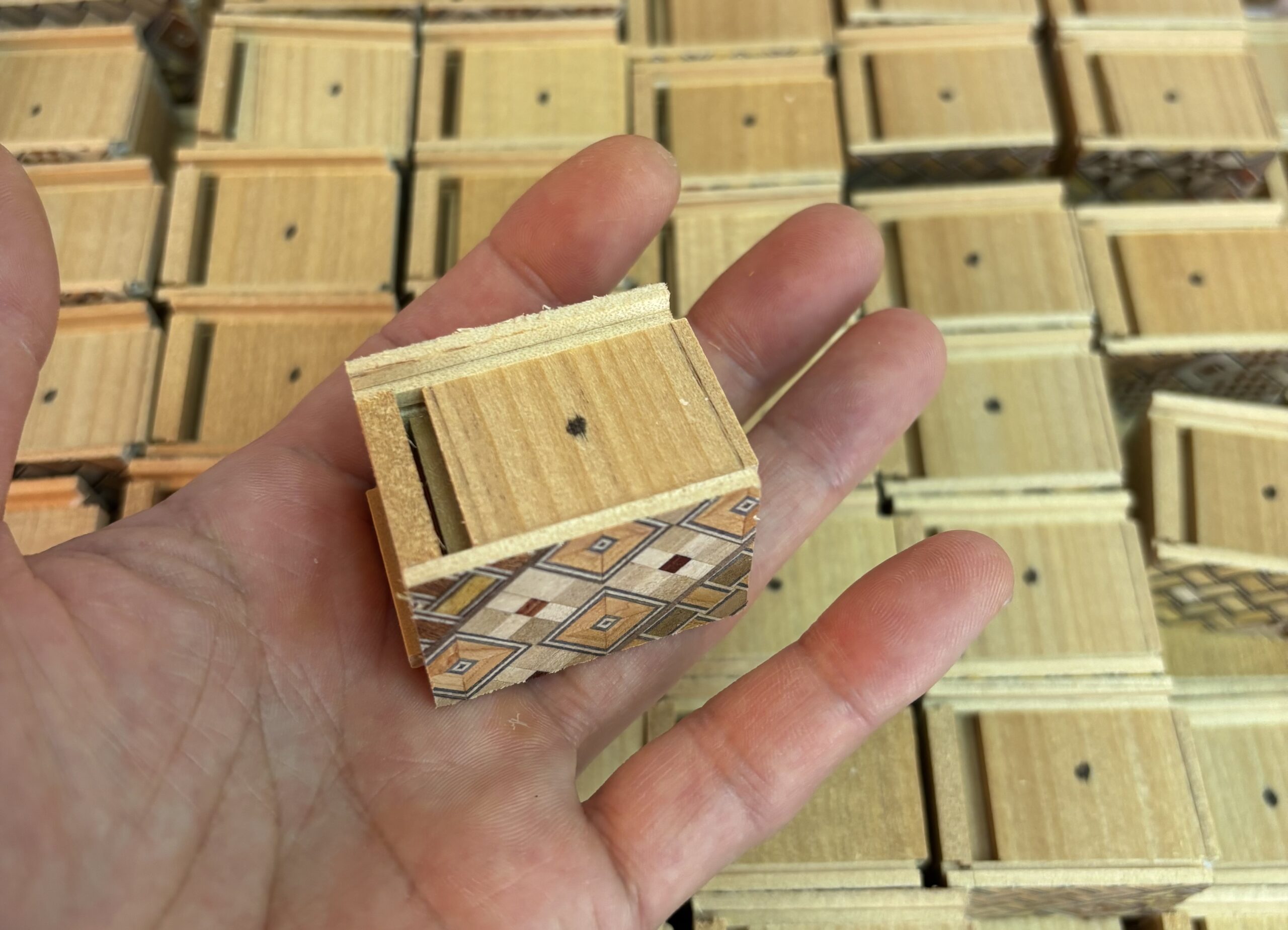
The black dot in the photo is a mark showing which side is the top, or lid panel. I try to use the more colorful and attractive yosegi pattern for the lid whenever possible.