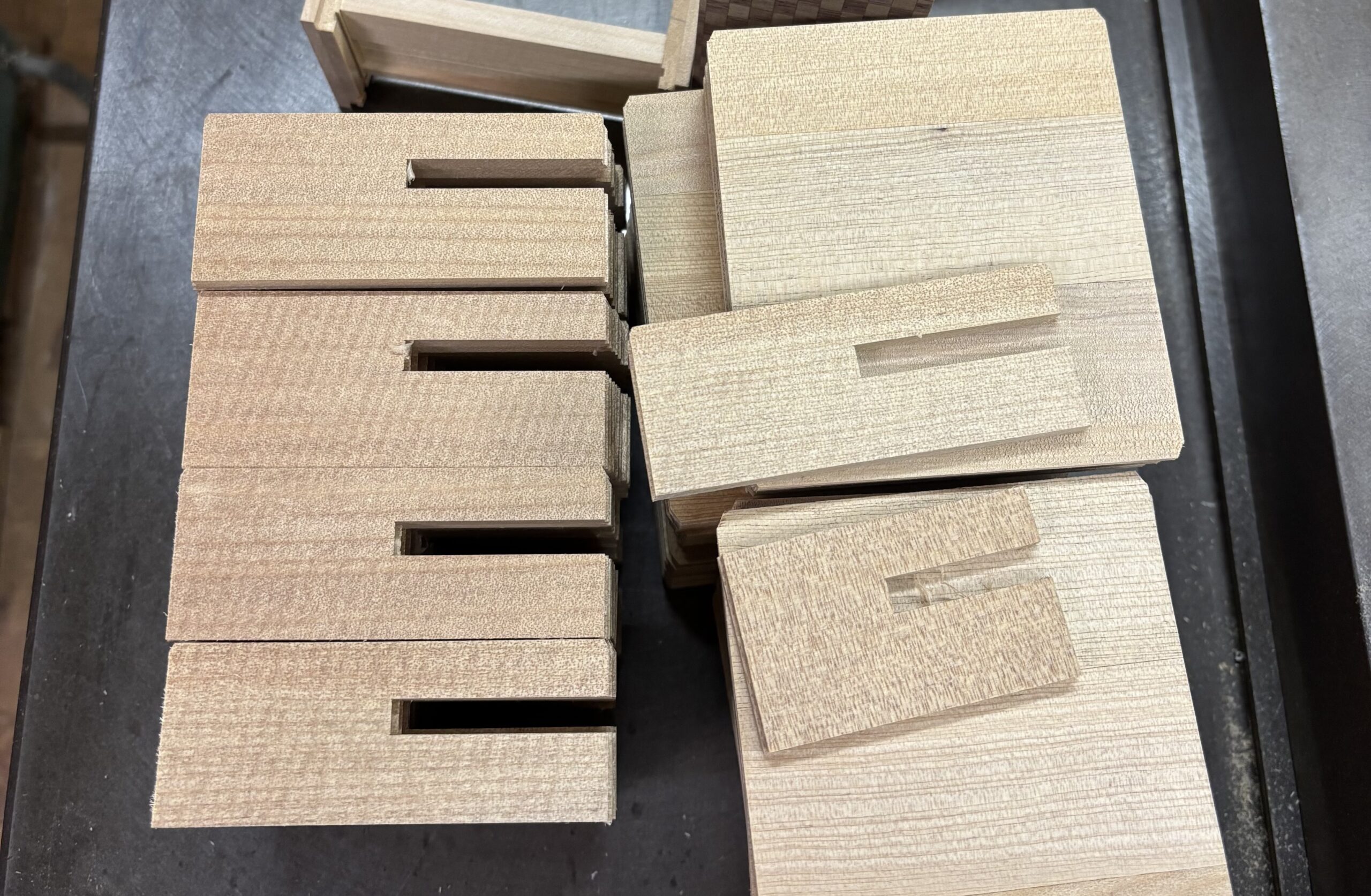
As I mentioned in yesterday’s blog, it was already raining this morning. The temperature was low, and it felt too cold for short sleeves. Just a few days ago, it was over 30°C, but today’s temperature may be more typical for this time of year. The humidity was already very high this morning. I went to the workshop in the afternoon, but I did not do much work that needed fine adjustments. However, I did apply the top coat to the boxes I had base-coated yesterday. I have also made the Aruki sliding panels for the wide puzzle boxes, but I am a little hesitant to attach them in this humidity, so I am keeping them in a storage case for now. However, I did attach the parts of wide box.
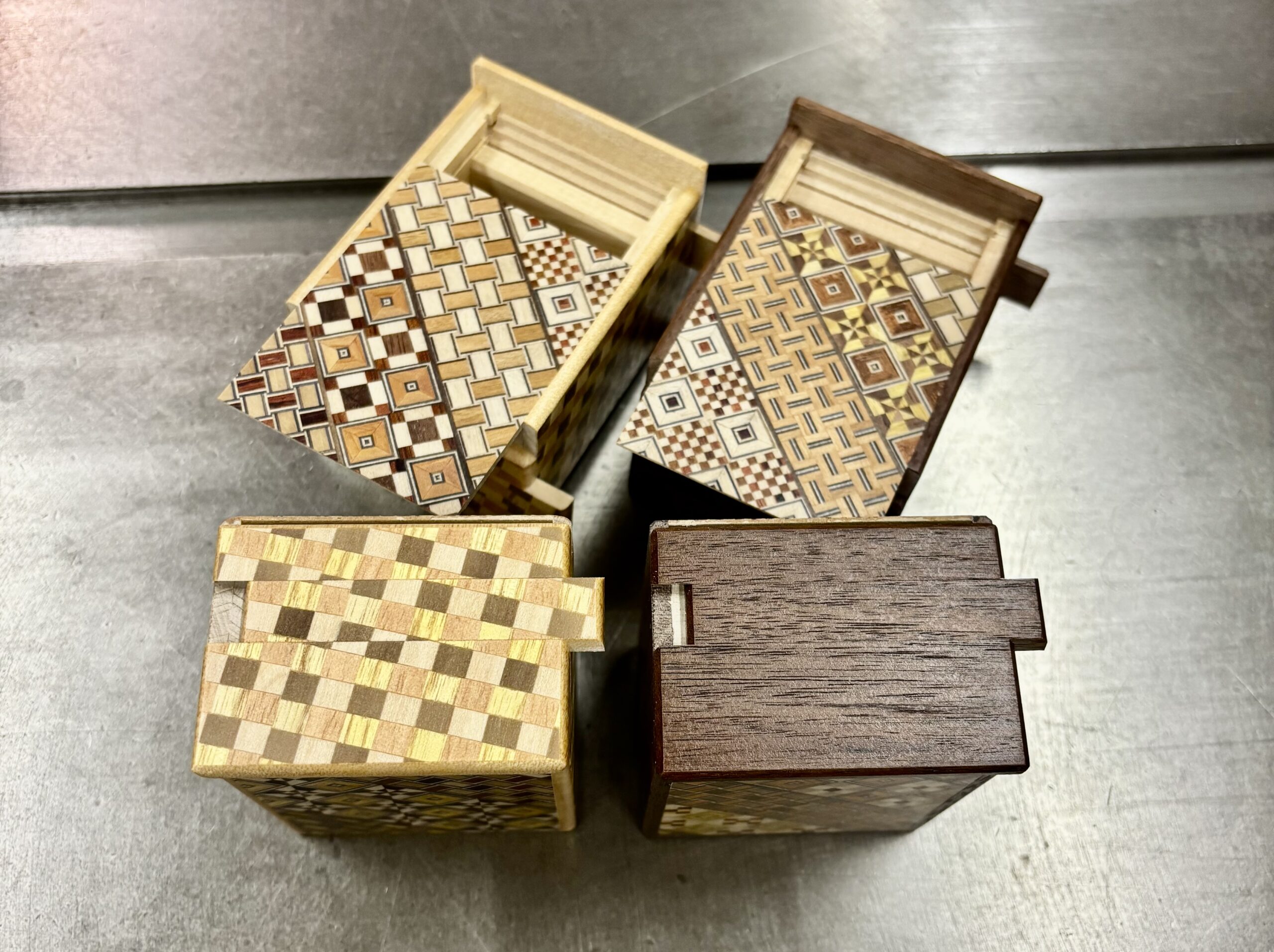
The photo shows the 3-sun 18-steps puzzle boxes I coated today. I applied the top coat, so the coating process is now complete. I usually apply two coats: a base coat and a top coat. I tend to apply the base coat a little more thickly. It fills the tiny pores and grain lines on the wood’s surface to create a smooth, level surface for the top coat. However, The coating is a little thinner than the coating used on other puzzle boxes or furniture. Other puzzle boxes with sturdier construction, as well as furniture, may have a thicker protective coating, but Japanese puzzle boxes are generally coated more thinly. In the past, Japanese puzzle boxes were not coated this way. Instead, wax was rubbed onto the surface to protect it. One important reason is that the coating can cause the moving parts of the mechanism to stick together. This may not be the main reason, but it is certainly a significant one.
Of course, the moving parts of other puzzle boxes can also stick together after coating. However, these boxes may have sturdier construction or thicker wooden parts, so they are less likely to break when freeing parts that have stuck together. Japanese puzzle boxes use thin, delicate wooden parts, so there is a greater risk of cracking or breaking part of the box when freeing a mechanism stuck by the coating. Also, the parts fit together so closely, with very little clearance, that the coating may cause them to stick together more firmly.
Now, back to the coating process. After applying the base coat, I sand the box to make the surface smoother and flatter before applying the top coat. But before sanding, I first move the mechanism to free any parts that have stuck together after the base coat. The parts will stick together again after the top coat, so if I skip this step, both coats will hold them together, making them harder to free. When I do this with the two designs I am making this time, the boxes with Walnut side panels, shown on the right in the photo, are easier to get moving because the coating does not hold the parts together as firmly. In other words, the coating causes the Agathis panels covered with Yosegi to stick together more firmly.
To be honest, I do not know exactly why this happens… I have some ideas, but I have never carried out experiments to identify one clear reason. Still, there is definitely a difference. This makes working with Walnut a little less stressful, because the box can sometimes be damaged when freeing parts that have stuck together. With experience, I now know not to force them apart, but I used to make this mistake quite often. Pushing too hard on parts stuck together by the coating would sometimes split the wood. I suspect that oils and other substances in Walnut may be part of the reason it does not stick as firmly. I have also heard that it contains a relatively large amount of lime, though I have not confirmed whether this affects the sticking. These surface properties may also make it harder for glue to bond. By comparison, Agathis has a less oily surface. It feels dry rather than sticky, and coatings and glue seem to bond to it more easily. Agathis is soft, easy to cut, and easy to work with. However, the parts can stick together quite firmly after coating, which makes the coating process a little more challenging. Both woods have their advantages and disadvantages! I have noticed similar differences with other woods too. Soft woods such as Hō tend to behave like Agathis, while hard woods such as Rengas tend to behave more like Walnut. So now, I always move the mechanism once after the base coat, before applying the top coat. This keeps sticking to a minimum, and I almost never damage a box during this process anymore.