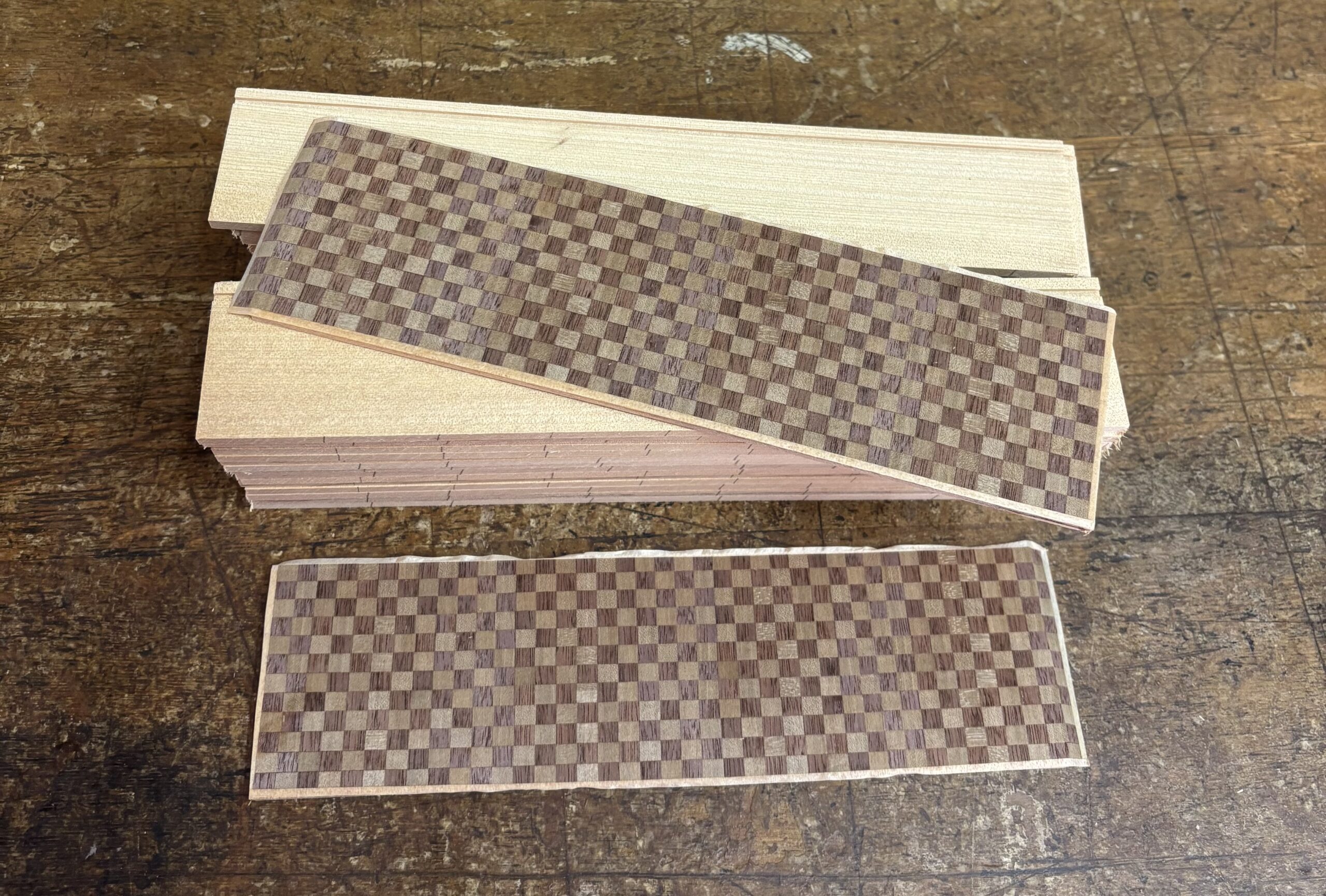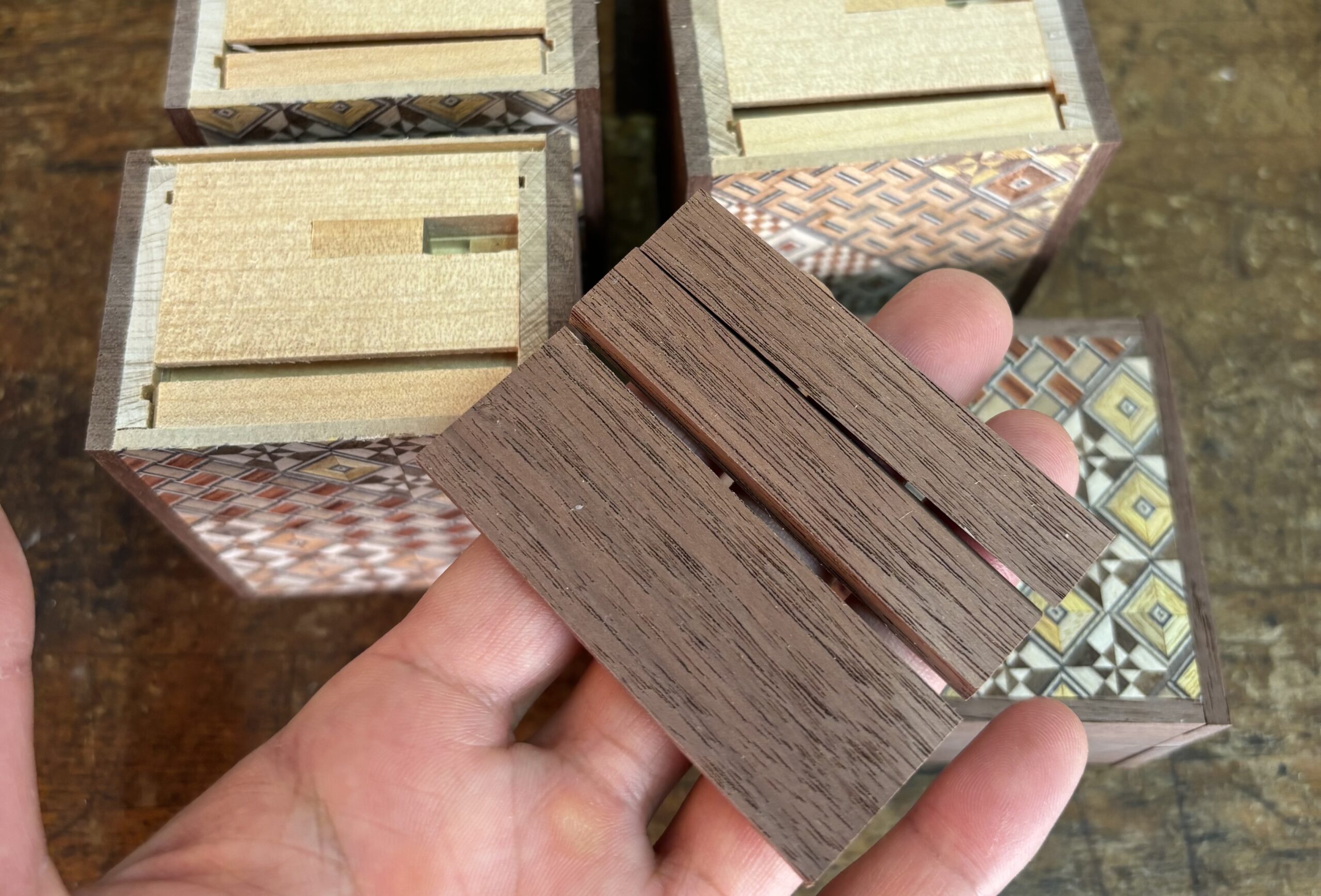
The weather cleared up this morning, and the temperature dropped, making it a pleasant, refreshing day. Days like this are ideal for fitting the mechanisms and especially for gluing the panels in place. I started attaching the sliding key panels to the 3-sun boxes yesterday, and there was still one side left to do. With today’s weather, I could attach those panels without worrying about the humidity. Today, I also began working in earnest on the wide 14-steps puzzle boxes.
I added a few more boxes to this batch, so I am currently making 44 of the 3-sun boxes. The sliding key panels for these boxes are about 6.5 cm long and 5 cm wide. As I often explain, each panel is divided into three parts, with the sliding key in the middle. These three separate parts form one panel. They are cut from a single board, so the wood grain continues across all three. For larger panels, such as those on 4-sun or 5-sun boxes, I apply glue to the contact areas on the box and place the three parts onto it one at a time. Each part has its own position, so I need to place it carefully. If it shifts, it may touch glue meant for another part and stick where it should not. So I carefully attach each part in turn. With the smaller 3-sun panels, however, I can place all three parts onto the box at once. This is possible because the whole panel is only about 5 × 6.5 cm. Even so, the parts are separate, so they will fall apart unless I hold them properly. I also need to place them in exactly the right position for the gluing to work. I have become used to this method over many years of making boxes. Although I make smaller batches these days, I used to make 100–300 boxes at a time. I developed this way of attaching the panels to work more quickly. Even now, I can attach the sliding key panels to 3-sun boxes faster than I can on the other sizes.
After that, I worked on making the parts for the wide puzzle boxes. “Wide” simply means that the box has extra width, so many of the parts require longer pieces of wood than usual. This is because the grain in the axis panels and Aruki panels runs across the width of the box. Wood changes very little in length along the grain, but it expands and shrinks more across the grain. By using this natural property and running the grain across the box’s width, I help keep the mechanism stable. If the grain ran the other way, changes in the width could make the mechanism stiff. An Aruki panel might even shrink enough to come out of its grooves. So, for these wider boxes, I need longer pieces of wood for both the Aruki panels and the axis panels. The dimensions are a little different from those I usually prepare for 4-sun and 5-sun boxes, so I take care not to mix them up. For example, a board about 30 cm long might provide four axis panels for a 4-sun box, but only three for a wide box. In most other ways, the wide box is based on my 4-sun puzzle box, so the boards used for the Aruki panels, frame panels, and axis panels have the same thickness.