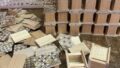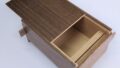
The temperature has been a little lower over the past few days, making the weather more comfortable. However, because of the rain from evening into the night, the humidity has been high. I have mainly been making Mame puzzle boxes recently, so it has not bothered me very much. However, it would be unpleasant weather if I were making regular-sized puzzle boxes. As for the Mame puzzle boxes, the 14-step boxes are now finished and are going through the final check. The 4-step boxes moved from the finishing process to the undercoat today. The end is finally coming into sight after making Mame puzzle boxes twice in a row. However, I am also thinking about making another batch next month for my own stock.
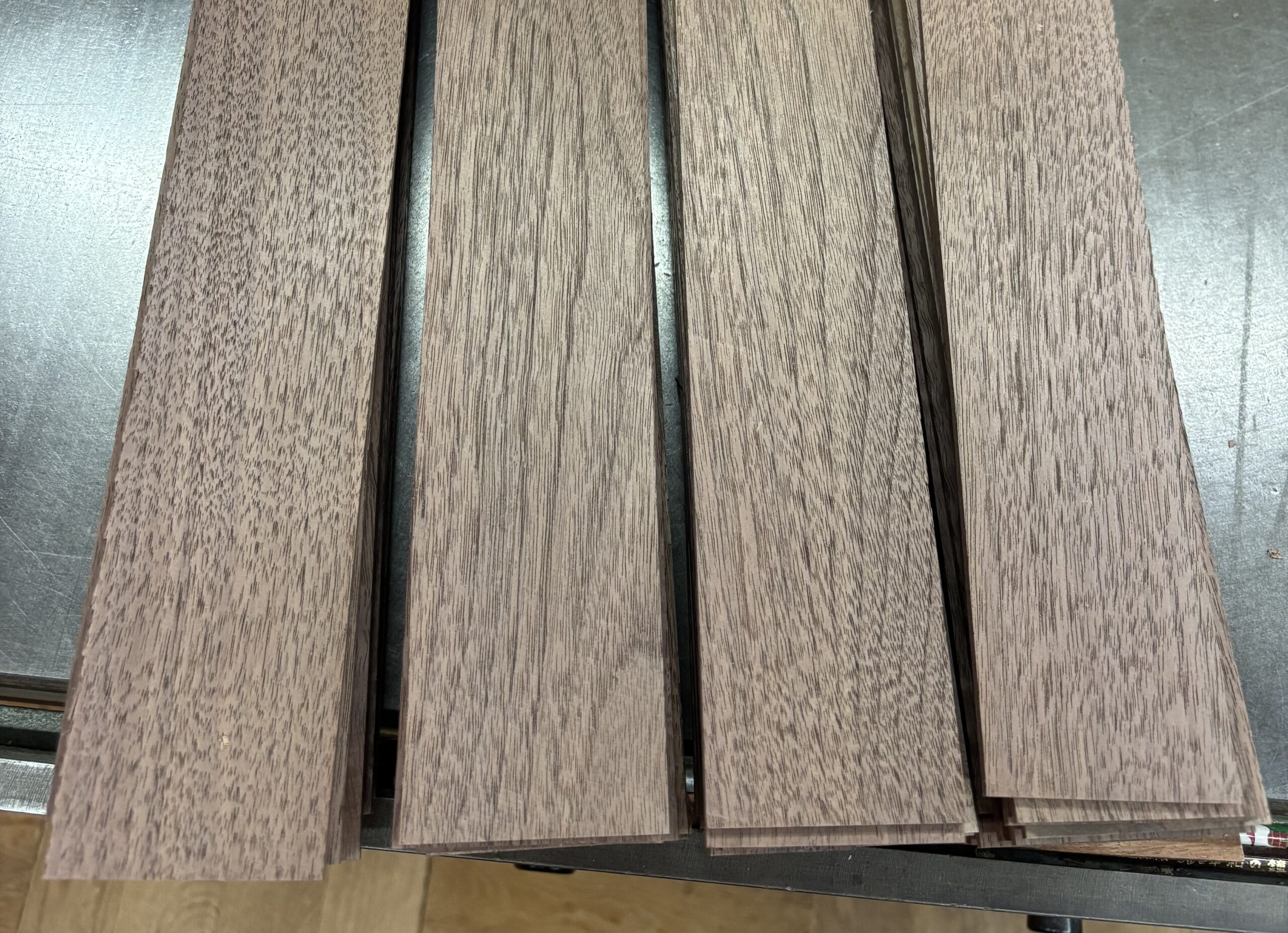
While waiting between the undercoating steps, I started preparing for my next production, which will be 4-sun puzzle boxes. Today, I first cut the Walnut for the side panels and planed it to the required thickness. The photo shows this work. This time, I will make 12-step and 14-step puzzle boxes. The side panels will be Walnut, while the top and bottom panels will vary depending on the order. Recently, I made the final 3-sun puzzle boxes with natural wood top and bottom panels. Among the boxes I am preparing this time, there will also be the final natural wood version of the 4-sun puzzle box. Because of the amount of material available, I will not have any of these for my own stock. However, I plan to make the all-Walnut version again after a long break. This type was very popular in the past, but I have not made it for some time. After that, I also plan to make square puzzle boxes, so I included a small amount of Walnut for their side panels as well.
Like many other woods, Walnut has become much more expensive since the pandemic. Of course, Walnut also has different qualities depending on the part of the tree, but for puzzle boxes, lighter wood with calm and straight grain is best. However, it is not possible to buy or use only those parts, so I use different parts of the wood for different parts of the box. In the photo, the wood is stacked in four groups. The grain in the middle two groups is used for the long side panels, which are fixed parts of the box. This type of grain is sometimes called flat-sawn grain. The grain is not straight and forms large patterns. Because these panels can be a little unstable, it is better to use them for parts that are glued and fixed in place. The boards in the two outer groups have straighter grain, and I use them for the sliding key panels. Since the sliding key panels are not fixed and have some areas that are not glued, they can easily warp later if the grain is not calm and straight. This kind of straight grain is called quarter-sawn grain.