Today was another hot day. I had planned to continue working on the 3-sun puzzle boxes, but since I thought I might have something to do in the evening, I decided not to start that work because it would take some time. Instead, I worked on the next production, the Mame 14-step Japanese puzzle boxes. These are made to order for a shop, and I will be making about 80 of them.
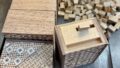
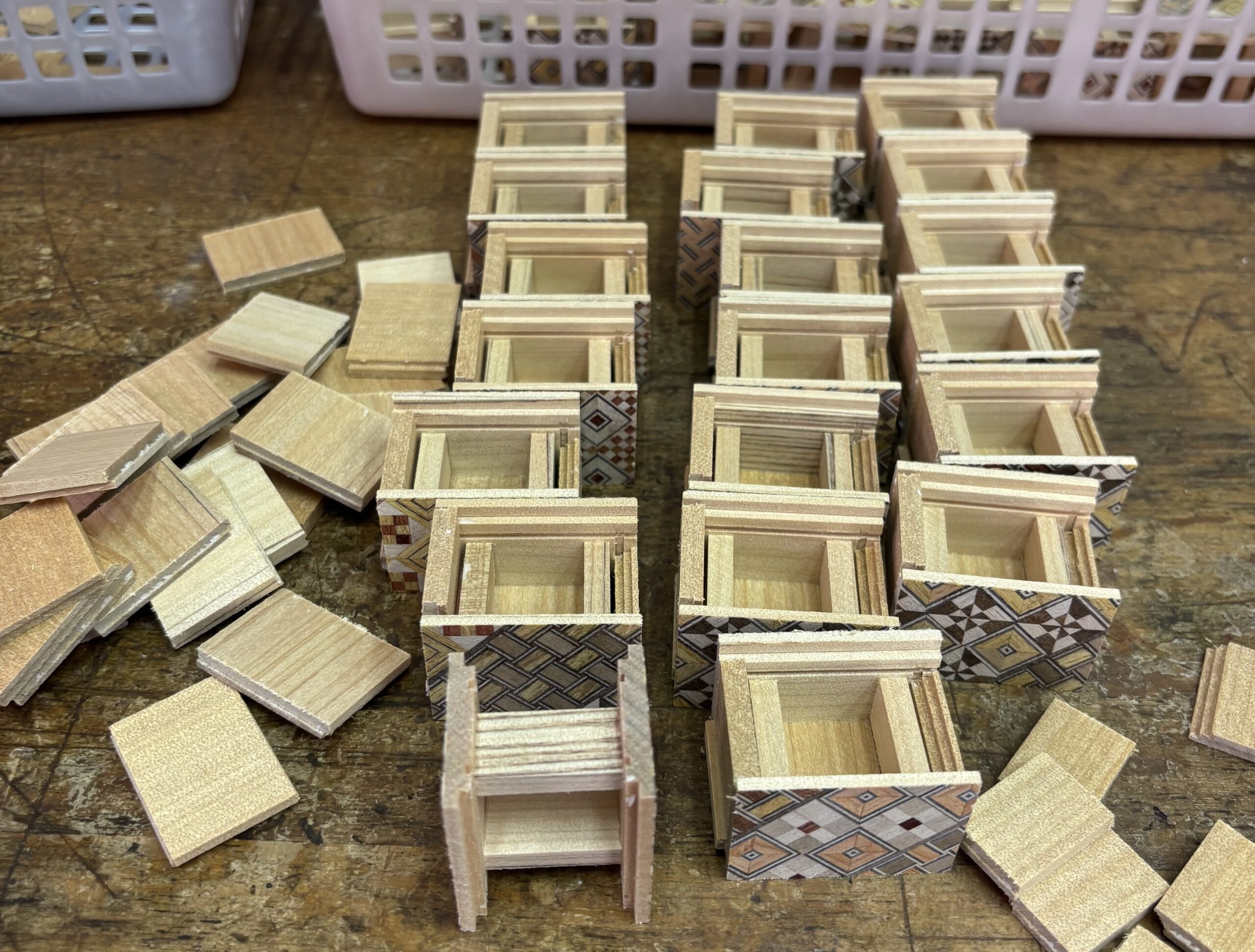
I had already prepared the materials and made and assembled the frame parts. So today, I made and attached the Aruki. I made the Aruki during the morning and started attaching them little by little in the afternoon. The photo shows this work. I often think that no Japanese puzzle box needs better-quality wood than a Mame puzzle box. Of course, other sizes also need good material for the Aruki, but Mame puzzle boxes are more delicate and require fine flexibility. As I have mentioned before, I would prefer to use Katsura wood if possible. However, good Katsura wood is difficult to find, so I select and use the best-looking parts from the Agathis wood I have in stock.
This mechanism has four panels. At this stage, the key point is to attach the panel that moves first, which is the smallest panel in this case, a little tighter than the others. If this panel is too loose, it may move while I am working and make the box difficult to build. It is also difficult to fix if it becomes even looser later. It is easy to loosen it when I check the mechanism at the end. Of course, there is a limit to how tight it should be. The other panels are attached with their usual firmness. Because a Mame puzzle box has such a small mechanism, adjusting its movement is very delicate. As I wrote yesterday about the 3-sun puzzle box, a small mechanism should generally move more lightly. To create the right amount of flexibility and resistance even with light movement, fine-grained, soft wood is essential.