Today was another nice day with low humidity, so it was very comfortable. I had a car inspection during the day, so I worked only a little in the morning and again in the evening. In Japan, a yearly car inspection is required by law. Some people don’t always do it since the penalties are not very strict, but I take my car to the shop once every six months. Usually, when you buy a car, the inspection service is included in the price, and in my case I have already paid for about five years of inspections. If I sell the car and don’t use that service, the remaining cost is returned. One inspection usually costs around 5,000 yen. There is also a mandatory vehicle inspection called “shaken”, which is required after three years for a new car, and then every two years after that. For used cars, it is required every two years from the beginning. After the inspection, a sticker is placed on the car, and if it is expired or missing, that car cannot be driven. The cost depends on the dealer, but it is usually around 100,000 yen. Today, I also had my car washed in addition to the inspection.
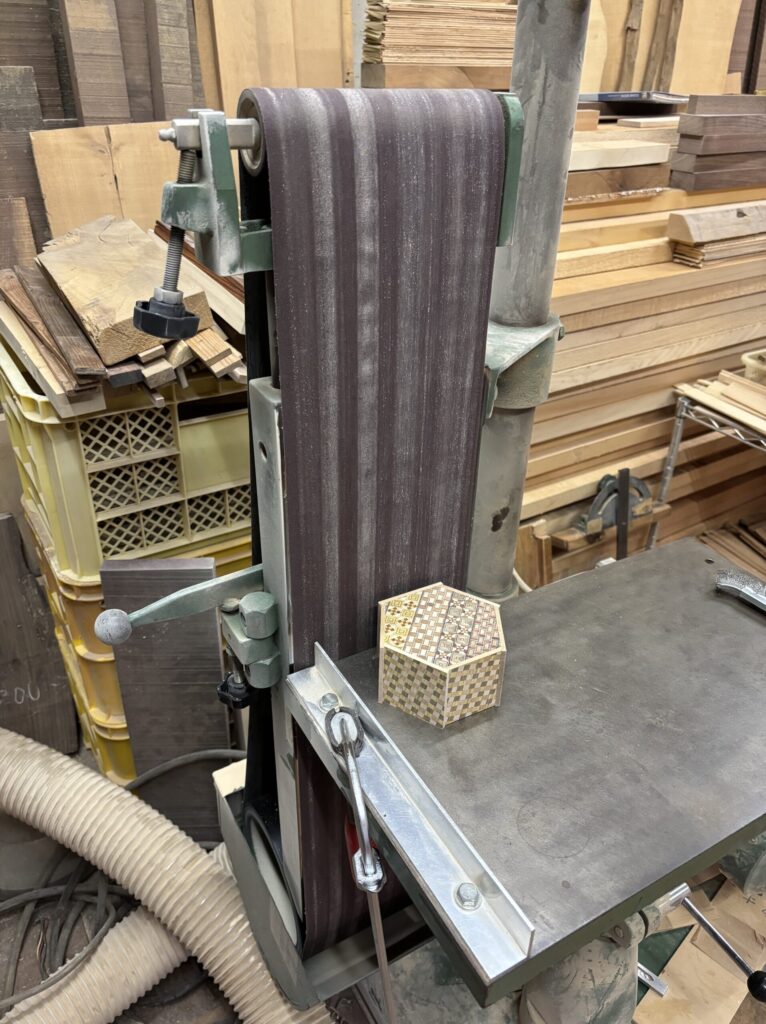
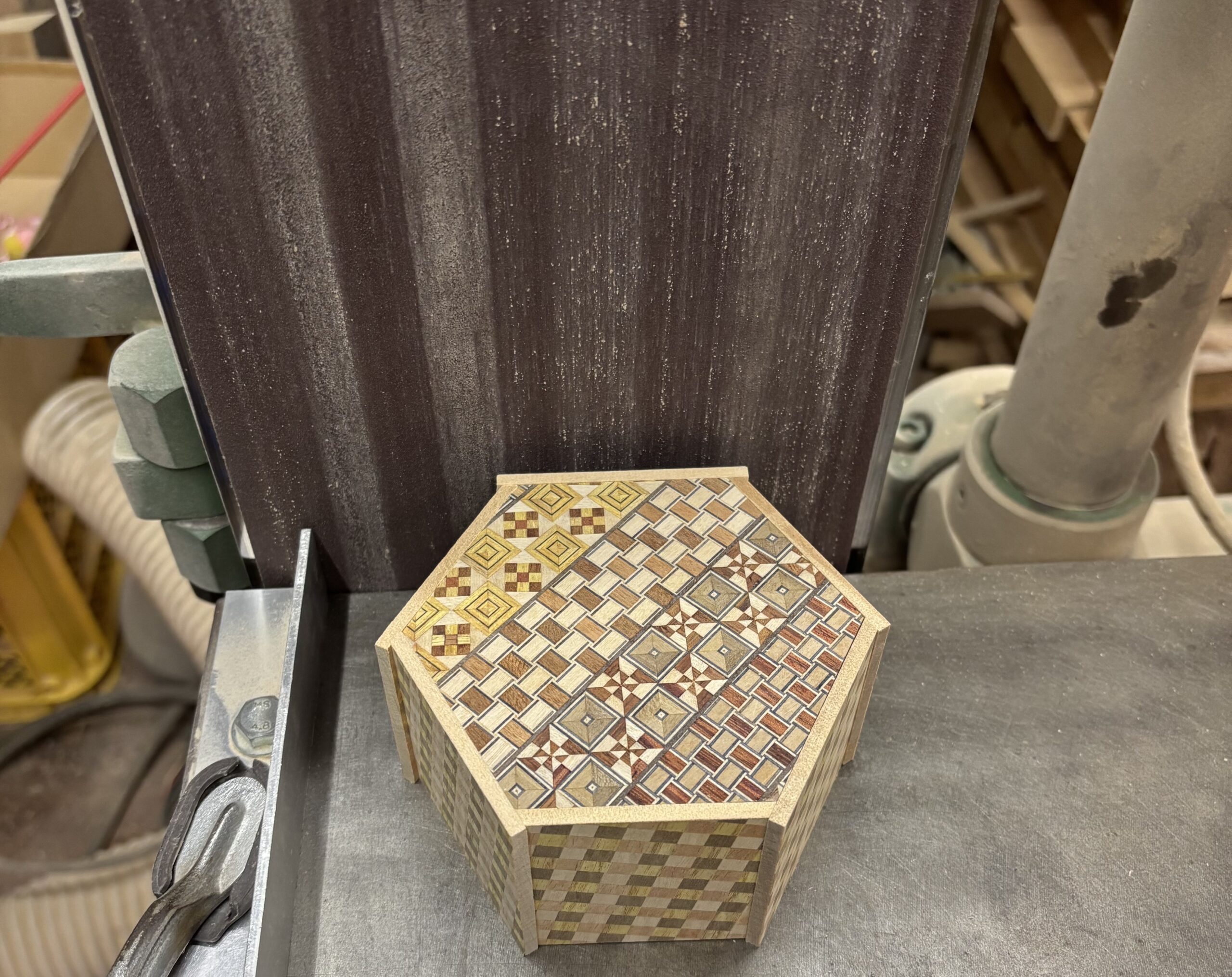
For the hexagonal boxes I’m currently making, I finally finished attaching the side panels today. I also posted about it on Instagram (@okapuzzlebox). When attaching the panels, I shave the surface of the box slightly to make it perfectly flat. For this kind of work on puzzle boxes, many people today use a machine called a universal sander. It’s a sanding machine, and the “universal” part means that the direction of the sanding belt can be adjusted freely. When working on a standard square puzzle box, the sanding belt is usually set horizontally. But in the photo, it is set vertically (sorry, the workshop is a bit messy…🤣) Since the hexagonal box has angled sides, it is difficult to sand properly if the belt is horizontal. Also, because each surface is relatively small, it is harder to control in that position. There is also a safety concern—if the box does not contact the sanding belt properly, it can be pulled by the machine. So for this box, I use the machine vertically, as shown in the photo. In this position, the force of the machine pushes downward, so as long as the box stays on the table, it is much safer. Woodworking machines like this are very dangerous, so I must take the utmost care with safety.
In other types of boxes where I use the sander vertically like this, there are models such as the 36-step or 54-step puzzle boxes, where the sliding keys move to both sides from the center. This sanding process is very delicate. Ideally, it would be best not to sand the assembled box at all, but in reality, small misalignments and unevenness occur during assembly. If these are not completely corrected, it becomes impossible to attach the side panels (Kannuki sliding key panels) without gaps. Also, although this hexagonal box does not have them, many puzzle boxes include small internal wooden parts (bocchi), and when those are used, they also need to be sanded down to the same level as the surface. So this process is essential. One important point is that the sanding belt and the table holding the box must be perfectly at a right angle, and this needs to be carefully adjusted. Otherwise, the surface will not be sanded at the correct angle. The pressure applied when sanding cannot really be explained in words—it has to be adjusted carefully for each box while sanding lightly. Since this is a professional woodworking machine, the sanding power is very strong. If I press too hard, it will remove too much material, so I have to rely on both my eyes and the feeling in my hands. I plan to move on to the finishing work for the hexagonal boxes starting Monday.