I worked in the workshop from the morning again today. I had something to take care of, so I planned to leave a bit earlier than usual. Because of that, I kept the workload lighter and finished earlier.
The 4-sun double puzzle boxes are still in the middle of the coating process and not finished yet. While waiting, I’ve been continuing the work on the hexagonal boxes. Today, I completed all the remaining yosegi sheet application and also prepared the materials for the other parts. I shaved them down to the correct thickness, so everything is now ready to start making the parts at any time.
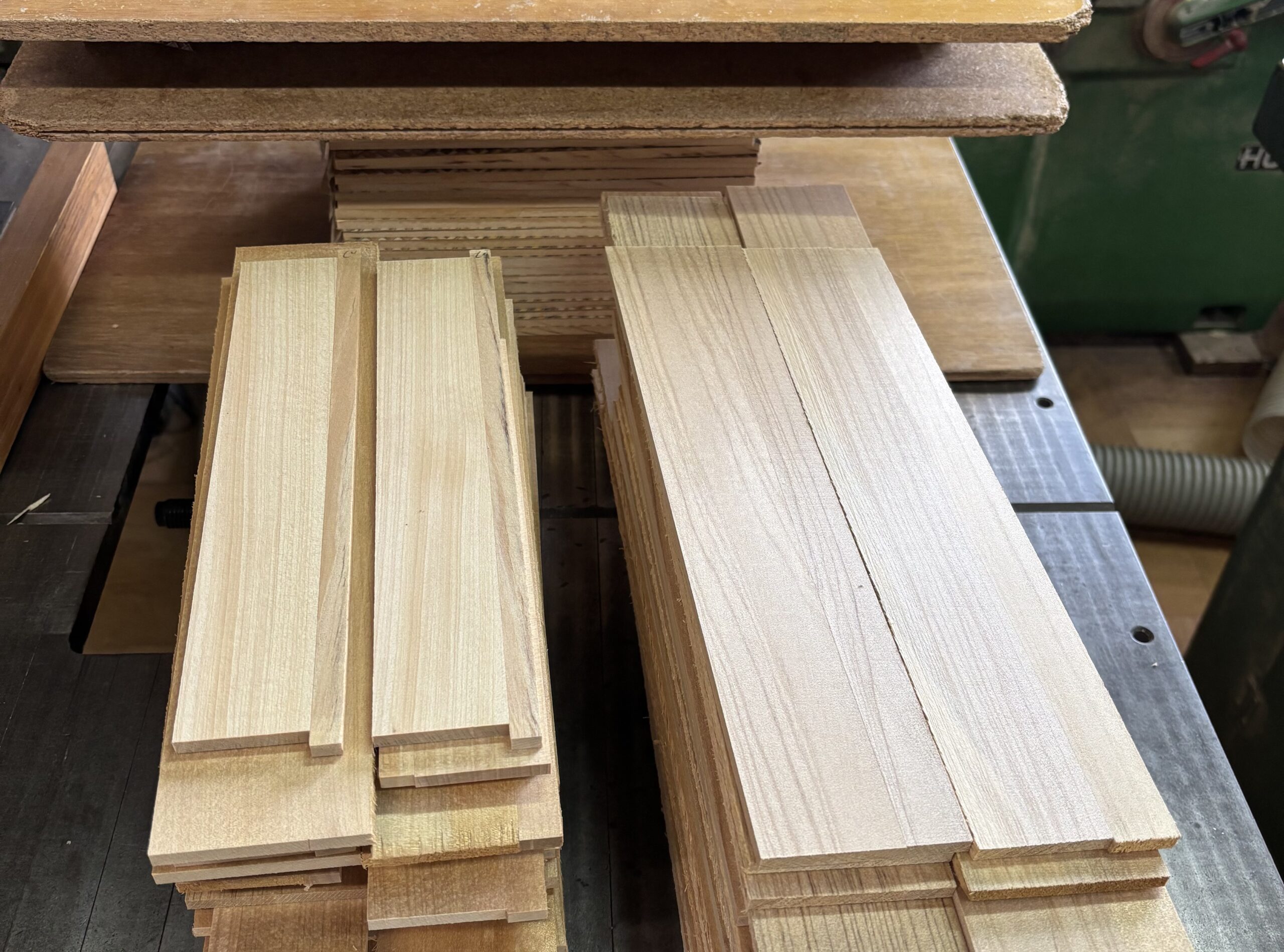
The photo shows all the materials for the hexagonal boxes I’m making this time. In addition to these, there are boards with the usual ichimatsu yosegi sheets already attached, and with all of this, I can make about 50 hexagonal puzzle boxes. One special feature of these materials is the two kinds boards in the center of the photo. The one on the left will become the inner axis panel, and the one on the right is the Aruki sliding panel. Both of them are shaved to the same thickness of about 6 mm. And from these boards, I will make two types of axis panels and two types of Aruki panels. It is much simpler compared to other Japanese puzzle boxes.
So there isn’t much confusion when preparing the materials and making the parts. The difficult part of this box is the assembly, and also adjusting the length of the Aruki panels and fitting them in place. Because the box has a hexagonal shape, it’s quite hard to assemble it accurately. The top and bottom fixed panels are both hexagons, and they need to be perfectly aligned with each other. Even so, it’s difficult to match them perfectly at first, so I adjust them later by shaving them down. In the first place, I need to cut out a precise hexagon, but it’s almost impossible to make it perfect, so it usually ends up slightly distorted 😂 Still, in the end, everything has to fit together without any gaps, so I carefully adjust things when attaching the side panels.
And another difficult part is adjusting and fitting the Aruki panels. I need to shape each Aruki panel so it fits the slightly different hexagonal frame of each box. Since this box works only with the movement of the panels, the length of each panel is very important. If it’s too long, the mechanism gets stuck. If it’s too short, the panel can come off. The difference is only a few millimeters, but that small range is critical. I need to find that exact point and adjust the length so it works for every box. Then, attaching the panels is also hard work. Each box uses five Aruki panels, so there are many pieces to handle. I carefully adjust each one so they all have the right level of resistance when moving. So preparing the materials is relatively quick, but from there, the process becomes long and detailed. That’s how the process goes when making a hexagonal puzzle box.