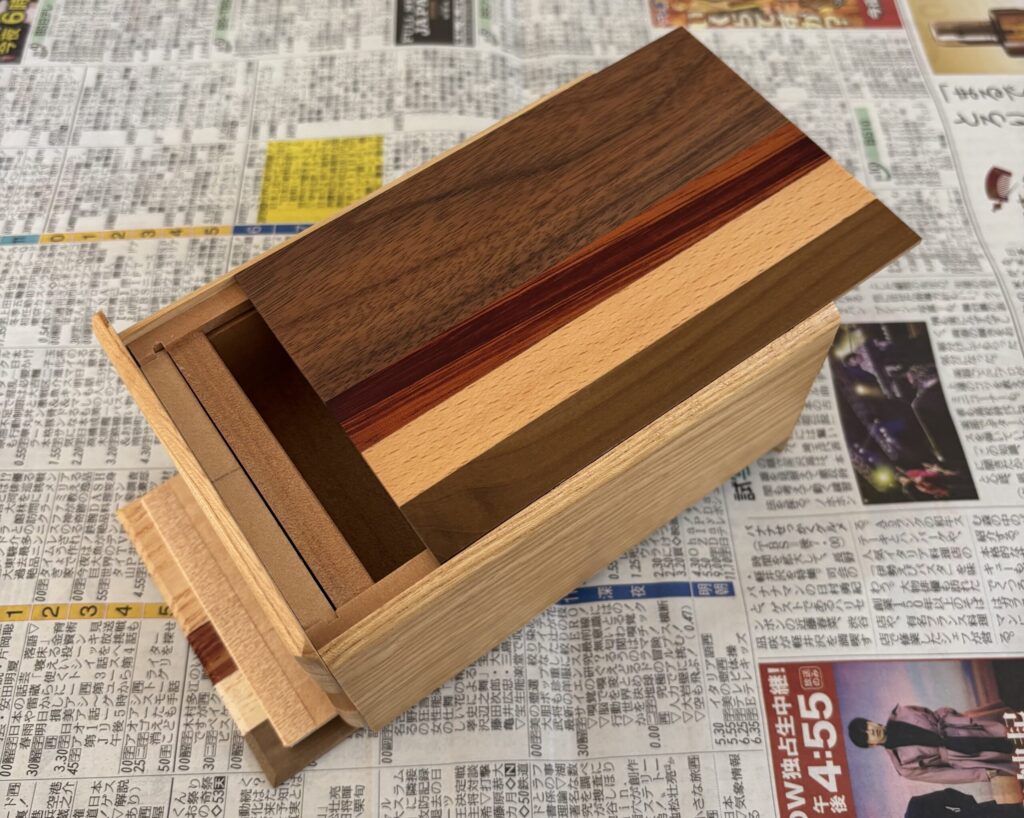
It was sunny again from the morning today. The weather seems to be getting worse, but it was still a comfortable day. I came to the workshop in the afternoon and took care of a few tasks and some work. I am currently making a 4-sun double compartment box, but in the past, I also made them in a 5-sun size (about 15 cm / 5.9 inches). I still have one of those double boxes from before, so I would like to show it today.
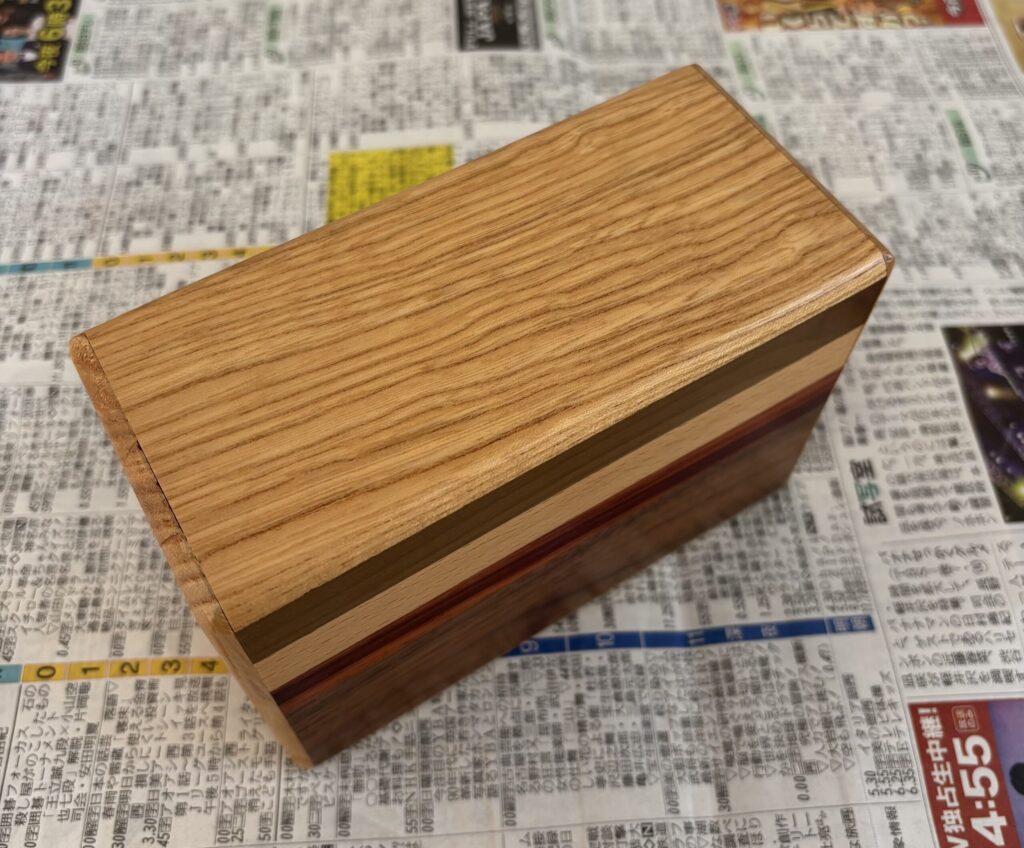
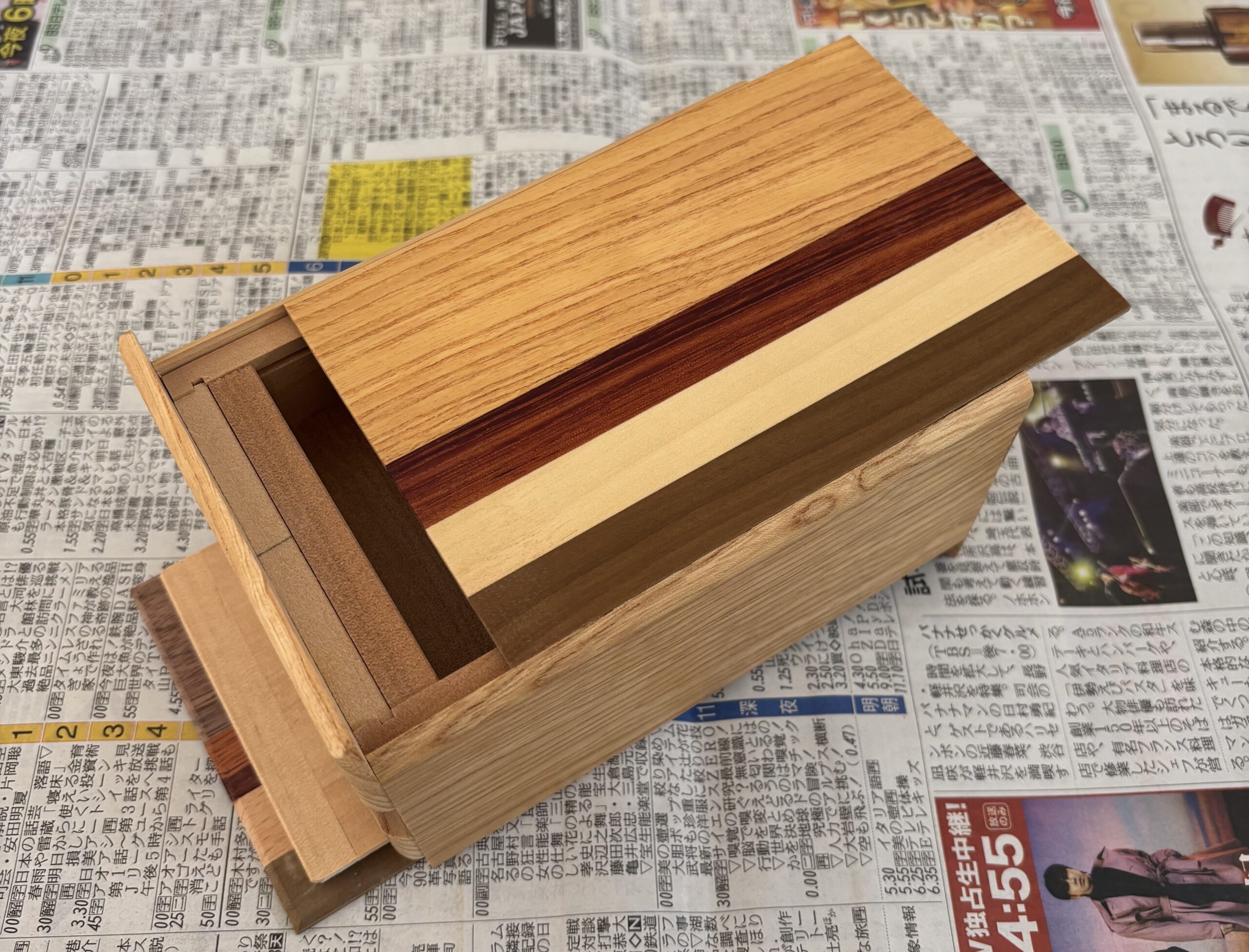
Some of you may already know this box, as I have shared it on social media before. I believe this box was made about 20 to 22 years ago, before I moved to my current workshop (I used to have my workshop in a different location for a few years). All of the outer panels feature natural wood designs, and taking advantage of the double box structure, the top and bottom lid panels use different color tones. The woods used for the lid panels are as follows:
Panel 1: Walnut, Rengas, Beech, Magnolia (Ho)
Panel 2: Zelkova (Keyaki), Rengas, Dogwood (Mizuki), Magnolia (Ho)
I included the English names for reference, but Keyaki, Mizuki, Ho are from Japan. The wood I used as “Zelkova” is actually a related species rather than true keyaki. It is a Japanese wood, but quite rare—I bought it as a material that is not usually available even at lumber shops. True keyaki has a more brown tone, but this wood is much more yellow. It is quite similar in color to nigaki, a yellow wood often used in Hakone yosegi. From those days, I have often used this striped lid panel design, combining a wide piece of wood with two or three narrower types of wood, and I still use this style today. When making lid panels, I try to use a stable and gentle wood for the outermost pieces. At the boundary between the lid panel and the side panel, paint can easily get in during finishing, and the mechanism can stick there. For that reason, I use magnolia (Ho) wood on both sides of the panels in this box. Walnut is also a suitable wood for this purpose. This keyaki-type wood can be a bit problematic in that respect. These woods may still stick slightly, but they tend to separate cleanly. However, woods like rengas or purpleheart can be more troublesome. When removing the stuck coating, the wood itself can sometimes tear. At that time, I may not have been very aware of this point myself 😅
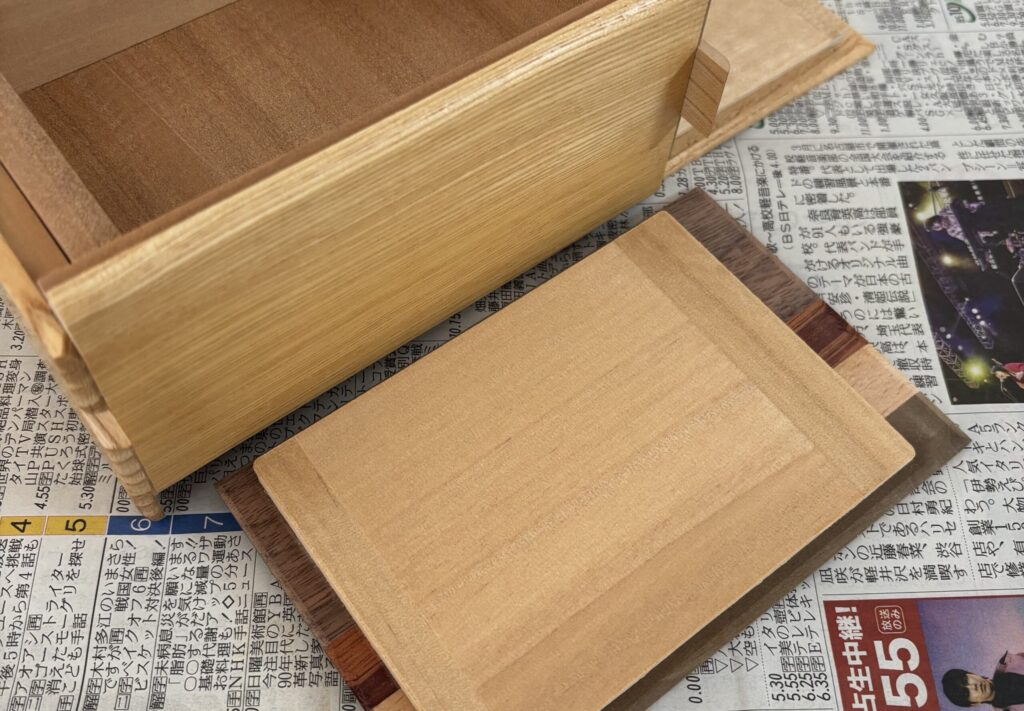
And for the side panels, I used a wood called Sen, which is quite rare. It is also a Japanese wood, often used for electric guitars and furniture. It has a clear and beautiful grain, so it is usually used in a way that shows that pattern. It is relatively light and easy to work with, but one of the characteristics of wood with strong grain like this is that it tends to warp. Because of that, I don’t think it is very suitable for the outer panels of puzzle boxes. At that time, I probably wanted to use more distinctive materials, which is why I chose it. It makes me feel my younger days…haha. I likely bought just a small amount from a lumber shop. Around the same time as this box, I also made another model called the “Japan Edition,” which had striped top and bottom panels. That box also used this Sen wood.
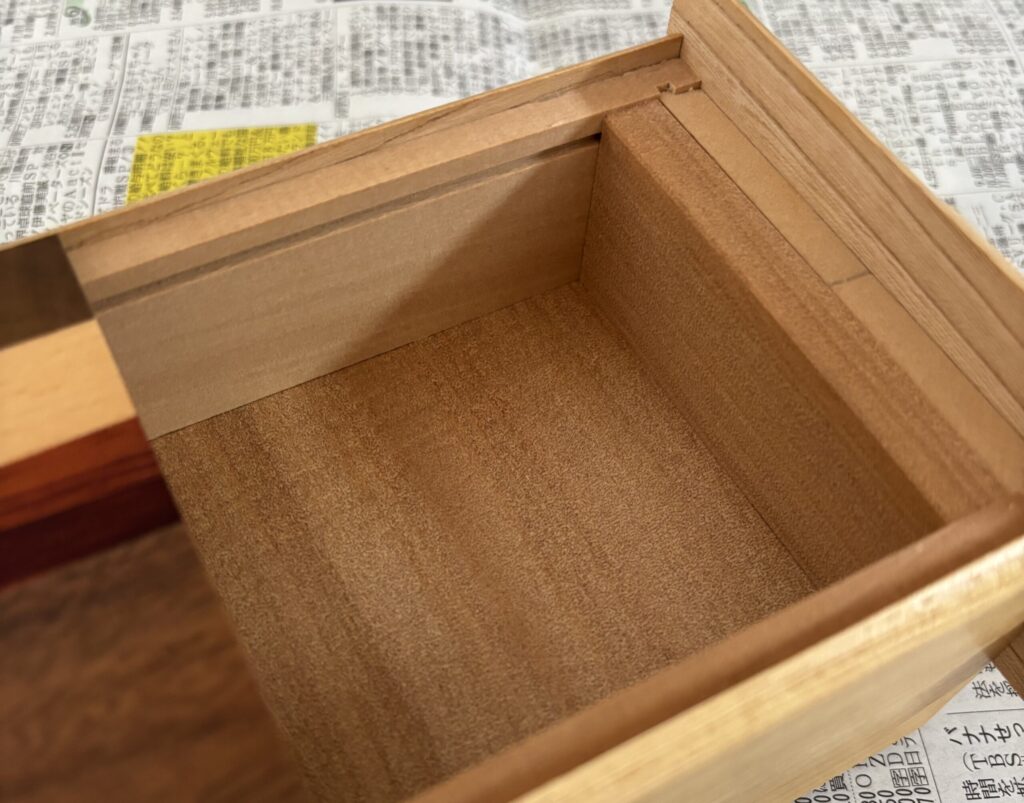
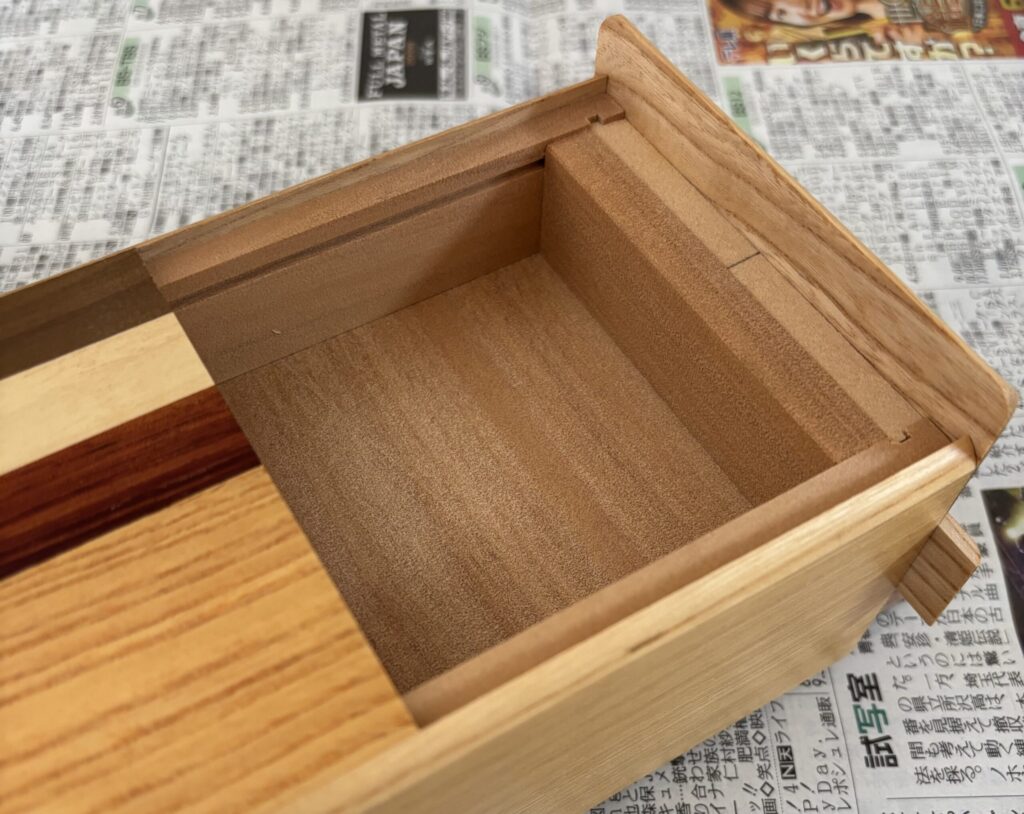
Inside, there are divider panels, and unlike today, they are made from solid agathis wood. Nowadays, I use engineered boards like plywood or MDF. However, to prevent the box from shrinking, the grain direction of the divider panels is set horizontally, just like the axis panels. I think this is the correct way to make them. Also, the position of these divider panels is different depending on the side. On the walnut lid side, the space is wider, while on the keyaki lid side, it is narrower. At that time, I probably felt that having equal spaces on both sides would be less interesting.
The finish on this box was done by a master craftsman who specialized in coating, and who has sadly passed away. The result is excellent, and even now there are no signs of deterioration in the finish. There is a slight yellowing from UV exposure, but the coating itself is very strong. Whenever I visited him to request coating work, he would often talk about his materials and his approach to finishing. He was a very stubborn person, but he had a deep passion and strong commitment to his craft. He used to say, “Even after many decades, my finish won’t deteriorate.” Now, this box is proving exactly that.
Unfortunately, this box does not have a date or a stamp. Seeing it again after so many years made me realize how important those markings are, so we can know when it was made. From now on, I would like to make sure to leave that kind of record as well.