It was sunny again from the morning today, but the temperature was not very high, so it was a comfortable day. At this time of year, we are not used to the heat yet, so when there are suddenly hot days, it can be tiring. That’s why a temperature like today, around 20°C, feels very comfortable 😊
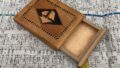
I continued with the final checks on the 4-sun boxes and worked on the 3-sun boxes today. The 4-sun 14-steps puzzle boxes were finished with coating yesterday, and today I did the final check. They are now completed. For the 3-sun 18-steps boxes, I am currently attaching the Aruki sliding panels. Using some of those boxes, I also worked on making the top and bottom panels today. This time, there are two types of side panel designs—Ichimatsu yosegi and walnut—but the top and bottom panels are all traditional yosegi.
The reason the assembly of the 3-sun boxes has not progressed much is that I have also been working a little on the next project. Today’s title, following yesterday’s “symmetrical box,” is a “box with nowhere to hide”😅. Well, “nowhere to hide” might be a bit of an exaggeration. You could also call it a box with no blind spots. In other words, I’m talking about the double puzzle box I will be making next. As I wrote yesterday, this box has exactly the same structure on the top and bottom, and also on the left and right, and it can be opened from both sides. Usually, a Japanese puzzle box has only one opening side. In the past, I developed this idea further and made a puzzle box called a “4×4 box.” Like this one, it opens on both the top and bottom, and since it is divided into two sections, it has four storage spaces. That box also had two opening sides, but most puzzle boxes have only one. Because of that, when I usually make a puzzle box, I carefully choose which part of the wood will face the opening side and which part will be used for the bottom. For example, the opening side needs to have the Aruki panel attached, so I try to use a part of the wood that has good flexibility. Also, although it is rare, if there is a small knot or imperfection in the wood, I may place that part on the bottom side, where it will be covered by a fixed panel and not be visible.
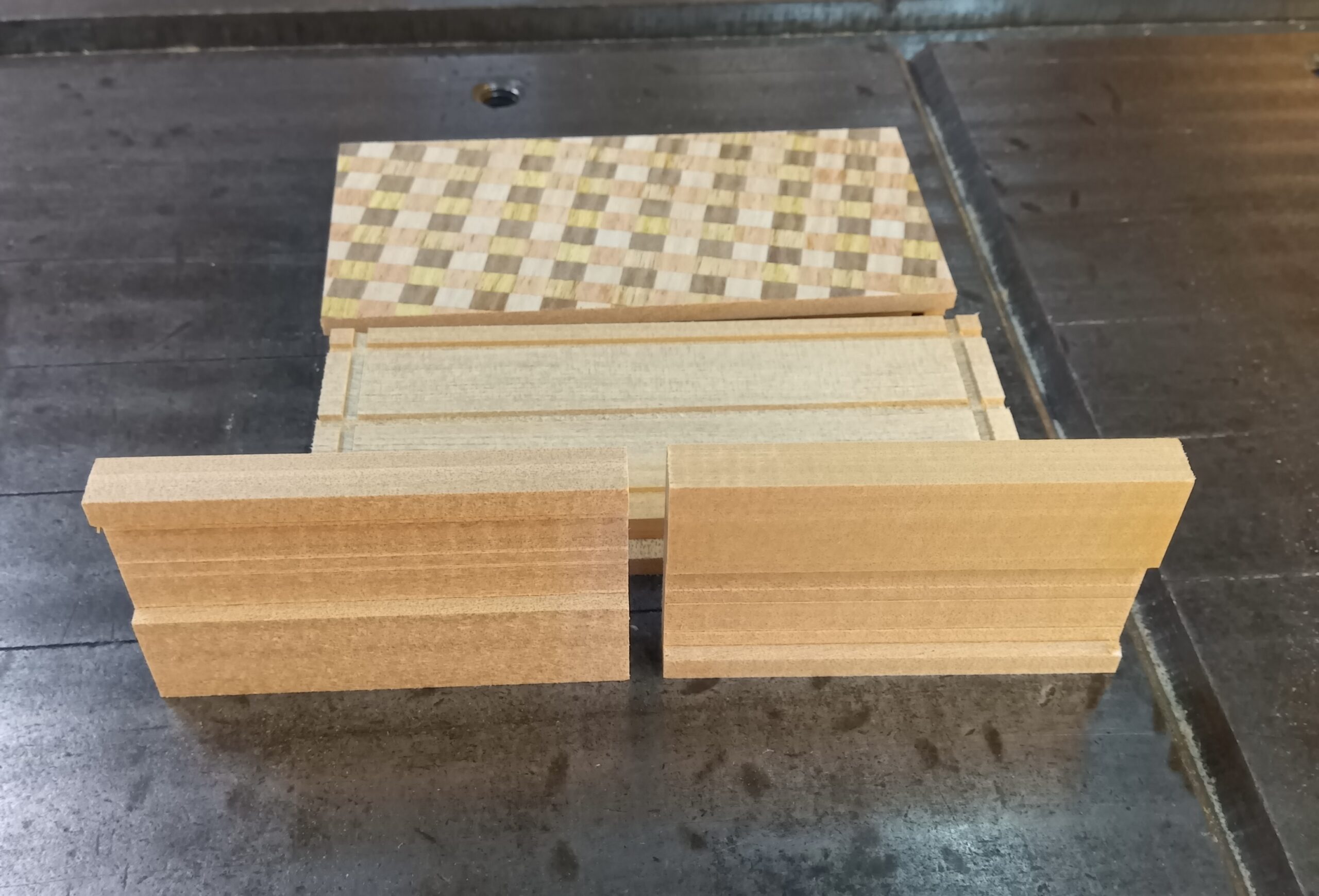
However, this double box opens on both the top and bottom, so both sides must be finished like a visible surface. It may be a little hard to see in the photo, but normally, the top side of the axis panel (the side facing the lid) is carefully planed smooth, while the bottom side is left as it was cut with a saw, and you can still see fine saw marks if you look closely. But for this box, both sides of the axis panel are planed and finished. The two axis panels placed side by side are actually upside down relative to each other, but both top surfaces are fully finished. In this way, there are no hidden areas in this box, so I have to be very careful when selecting materials. I try to use only high-quality wood without defects for every part. Of course, it’s not that I use poor materials for regular puzzle boxes 🤣
Have a nice weekend!